
FREE Tools
Select from below to learn more!
Free Tools
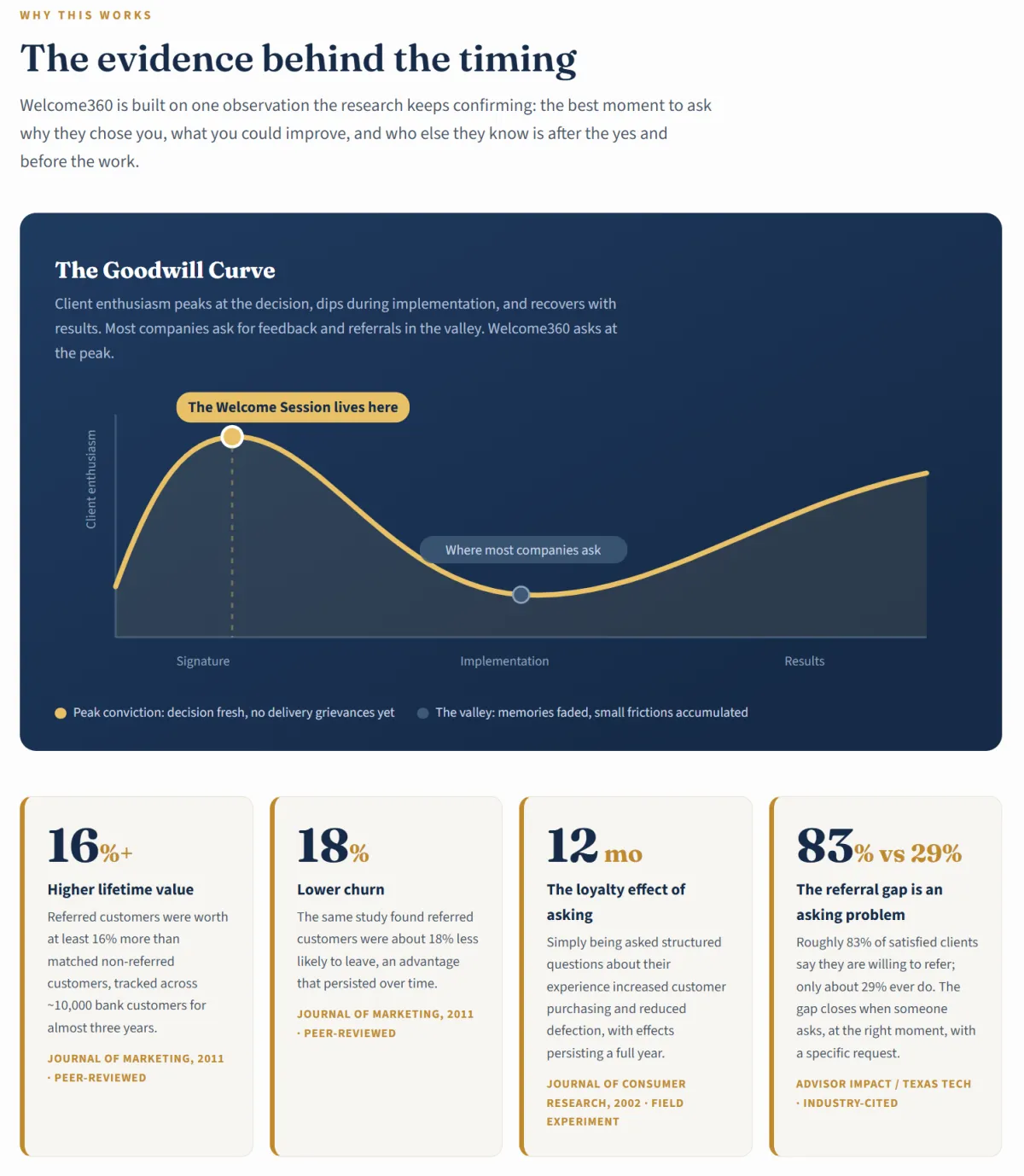
Welcome360 • A Client Growth System: The 45-Minute Meeting That Turns Every New Client Into Referrals.
Discover how the Welcome360 System reveals the exact strategies to:
Ask for Referrals at Peak Goodwill — Before the Honeymoon Ever Fades
FREE AI Insight Miner: Turn One Client Conversation Into 7 Finished Business Assets
Capture the Exact Words Clients Use to Sell You (Then Reuse Them Everywhere)
Close the Feedback Loop That Makes Clients Refer Twice
Sellthrough360 - Flows, Bundling, Upselling Systems for Revenue Generation
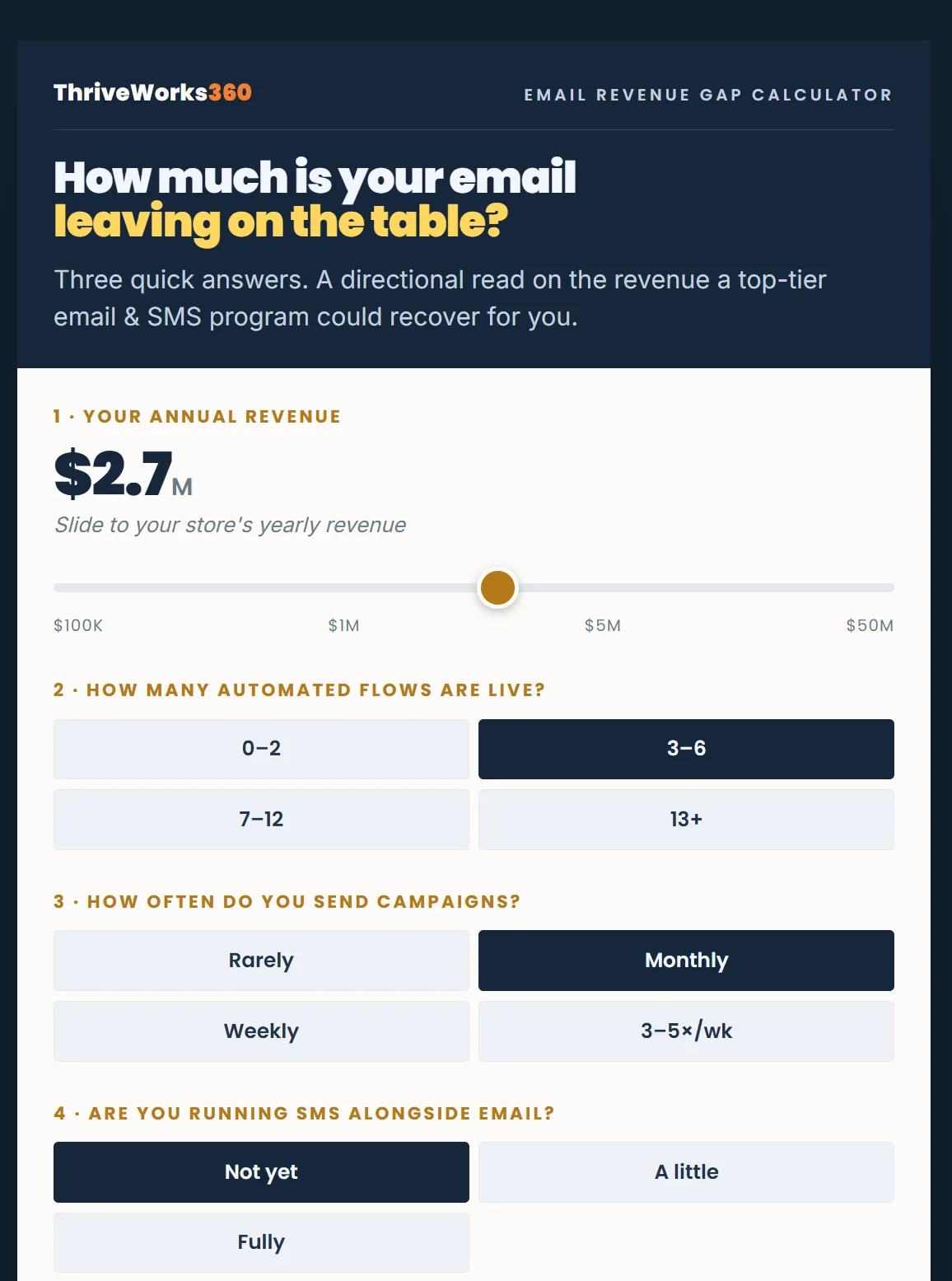
How much is your email leaving on the table?
Three quick answers. A directional read on the revenue a top-tier email & SMS program could recover for you.
Your annual revenue
How many automated flows are live?
How often do you send campaigns?
Are you running SMS alongside email?
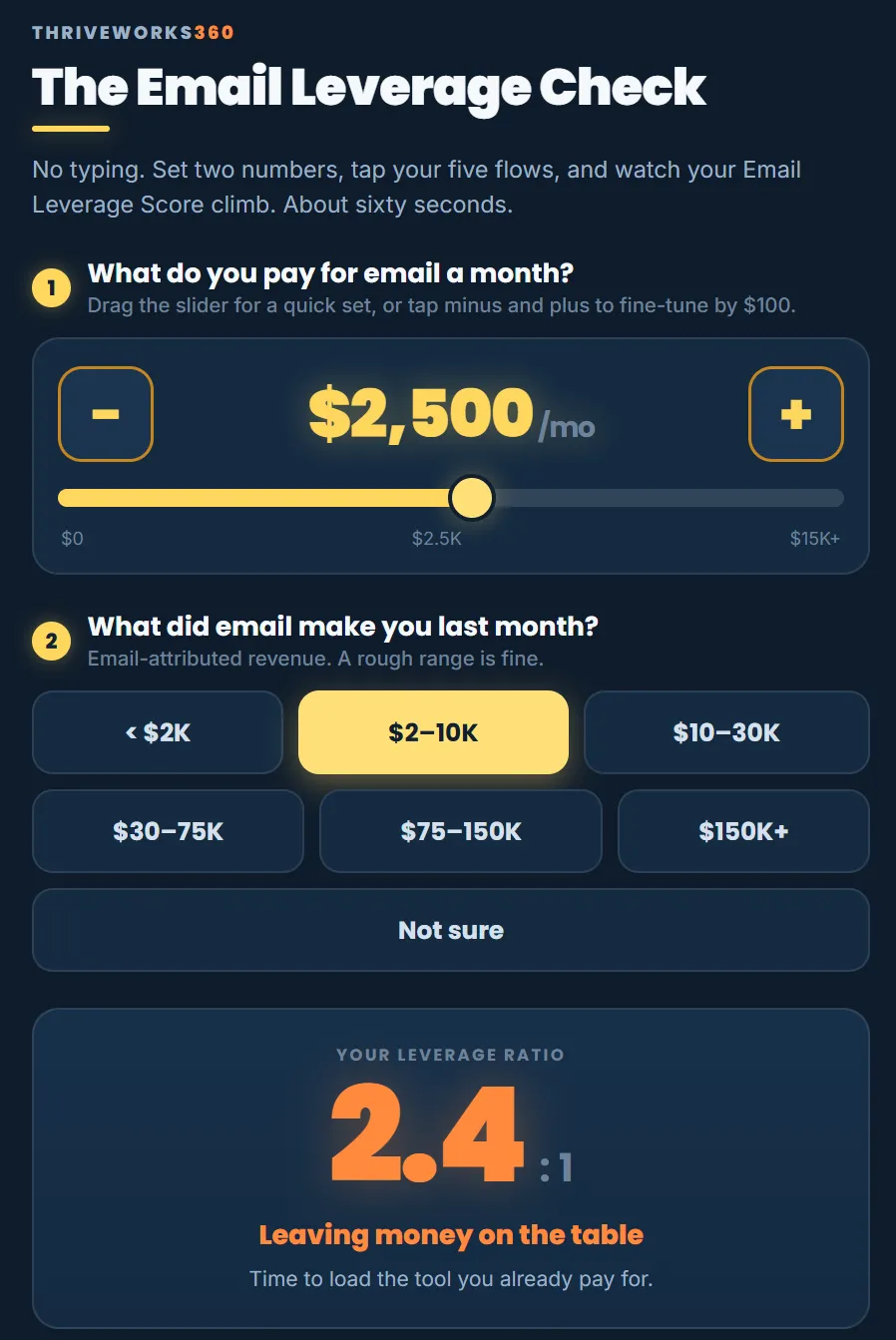
The Email Leverage Check
No typing. Set two numbers, tap your five flows, and watch your Email Leverage Score climb. About sixty seconds.
What do you pay for email a month?
What did email make you last month?
Which of these 5 are running?
Download a printable form
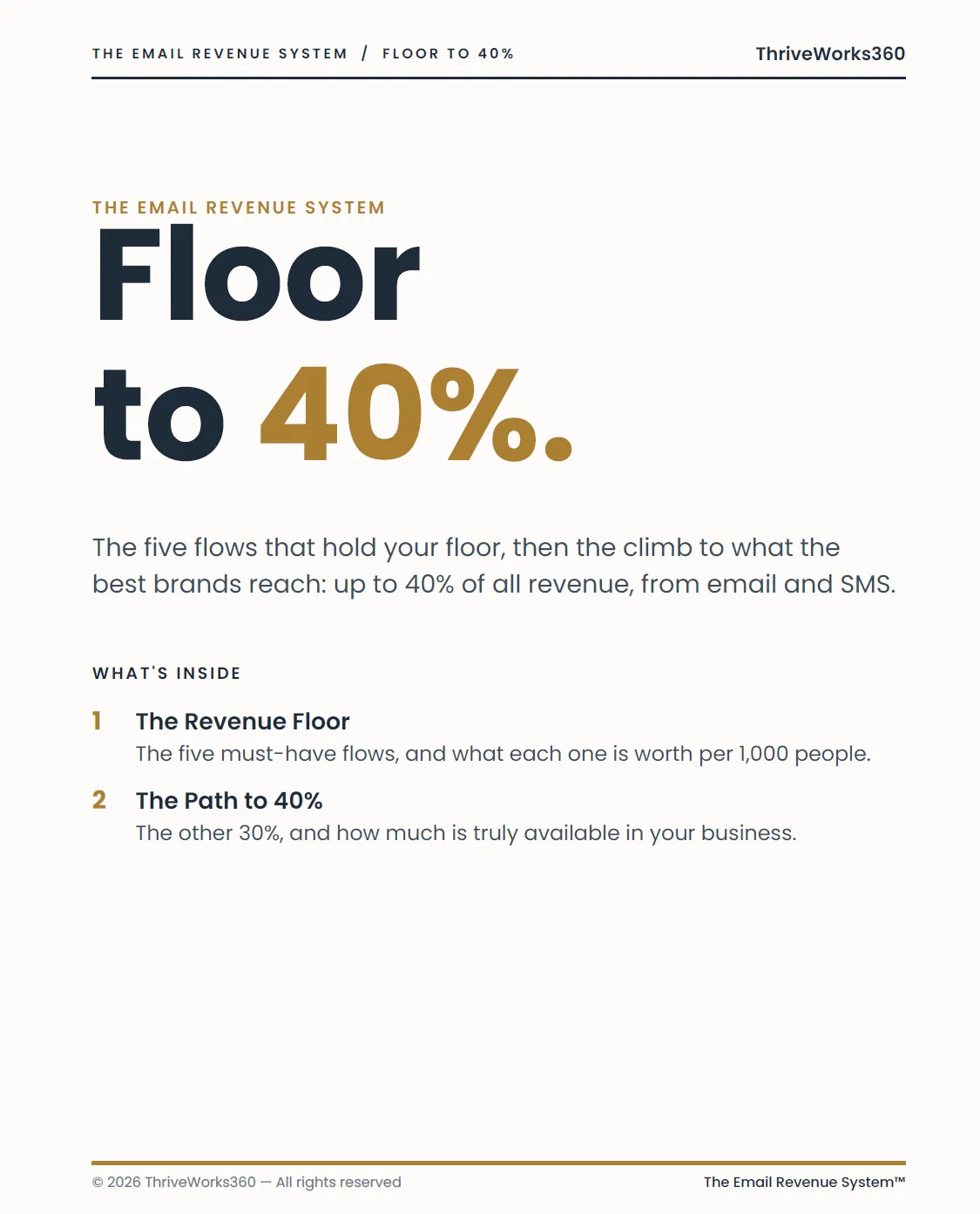
The Email Revenue System Floor to 40%.
The five flows that hold your floor, then the climb to what the best brands reach: up to 40% of all revenue, from email and SMS.
The Revenue Floor - The five must-have flows, and what each one is worth per 1,000 people.What did email make you last month?
The Path to 40% - The other 30%, and how much is truly available in your business.

See the money already in your business, climbing in real time.
Slide in your two numbers, then answer 15 quick questions. Watch the dollar figure move as you go. By the end, you'll know your biggest pocket of found money, the fastest switches to flip, and roughly what it's worth — before you spend a cent on new ads.
Your List
Your Automations
Your Repeat Buyers
Your Offers & Pricing
Your Between-Launch Revenue
Answer all 15 to lock your result
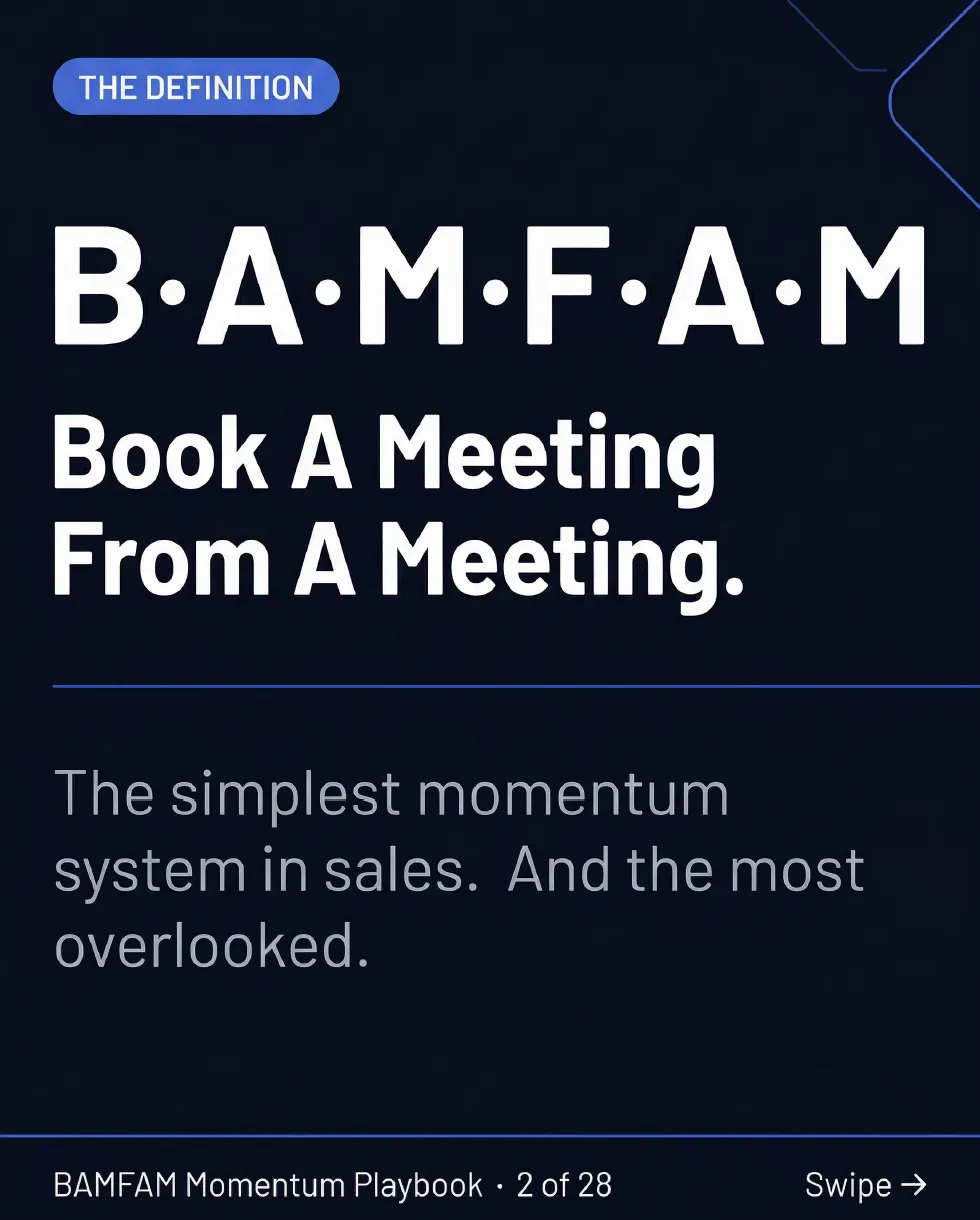
Connect • Clarify • Confirm • Calendar: The 4-Beat Playbook That Ends the Follow-Up Chase.
Discover how the BAMFAM Momentum Playbook reveals the exact strategies to:
Book the Next Meeting While You're Still in the Meeting
Turn "Let Me Get Back to You" Into a Yes (It's Friction, Not Rejection)
Kill the "Just Bumping This Up" Email Forever
Make Momentum Measurable With the Team Scorecard

Stop • Scan • Decide: The 3-Step Playbook to Win the First 51 Seconds.
Discover how the FOCUS360 Playbook reveals the exact strategies to:
FREE GPT Agent to test and build your content
Stop the Scroll on Command
Hold Attention for the First 51 Seconds:
Multiply Conversions With a Single Clear Path:
Unlock Your Business’s Full Potential – Without the Pain
Step into the realm of effortless growth with our P.A.I.N.-L.E.S.S. Playbook.
Designed for entrepreneurs who seek the "Golden Nuggets" that transform them and their businesses without the overwhelming stress. This tool shows a simple and streamlined path toward business success.

Take Control of Your Journey with Our Ultimate FREE Autopilot 360 System Masterclass and Cheat Sheet.
Build A Self-Managed Business And Break Through 6-7 Figures To 8 Figures While Seamlessly Producing Huge Profits!


Uncover Hidden Revenue in 3 Simple Steps
See more details about how this impacts business performance.
PAID COURSE
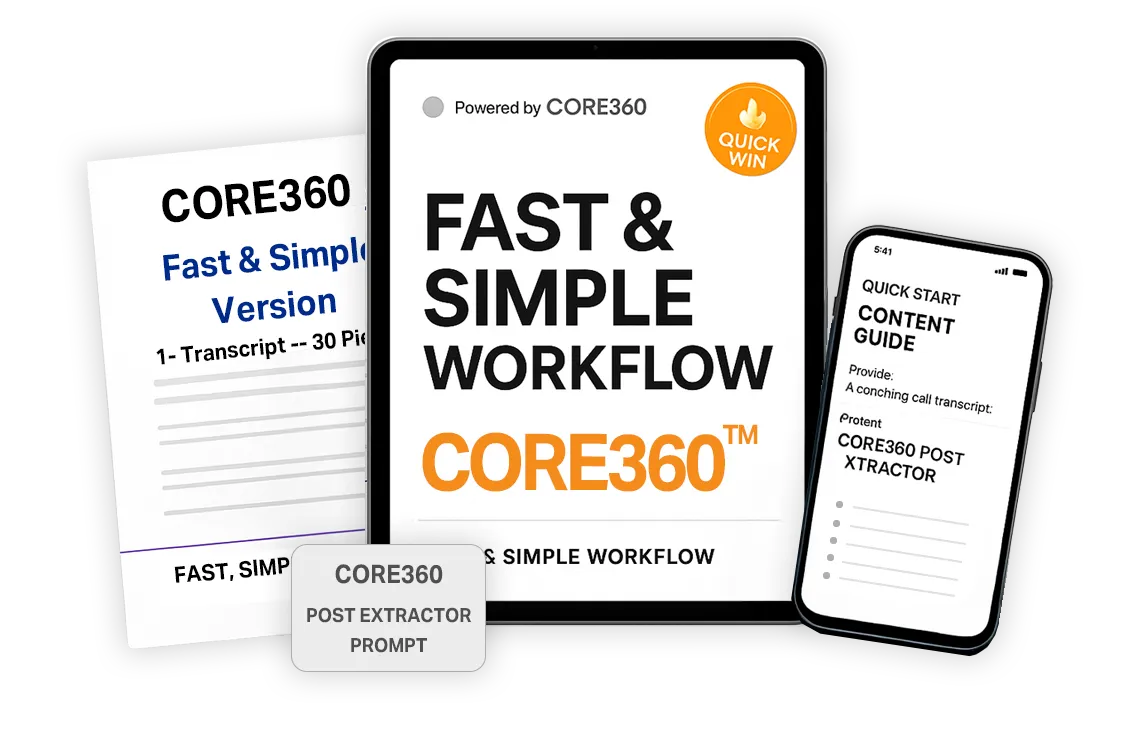
CORE360: Multiply Your Message — Without Writing a Single Word
See how to easliy increase your visibility with the CORE360 System and AI-driven Prompt Booster Pack™
Built for founders and entrepreneurs who already say brilliant things — this AI-optimized vault gives you the exact prompts to turn one voice note into days of content across Instagram, LinkedIn, TikTok, YouTube Shorts, and Facebook.
No burnout. No blank pages. Just scroll-stopping content formulas that match your voice and work on every platform.
A simple upgrade with exponential reach.
BLOG

Your Retail Price Was Never Yours
There are up to four kinds of buyers coming for your product. Most founders only build a price for one of them.
The day I got my first wholesale email, I lost money by saying yes.
It wasn't a bad deal. The problem was simpler, and stranger, than that. Nobody had ever told me my retail price wasn't really mine to begin with.
I still remember how that email felt. A real store wanted to carry my product. That's the dream. Someone out there found the thing I built and believed in it enough to put it on their shelf.
Then I hit the next line. They wanted fifty percent off. Half. My stomach dropped, and I spent that night at eleven o'clock with a spreadsheet open, trying to work out whether I could even afford to say yes.
Here's what I know now that I didn't know then. There are three kinds of buyers coming for your product. Four, really. And if you're like most founders, you built a price for exactly one of them.
By the end of this, you'll know all of them. You'll know what each one takes off the top. And that late-night panic never has to happen to you.
The Advice You Got Was Built for One Buyer
The usual advice sounds reasonable. Figure out what people will pay, set your price, go sell.
That advice was written for a world where you only ever have one kind of customer: the person on your website. It works beautifully. Right up until someone else wants to buy from you. And if your product is any good, someone else always does.
Most pricing guides start at retail and work down. "Here's my price. Is there any margin left after my costs?" That's backwards. It falls apart the moment a second kind of buyer shows up with their hand out for a discount, because that buyer was never in the math to begin with.
The Three Buyers Hiding Under Your Price
I call it the Three-Tier Purchase Stack. Once you see it, you can't un-see it.
This isn't theory. It's the group of buyers sitting under every physical product that sells well. And the whole trick is simple. Once you name each buyer, pricing for them stops being a guess and turns into arithmetic.
But first, the part that changes everything. Every buyer wants your product for a different reason. The shopper buys the product. The retailer buys your margin. The distributor buys your volume. They're not being greedy. They're being paid for a job. Shelf space. Trust. Shipping. Reach. You either pay them for that job with a discount, or you do the job yourself and pay in cash and time. There's no third door.
So let's walk through all three.
Tier 1: The Direct Consumer
This is who you built the price for. Full retail, straight into your account. It feels like pure margin.
It isn't. Because you paid to find every single one of those people. Ads, content, email, your own hours. Finding customers is the hidden discount on Tier 1. Nobody buys from you for free. You just never get a bill for it, so it's easy to forget it's even there.
So before you celebrate a full-price sale, subtract what it actually cost you to find that customer.
Tier 2: Dealers and Retailers
This is the email that ambushed me. A store, a shop, anybody who buys your product to sell it again. And they're going to want roughly half off.
[Add your first-dealer story here. What was the product? What shop or trade show? Roughly when? Two or three plain sentences, told straight. Only use a number you can stand behind.]
Here's the reframe that took me years to reach. Fifty percent off isn't robbery. It's rent. Rent on their shelf. Rent on their customer list. Rent on years of trust their customers already have in them. That store can put your product in front of people you will never reach with an ad. Not for lack of trying. Because that audience is theirs. You're not giving away half your price. You're renting a way in that you couldn't build yourself for ten times the money.
Tier 3: Distributors
Below dealer pricing sits one more level. Distributors. The people who sell to whole networks of stores at once.
[Add your real distributor discount here. Soft language is fine: "for us, that's usually around ___ percent off retail." Only fill in a number you'd say out loud. If you're not sure, just write "well below dealer pricing" and move on.]
Distributors don't buy pieces. They buy pallets. They warehouse your product, they ship it, and they open doors you can't knock on yourself. Whole groups of dealers. Sometimes whole regions. You give up more margin per unit, and in exchange you move volume you could never move alone.
The Basement: International
There's one more level down in the basement. Selling to other countries.
It sits below your distributors, with its own math, its own headaches, and honestly its own whole conversation. For now, just know it's down there. Because if your product works, one day an email from another country is going to land in your inbox. I'd rather you saw it coming.
Quick Warning: Amazon Is Not Tier 1
Before you ask. No. Amazon is not your direct-consumer channel.
I know it feels like it. A shopper clicks, a shopper buys, the product ships. But Amazon is a fourth thing entirely, and treating it like Tier 1 is one of the most common and expensive mistakes a product founder can make. It's worth its own conversation. Just don't quietly file it under "direct" in your head, because the math is not the same.
The Picture That Makes It Stick
Here's the image I want you to keep.
Your retail price is a paycheck. Up to four people live off it. You. Your dealer. Your distributor. And the machinery it takes to reach a shopper directly in the first place.
Budget like that paycheck is all yours, and somebody in the house doesn't eat. For a while it won't be you. It'll be a slice of margin you didn't know you were giving away. But eventually? Eventually it's you.
That's the real cost of the first-dealer email. Not the one deal. The fact that your price was never built to be shared, so every yes to a new channel feels like a loss instead of a plan.
The Real Fix: Build Your Price From the Bottom Up
Knowing the three buyers is only half the job.
The other half is building your price the right direction. Start from what it costs you to make and ship one unit, then build up from there. Don't start at retail and cut down.
When you build up from the bottom, you set the price so all of it works. A dealer at half off still works. A distributor below that still works. Your full-price sale, minus the cost of finding that shopper, still works too.
Then a yes to any channel is just math. Not a punch in the gut.
That's the whole difference between a founder who panics at the wholesale email and one who already knows the answer before they even open it.
Where This Fits With DNA360
If you've come across DNA360, this is that same thinking aimed straight at product brands.
One of the core layers of DNA360 is Customer DNA. Getting ruthlessly clear on who actually buys from you. For a service business, that's your ideal client. For a product brand, it's this. The stack. Consumer, dealer, distributor, and the international basement under all of it.
Most founders map one of those four and wonder why the other three keep eating their margin. Name all of them, price from the bottom up, and the leaks stop.
Your First Move
Did any of this hit a little too close to home? Has a wholesale or distributor email ever sent you into 11pm spreadsheet math? Then start by finding out where your margin is actually leaking.
A free Customer GapMap360 session shows you where your pricing and your channels are quietly costing you profit. It names the single biggest leak. And it shows you the first move to close it. So the next time a store asks for half off, you already know whether the answer is yes.
Because your retail price was never really yours.
The founders who win are simply the ones who built a price for everyone living off it.
Nathan, ThriveWorks360


Free Weekly Productivity Insights
Sign up for Sunday Snippets - my weekly newsletter where I I share actionable productivity tips, practical life advice, and high-quality insights from across the web, directly to your inbox.
What People Are Saying

Driving Growth, Amplifying Impact

Grace Company

8th to 2nd most recognized brands in the industry in one year

J&B Sewing
Launched new product line and grew 300% in two years

Sewrite
Increased national distribution, D2C Revenue by 400%.
Get In Touch
Email: [email protected]
Address
Office: 14881 S. Auburn Sky Dr
Assistance Hours
Mon – Sat 9:00am – 8:00pm
Sunday – CLOSED
Phone Number:
(888) 870-7314
Contact Us:
BECOME AN TW360 INSIDER
Sign up for exlcusive content, emails, & things Nathan doesn't share anywhere else.
Unleash Your Business Brilliance.
Reach out and connect for your opportunity to shine!
© 2026 ThriveWorks360 - All Rights Reserved, copyright 2024