FREE Tools
Select from below to learn more!
Free Tools
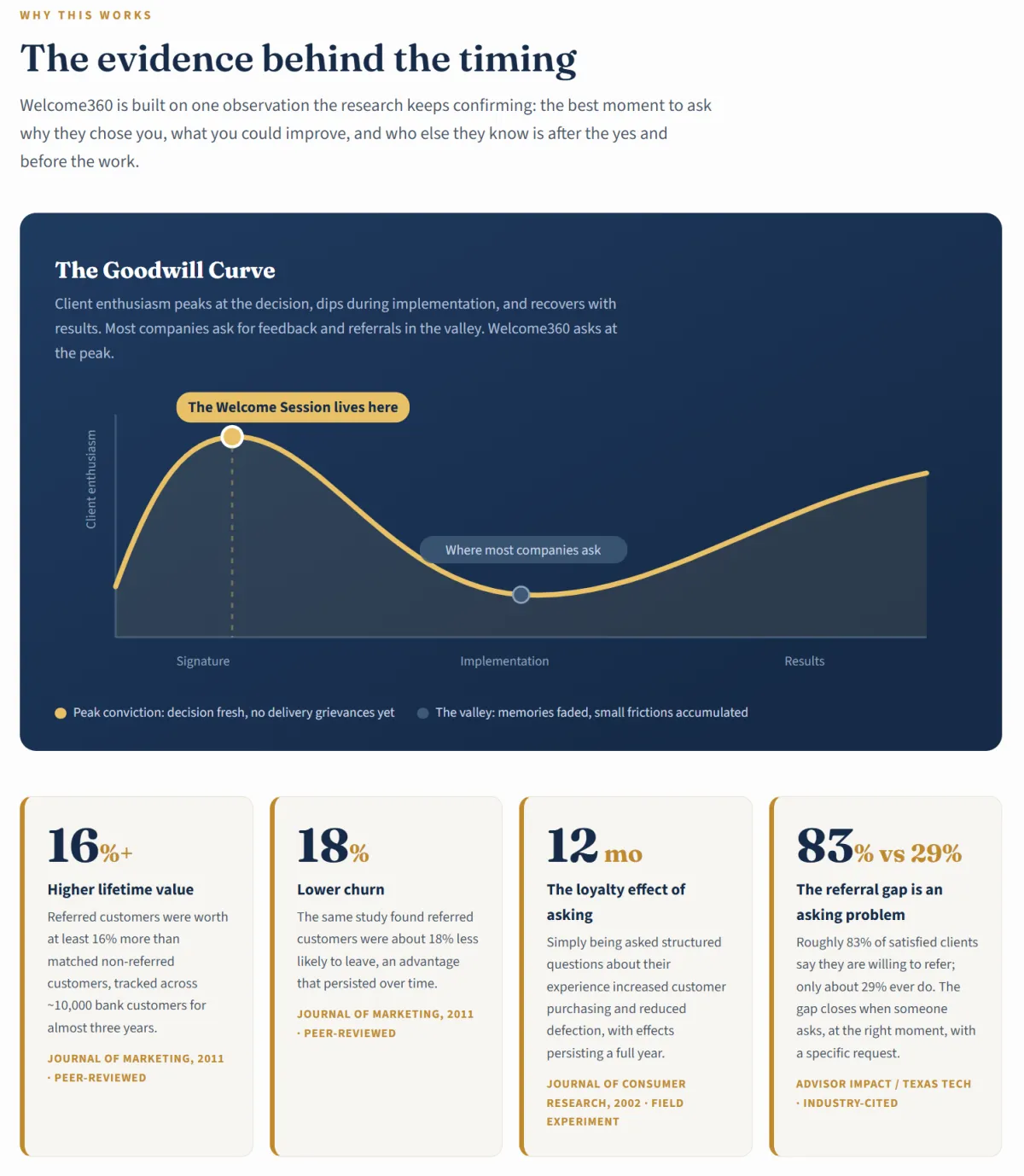
Welcome360 • A Client Growth System: The 45-Minute Meeting That Turns Every New Client Into Referrals.
Discover how the Welcome360 System reveals the exact strategies to:
Ask for Referrals at Peak Goodwill — Before the Honeymoon Ever Fades
FREE AI Insight Miner: Turn One Client Conversation Into 7 Finished Business Assets
Capture the Exact Words Clients Use to Sell You (Then Reuse Them Everywhere)
Close the Feedback Loop That Makes Clients Refer Twice
Sellthrough360 - Flows, Bundling, Upselling Systems for Revenue Generation
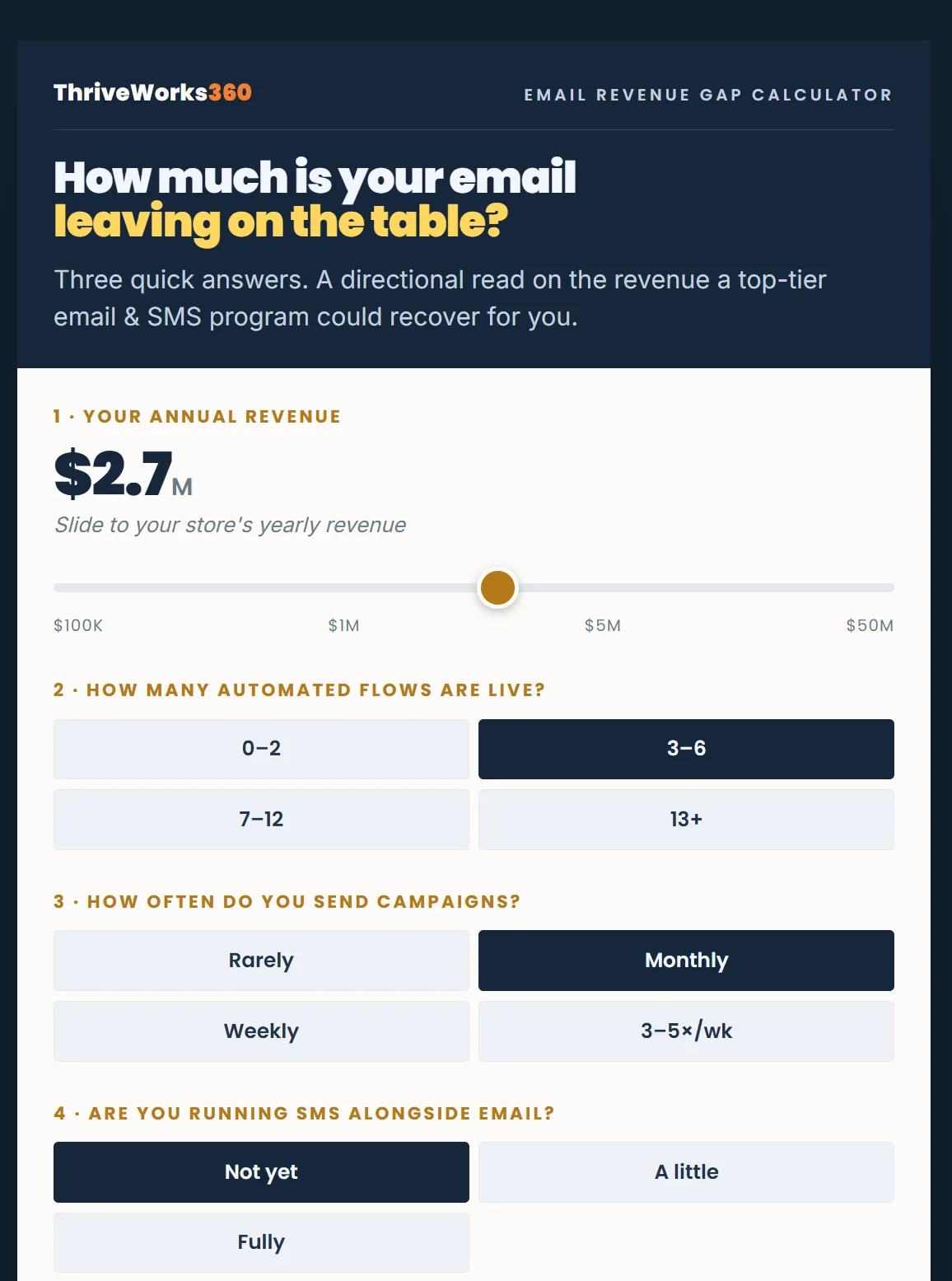
How much is your email leaving on the table?
Three quick answers. A directional read on the revenue a top-tier email & SMS program could recover for you.
Your annual revenue
How many automated flows are live?
How often do you send campaigns?
Are you running SMS alongside email?
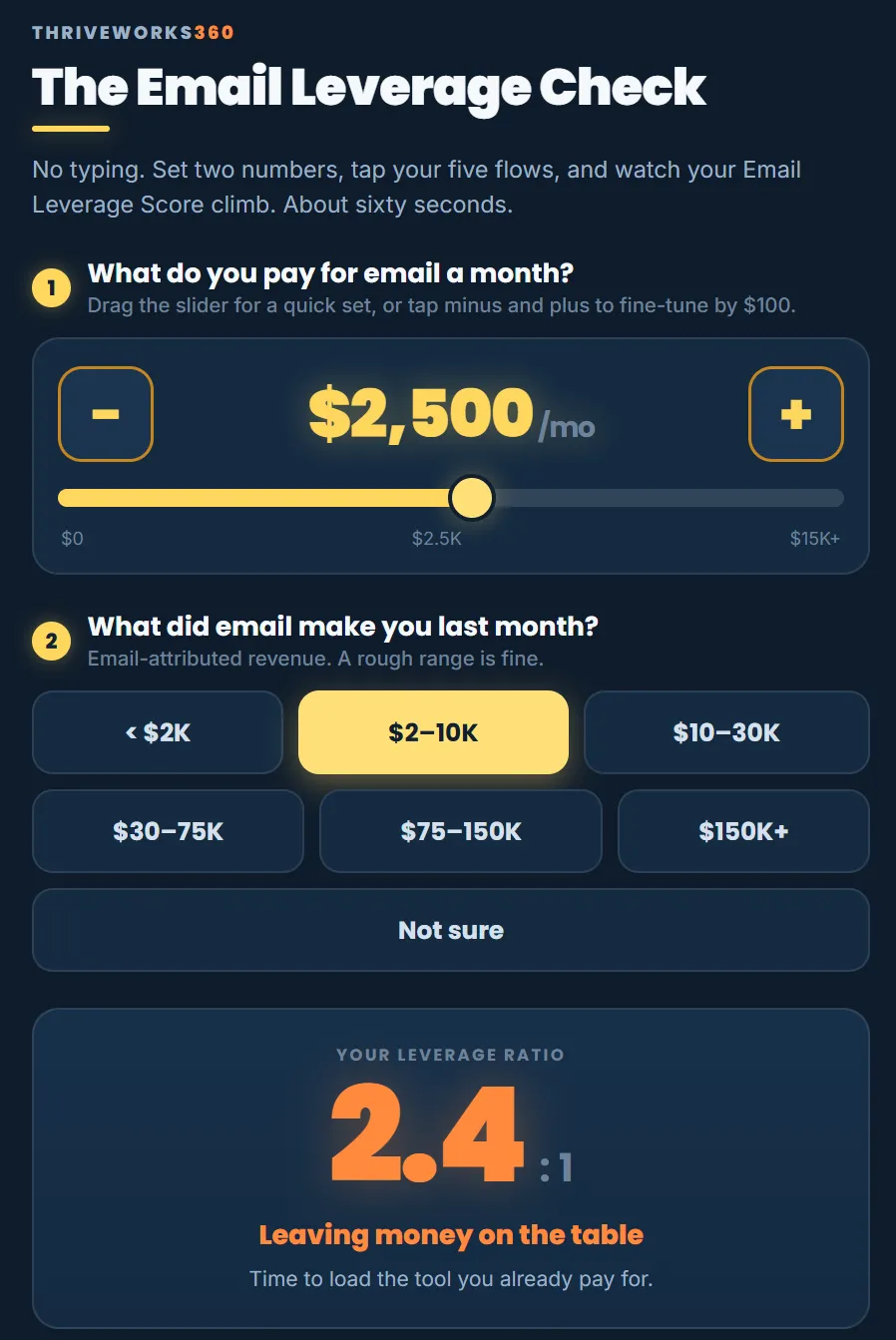
The Email Leverage Check
No typing. Set two numbers, tap your five flows, and watch your Email Leverage Score climb. About sixty seconds.
What do you pay for email a month?
What did email make you last month?
Which of these 5 are running?
Download a printable form
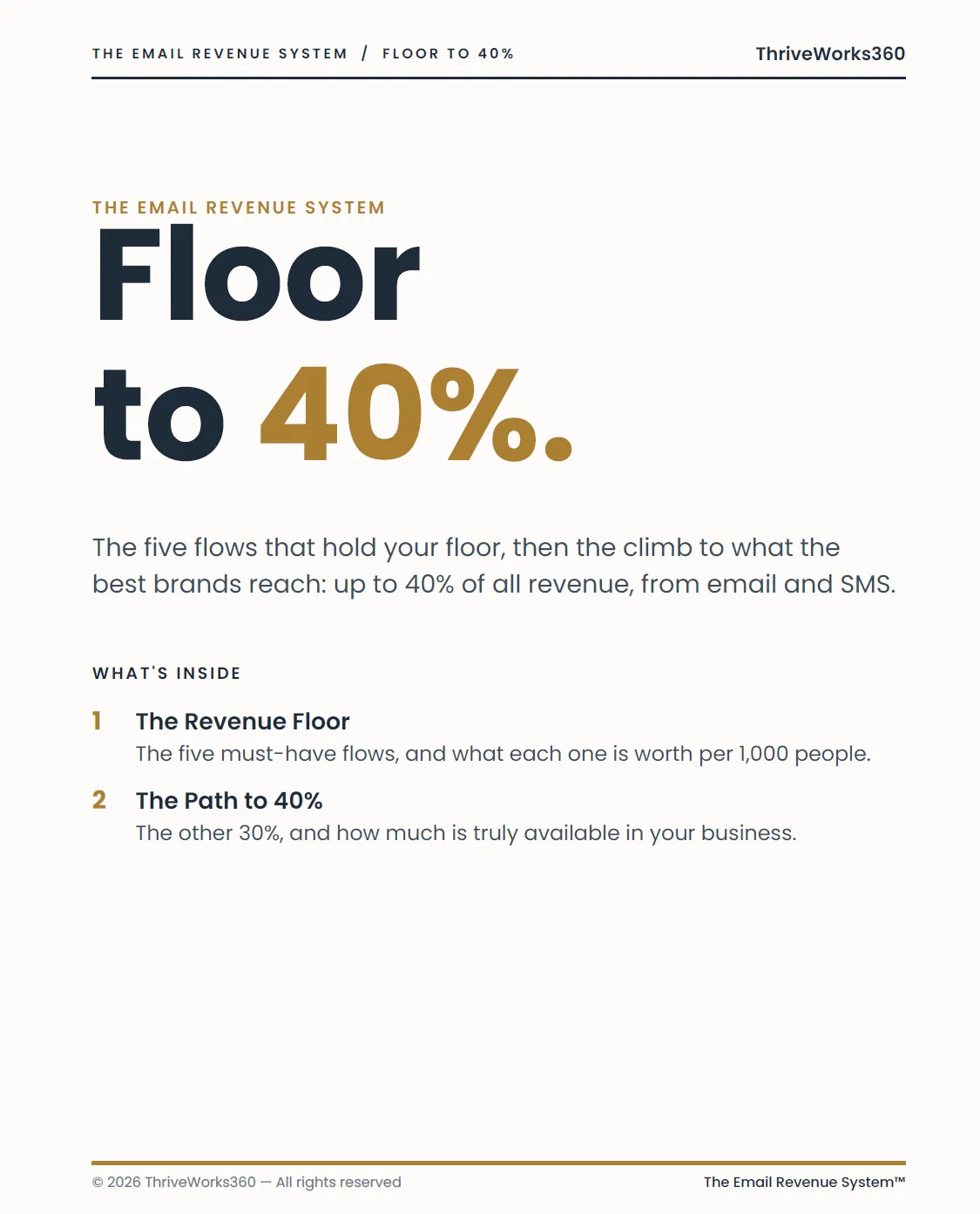
The Email Revenue System Floor to 40%.
The five flows that hold your floor, then the climb to what the best brands reach: up to 40% of all revenue, from email and SMS.
The Revenue Floor - The five must-have flows, and what each one is worth per 1,000 people.What did email make you last month?
The Path to 40% - The other 30%, and how much is truly available in your business.
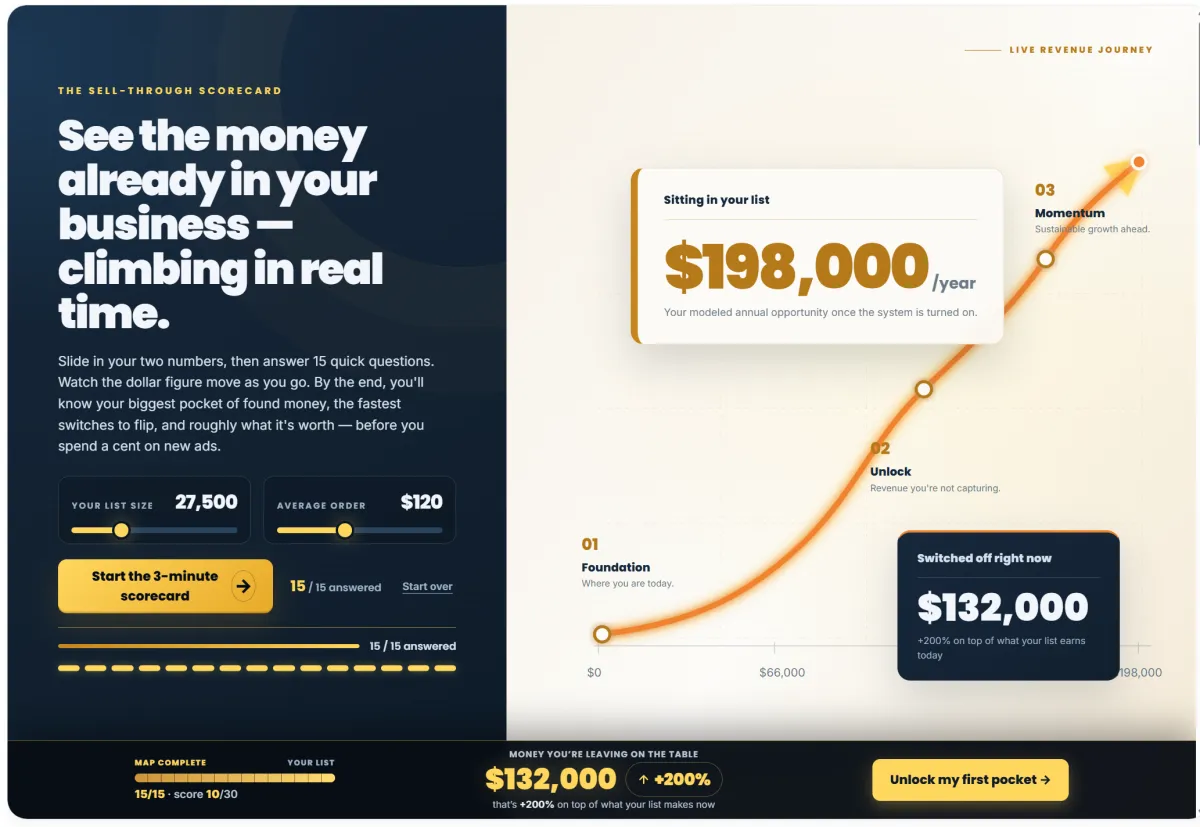
See the money already in your business, climbing in real time.
Slide in your two numbers, then answer 15 quick questions. Watch the dollar figure move as you go. By the end, you'll know your biggest pocket of found money, the fastest switches to flip, and roughly what it's worth — before you spend a cent on new ads.
Your List
Your Automations
Your Repeat Buyers
Your Offers & Pricing
Your Between-Launch Revenue
Answer all 15 to lock your result
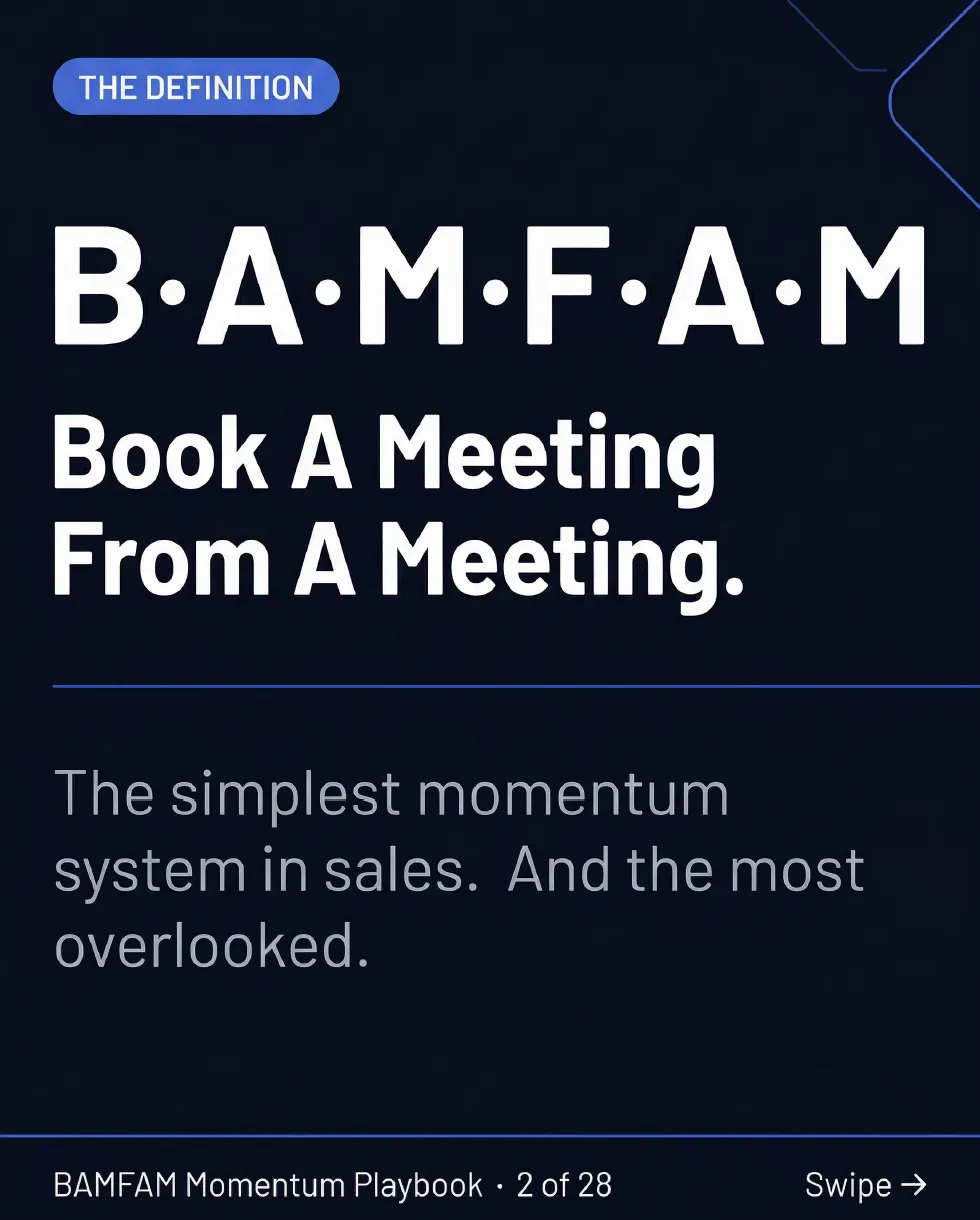
Connect • Clarify • Confirm • Calendar: The 4-Beat Playbook That Ends the Follow-Up Chase.
Discover how the BAMFAM Momentum Playbook reveals the exact strategies to:
Book the Next Meeting While You're Still in the Meeting
Turn "Let Me Get Back to You" Into a Yes (It's Friction, Not Rejection)
Kill the "Just Bumping This Up" Email Forever
Make Momentum Measurable With the Team Scorecard
Stop • Scan • Decide: The 3-Step Playbook to Win the First 51 Seconds.
Discover how the FOCUS360 Playbook reveals the exact strategies to:
FREE GPT Agent to test and build your content
Stop the Scroll on Command
Hold Attention for the First 51 Seconds:
Multiply Conversions With a Single Clear Path:
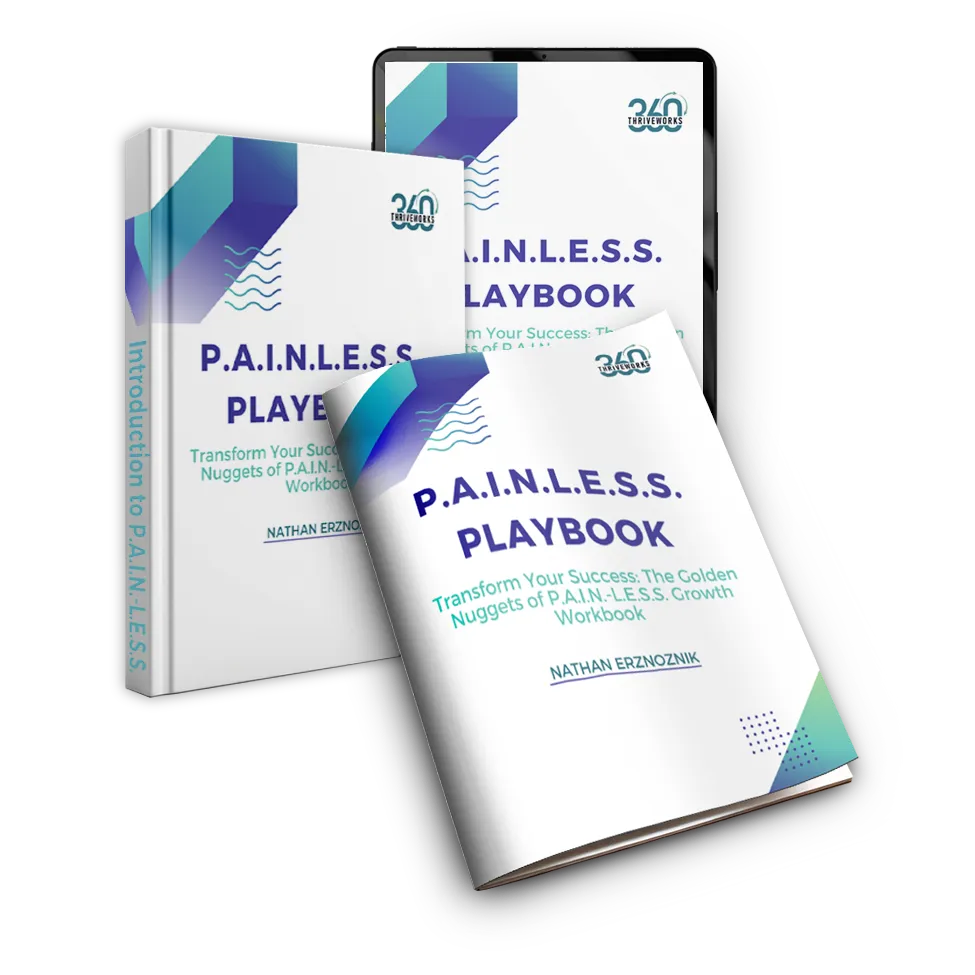
Unlock Your Business’s Full Potential – Without the Pain
Step into the realm of effortless growth with our P.A.I.N.-L.E.S.S. Playbook.
Designed for entrepreneurs who seek the "Golden Nuggets" that transform them and their businesses without the overwhelming stress. This tool shows a simple and streamlined path toward business success.
Take Control of Your Journey with Our Ultimate FREE Autopilot 360 System Masterclass and Cheat Sheet.
Build A Self-Managed Business And Break Through 6-7 Figures To 8 Figures While Seamlessly Producing Huge Profits!


Uncover Hidden Revenue in 3 Simple Steps
See more details about how this impacts business performance.
PAID COURSE
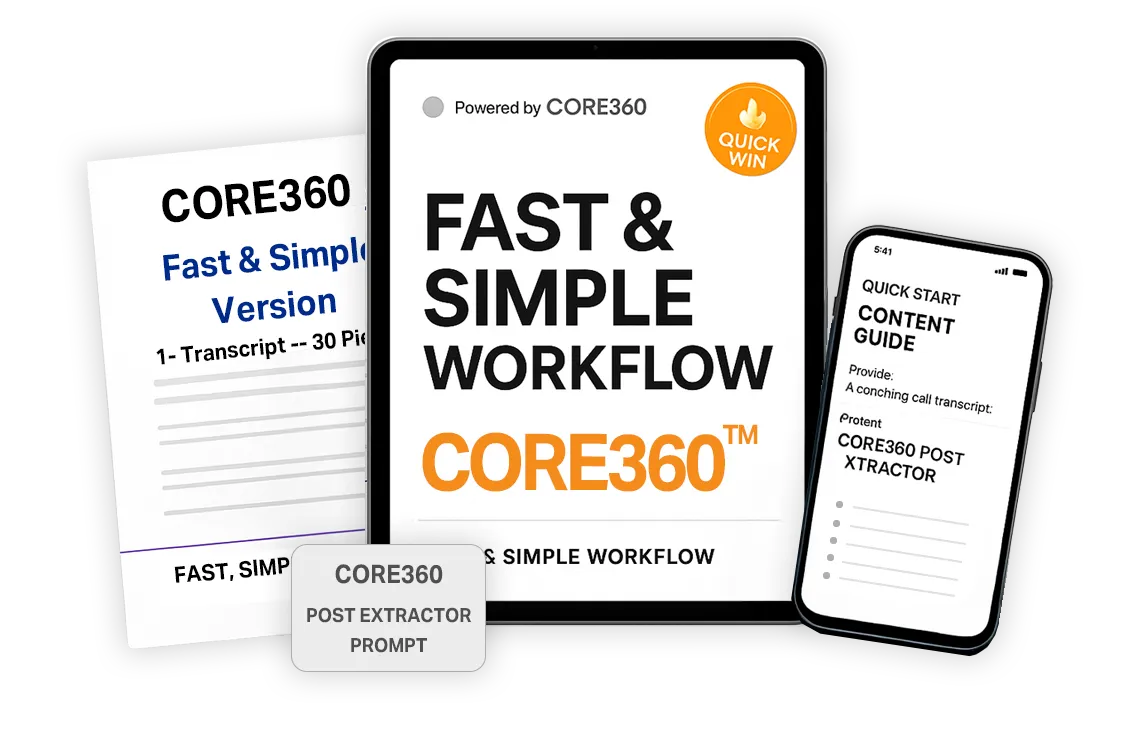
CORE360: Multiply Your Message — Without Writing a Single Word
See how to easliy increase your visibility with the CORE360 System and AI-driven Prompt Booster Pack™
Built for founders and entrepreneurs who already say brilliant things — this AI-optimized vault gives you the exact prompts to turn one voice note into days of content across Instagram, LinkedIn, TikTok, YouTube Shorts, and Facebook.
No burnout. No blank pages. Just scroll-stopping content formulas that match your voice and work on every platform.
A simple upgrade with exponential reach.
BLOG
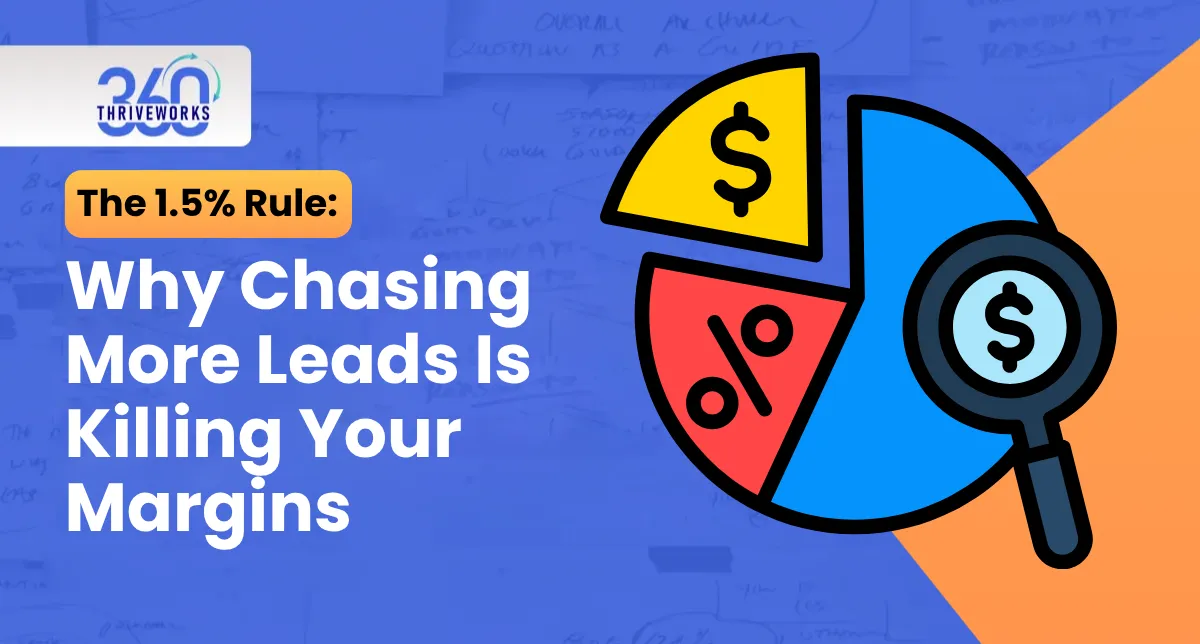
The 1.5% Rule: Why Chasing More Leads Is Killing Your Margins
The best growth opportunity usually isn't hiding in another list of 10,000 strangers. It's already sitting inside the customers you have.
Most founders believe the answer to slow growth is more.
More leads. More outreach. More ad spend. More sales calls. More names dumped into the CRM.
It sounds logical. If 100 leads produce five customers, then 1,000 leads should produce fifty. Simple.
Business rarely works that cleanly. As lead volume climbs, quality tends to slide. Your salespeople burn hours chasing prospects who were never a good fit. Marketing costs go up. Discounts creep in. And your delivery team inherits customers who need extra hand-holding, custom work, and constant attention.
Revenue might still grow. Margins often don't.
The real opportunity may not be buried in another list. It may already live inside the small group of customers who buy more, stay longer, need less, and pay you better.
That's the idea behind the 1.5% rule.
It isn't a hard math law. Exactly 1.5 percent of customers won't drive every company's results. Think of it as a lens. A reminder that a tiny slice of your buyers is often worth far more than the rest of the market combined.
The goal isn't to stop generating leads. The goal is to stop treating every lead as equally valuable.
The Lead Volume Trap
Lead generation is easy to measure. You can count form fills, email sign-ups, booked calls, downloads, replies, website visitors. The numbers look great on a dashboard, and they give the team a comforting sense of motion.
But motion isn't progress.
A campaign that pulls in 500 leads looks more successful than one that pulls in 50. Yet the smaller campaign might deliver more revenue, stronger margins, and better customers. The trouble starts when a business optimizes for what's easiest to count instead of what actually matters.
Marketing gets rewarded for generating leads. Sales gets rewarded for closing them. Operations delivers whatever got sold. And finance sees the real picture last, once the cost of serving those customers finally shows up on the books.
By then you may have signed customers who needed heavy discounts to buy. Who took months to close. Who need constant support, request endless custom work, pay late, rarely buy again, and leave almost no profit behind.
They still add revenue. On paper they can even look valuable. But revenue alone never tells you how healthy the relationship really is.
Your Biggest Customer May Not Be Your Best One
Founders usually spot their "best" customers by looking at who spends the most. That's a fair starting point. It's just not enough.
Picture two customers. Each one brings in $100,000 a year.
Customer A takes standard pricing, pays on time, follows your process, sends you referrals, and barely needs support.
Customer B negotiates every invoice, wants custom work, fires off urgent messages at night, drags out approvals, and eats twice the delivery time you planned for.
Same revenue. Completely different value.
Once you factor in sales effort, discounts, support, delivery complexity, and how they pay, Customer A is probably far more profitable. This is exactly why finding your best buyer has to go deeper than a list of your biggest accounts. The best buyer isn't the one who writes the largest check. It's the one who creates the strongest mix of revenue, profit, loyalty, fit, and ease.
What the 1.5% Rule Really Means
The rule asks one simple question. Who are the exceptional buyers already hiding inside your customer base?
These are the customers who buy your higher-value offers, decide quickly, need fewer discounts, stay longer, pay reliably, use your product the right way, get strong results, rarely need surprise support, and send you more customers just like them.
They might be a small slice of your list. Their impact is almost always bigger than their numbers.
Most companies never study this group closely. They build an ideal customer profile out of broad traits like company size, industry, location, or job title. Those details help a little. They rarely explain why one customer turns into a dream account while another turns into a headache.
Two companies can look identical on LinkedIn and behave nothing alike after the sale. The difference lives deeper than the demographics. It usually comes down to urgency, leadership priorities, buying behavior, how mature their operations are, who owns the budget, and the specific event that pushed them to buy in the first place.
That deeper pattern is your Customer DNA.
What "Best Buyer Identification" Actually Is
It's the work of finding the customers who create the most total value for your business, then figuring out what they have in common. That includes money, but it also includes the quality of the relationship. A useful analysis looks at seven things.
1. Revenue and margin. How much does the customer bring in? And more importantly, how much profit is left after discounts, labor, support, and delivery? High revenue can hide a weak margin.
2. Acquisition effort. How long did they take to close? How many meetings, proposals, and revisions did it take to win them? A customer who closes fast at full price can beat a bigger account that took nine months and dozens of sales hours.
3. Retention and expansion. Do they stay? Do they renew, reorder, upgrade, or add services? A buyer who keeps growing with you is worth far more than a one-time sale.
4. Cost to serve. How much time and attention does the account actually demand? Onboarding, training, support, custom work, meetings, internal back-and-forth. The true cost of a difficult account is usually spread across several departments, which makes it easy to miss.
5. Payment behavior. Do they pay on time? Late payers create admin work and squeeze your cash flow. A slightly smaller customer who pays like clockwork can be healthier for the business.
6. Strategic fit. Do they use your service the way it's meant to be used? Are their expectations realistic? Do they trust your process? Strong-fit customers are easier to serve because the relationship matches how your business was built to run.
7. Referral and reputation value. Do they introduce you to buyers like them? Does their success strengthen your case studies and your standing in a market you care about? Not every benefit shows up on an invoice.
How to Find Your Best Buyers
You don't need perfect data to start. You just need enough to spot real patterns. Five steps.
Step 1: Build a customer value list. List your active and recent customers. For each one, jot down total revenue, rough gross margin, length of the relationship, how long the sale took, discounts given, support hours, payment reliability, repeat purchases, and referrals. Some of this comes from your accounting software or CRM, some from a quick chat with your team. The first version won't be perfect. That's fine. You're after clarity, not a flawless spreadsheet.
Step 2: Rank them by total value, not revenue. Build a simple score that blends profit, loyalty, ease of service, payment behavior, and growth potential. You may find that a few customers you'd written off as "small" are actually your healthiest accounts. You may also find that a couple of big ones cause more strain than they're worth. That can sting. It's also useful.
Step 3: Study the top group. Once you know your highest-value customers, look for what they share. What problem made them start looking? What was happening in their business when they bought? Who was in the decision? What made them trust you? How fast did they decide? What results mattered most? Look for patterns in behavior, not just demographics. The buying trigger often matters more than the company size.
Step 4: Build your Customer DNA profile. Turn those patterns into a clear picture. A good profile might cover their business type, the decision-maker's role, the trigger event, their urgency, their main pain, what's driving them financially, how they buy, their common objections, the outcome they want, how well they fit your operations, and the warning signs to watch for. That gives marketing and sales something far sharper than a vague persona. Instead of "CEOs at companies with 20 to 100 people," you get "founders who just opened a second location, are feeling margin pressure, and need better visibility before they hire again." Much more useful.
Step 5: Actually use it. This work only pays off when it changes decisions. Let it shape your marketing message, your lead sources, your sales qualification, your offers and pricing, your content, your referral strategy, and your onboarding. You're not trying to shrink your audience to nothing. You're trying to stop spending equal time and money on people who don't have equal potential.
What Founders Usually Get Wrong
The first mistake is assuming a narrower target will slow growth. Usually it's the sloppy targeting that's already slowing growth. It jams the pipeline with low-fit prospects and buries the buyers who deserve more of your attention.
The second is trusting gut alone. Your team has opinions about the "best" customers. Those opinions should be checked against real margin, retention, and payment data.
The third is building the profile once and never touching it again. Customers change. Offers evolve. Markets move. The ideal buyer from three years ago may not match where you're headed.
The fourth is using the profile for marketing only. Customer DNA should guide qualification, sales conversations, pricing, delivery, retention, even what you build next. It's not just a campaign doc.
More Leads Aren't the Enemy
None of this is an argument against lead generation. A healthy pipeline matters.
But more volume only helps once you actually know what a good opportunity looks like. Without that clarity, cranking up lead gen is just pouring more water into a leaking bucket. The activity rises. The efficiency doesn't.
With a clear best-buyer profile, the same marketing budget suddenly works harder. Your messages get more relevant. Sales conversations get easier. Qualification improves. Your team stops forcing bad-fit deals up the hill. And the customers who do buy are far more likely to stay, grow, and pay you well.
Find the Buyers Behind Your Best Growth
Your next stage of growth may not need a bigger audience at all. It may just need a clearer view of the buyers who already prove where your business creates the most value.
Before you launch another campaign, buy another list, or push the sales team to do more, take a hard look at your top customers. They are usually telling you exactly where to focus.
Want to see where your own customer base is hiding its best buyers? Take the free DNA360 Audit and get a clear read on your Customer DNA who you're actually built to serve best, and where your current strategy is spending time and budget on the wrong accounts.
ThriveWorks360

Free Weekly Productivity Insights
Sign up for Sunday Snippets - my weekly newsletter where I I share actionable productivity tips, practical life advice, and high-quality insights from across the web, directly to your inbox.
What People Are Saying

Driving Growth, Amplifying Impact

Grace Company

8th to 2nd most recognized brands in the industry in one year

J&B Sewing
Launched new product line and grew 300% in two years

Sewrite
Increased national distribution, D2C Revenue by 400%.
Get In Touch
Email: [email protected]
Address
Office: 14881 S. Auburn Sky Dr
Assistance Hours
Mon – Sat 9:00am – 8:00pm
Sunday – CLOSED
Phone Number:
(888) 870-7314
Contact Us:
BECOME AN TW360 INSIDER
Sign up for exlcusive content, emails, & things Nathan doesn't share anywhere else.
Unleash Your Business Brilliance.
Reach out and connect for your opportunity to shine!
© 2026 ThriveWorks360 - All Rights Reserved, copyright 2024