FREE Tools
Select from below to learn more!
Free Tools
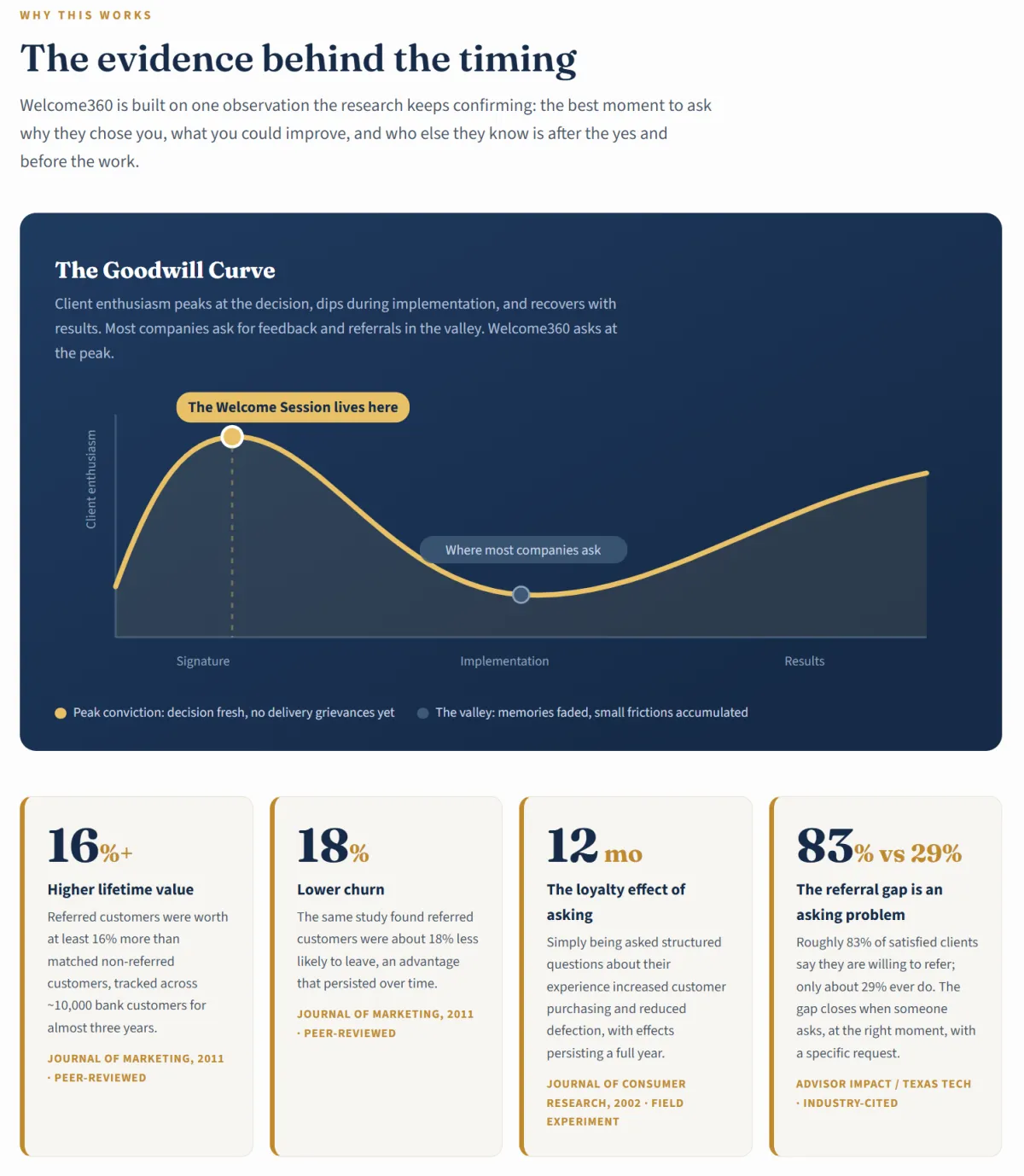
Welcome360 • A Client Growth System: The 45-Minute Meeting That Turns Every New Client Into Referrals.
Discover how the Welcome360 System reveals the exact strategies to:
Ask for Referrals at Peak Goodwill — Before the Honeymoon Ever Fades
FREE AI Insight Miner: Turn One Client Conversation Into 7 Finished Business Assets
Capture the Exact Words Clients Use to Sell You (Then Reuse Them Everywhere)
Close the Feedback Loop That Makes Clients Refer Twice
Sellthrough360 - Flows, Bundling, Upselling Systems for Revenue Generation
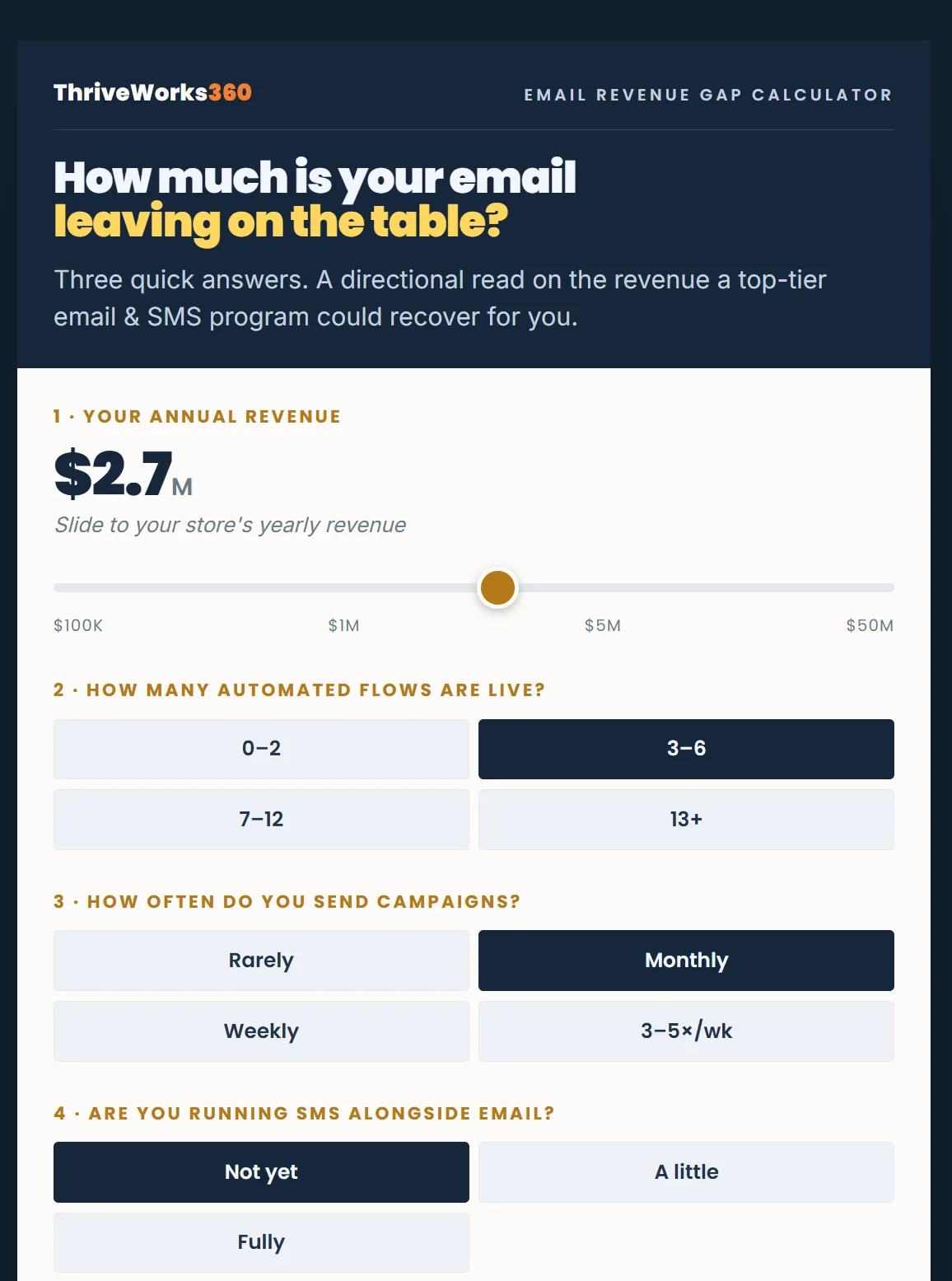
How much is your email leaving on the table?
Three quick answers. A directional read on the revenue a top-tier email & SMS program could recover for you.
Your annual revenue
How many automated flows are live?
How often do you send campaigns?
Are you running SMS alongside email?
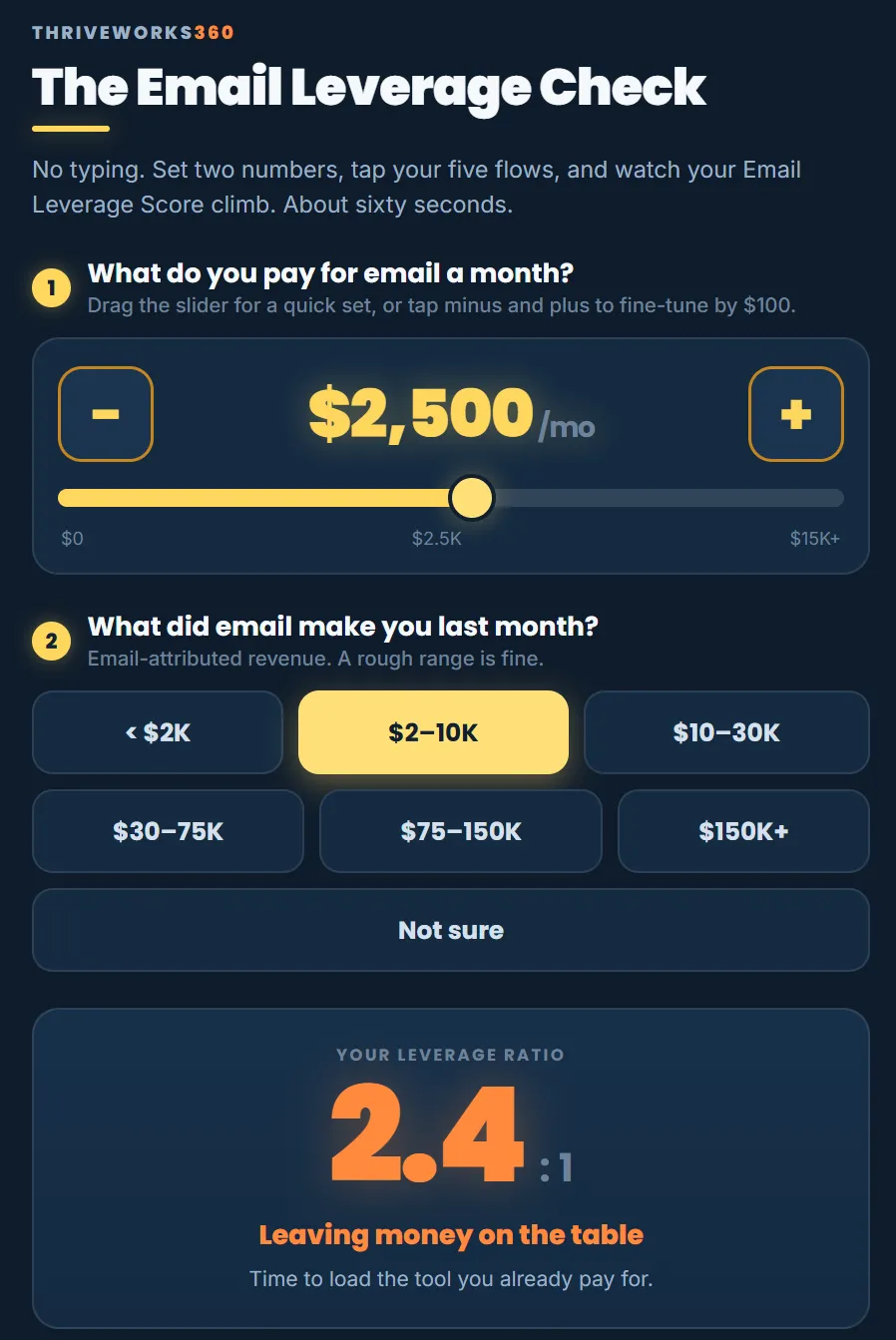
The Email Leverage Check
No typing. Set two numbers, tap your five flows, and watch your Email Leverage Score climb. About sixty seconds.
What do you pay for email a month?
What did email make you last month?
Which of these 5 are running?
Download a printable form
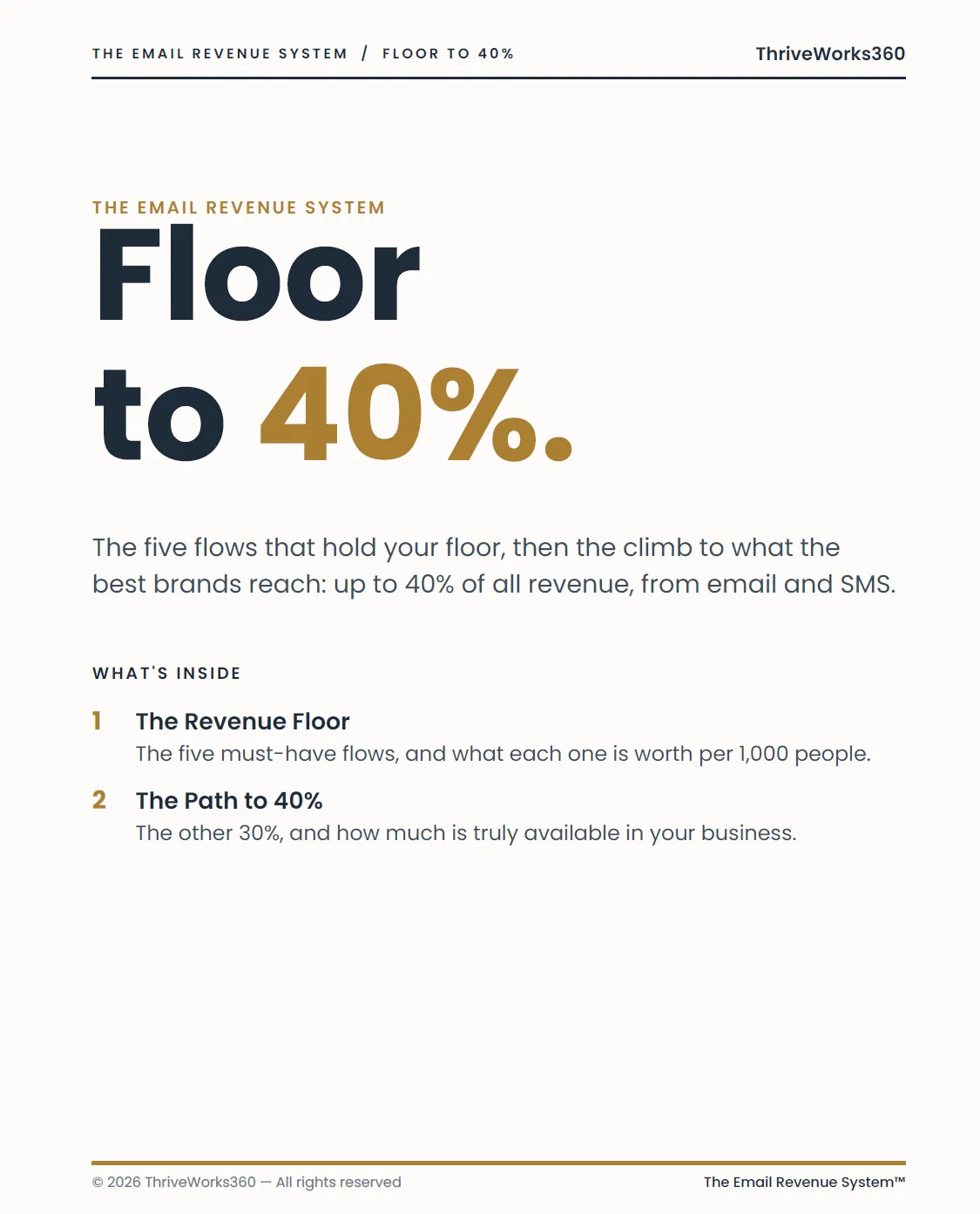
The Email Revenue System Floor to 40%.
The five flows that hold your floor, then the climb to what the best brands reach: up to 40% of all revenue, from email and SMS.
The Revenue Floor - The five must-have flows, and what each one is worth per 1,000 people.What did email make you last month?
The Path to 40% - The other 30%, and how much is truly available in your business.
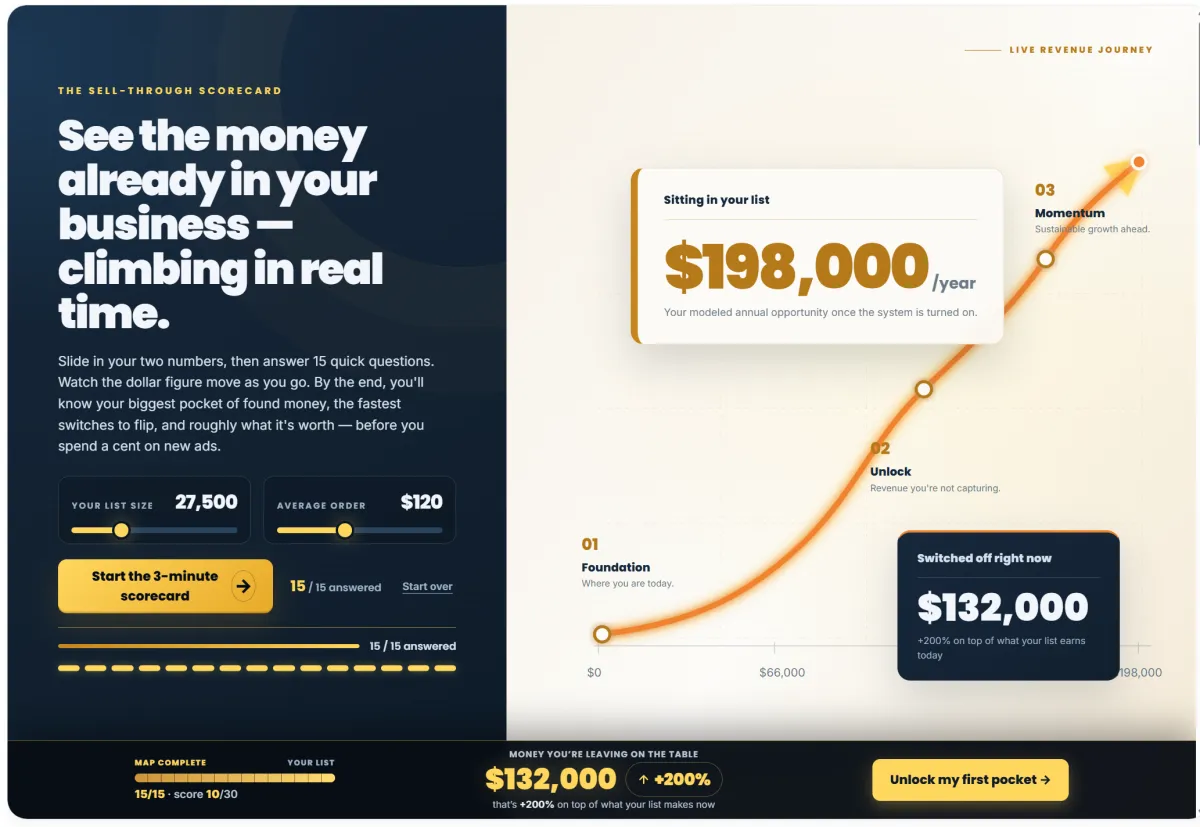
See the money already in your business, climbing in real time.
Slide in your two numbers, then answer 15 quick questions. Watch the dollar figure move as you go. By the end, you'll know your biggest pocket of found money, the fastest switches to flip, and roughly what it's worth — before you spend a cent on new ads.
Your List
Your Automations
Your Repeat Buyers
Your Offers & Pricing
Your Between-Launch Revenue
Answer all 15 to lock your result
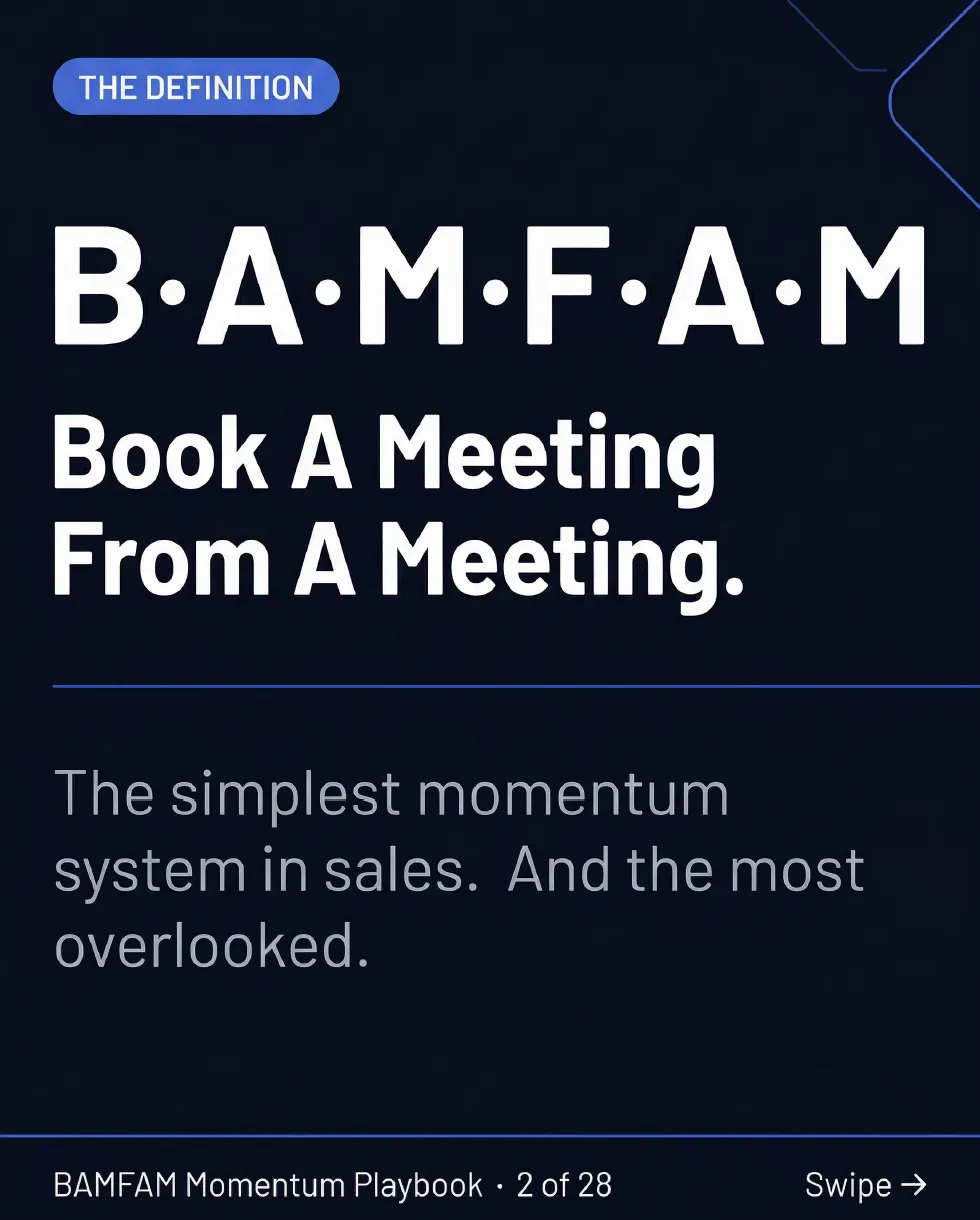
Connect • Clarify • Confirm • Calendar: The 4-Beat Playbook That Ends the Follow-Up Chase.
Discover how the BAMFAM Momentum Playbook reveals the exact strategies to:
Book the Next Meeting While You're Still in the Meeting
Turn "Let Me Get Back to You" Into a Yes (It's Friction, Not Rejection)
Kill the "Just Bumping This Up" Email Forever
Make Momentum Measurable With the Team Scorecard

Stop • Scan • Decide: The 3-Step Playbook to Win the First 51 Seconds.
Discover how the FOCUS360 Playbook reveals the exact strategies to:
FREE GPT Agent to test and build your content
Stop the Scroll on Command
Hold Attention for the First 51 Seconds:
Multiply Conversions With a Single Clear Path:
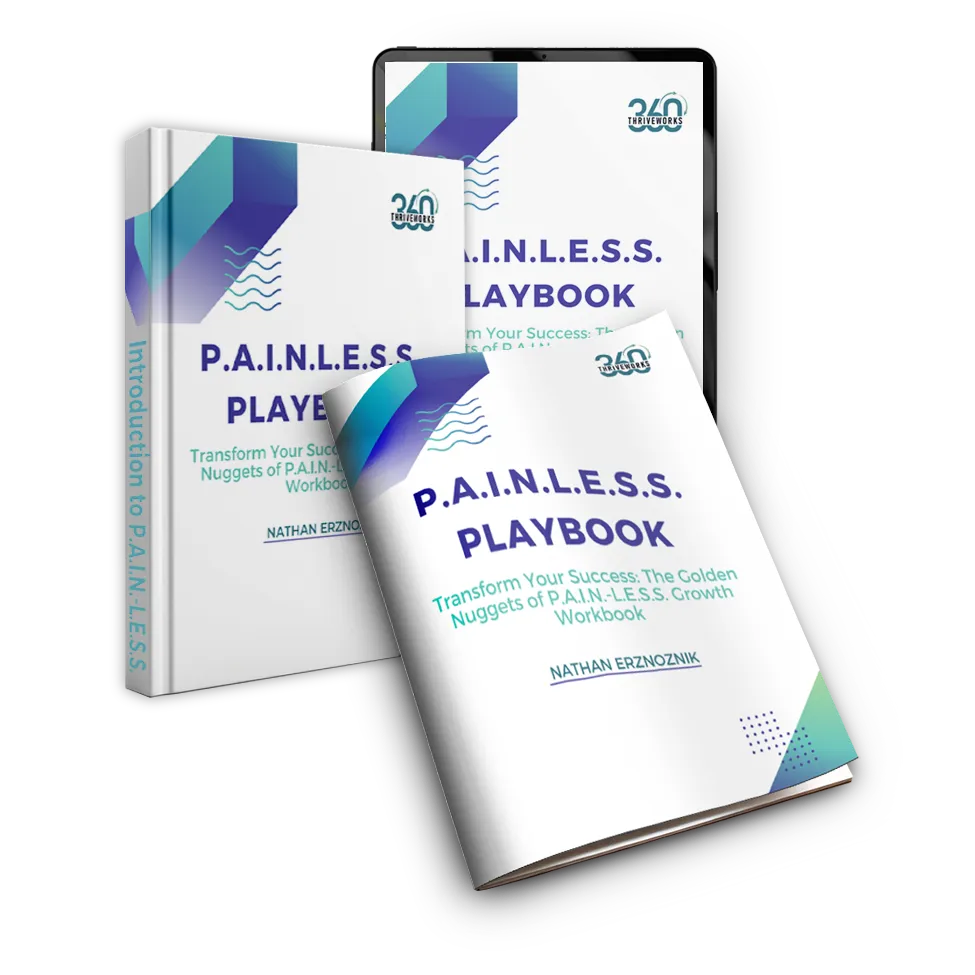
Unlock Your Business’s Full Potential – Without the Pain
Step into the realm of effortless growth with our P.A.I.N.-L.E.S.S. Playbook.
Designed for entrepreneurs who seek the "Golden Nuggets" that transform them and their businesses without the overwhelming stress. This tool shows a simple and streamlined path toward business success.
Take Control of Your Journey with Our Ultimate FREE Autopilot 360 System Masterclass and Cheat Sheet.
Build A Self-Managed Business And Break Through 6-7 Figures To 8 Figures While Seamlessly Producing Huge Profits!


Uncover Hidden Revenue in 3 Simple Steps
See more details about how this impacts business performance.
PAID COURSE
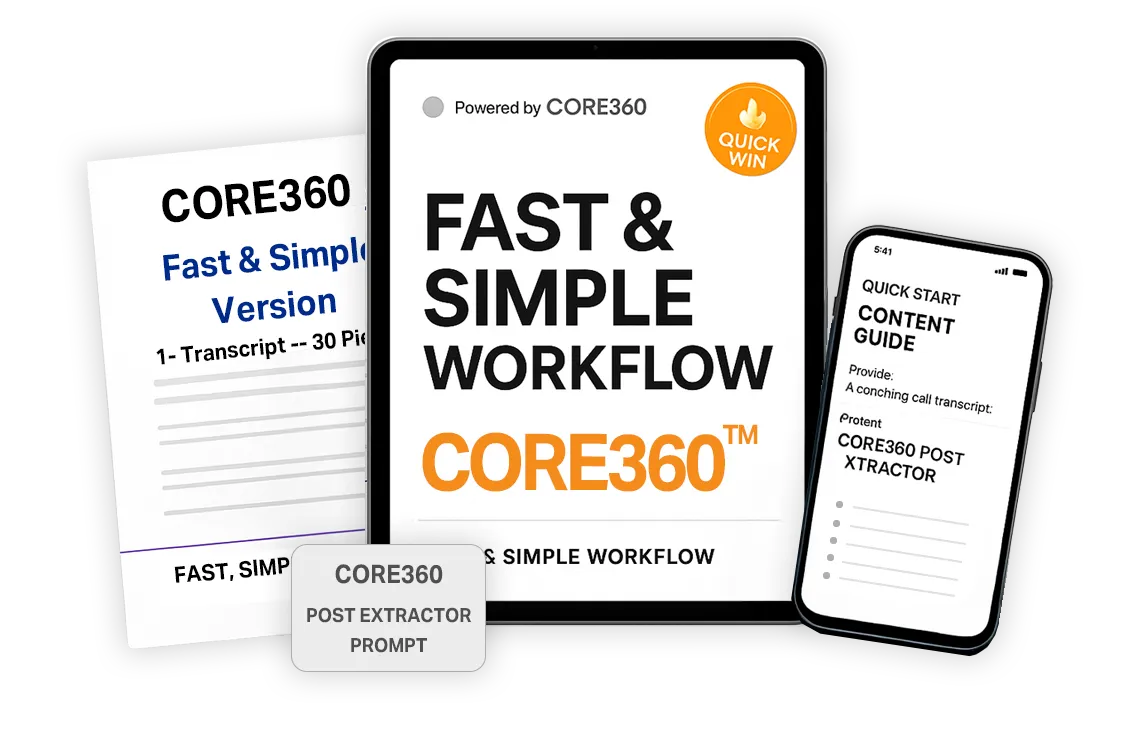
CORE360: Multiply Your Message — Without Writing a Single Word
See how to easliy increase your visibility with the CORE360 System and AI-driven Prompt Booster Pack™
Built for founders and entrepreneurs who already say brilliant things — this AI-optimized vault gives you the exact prompts to turn one voice note into days of content across Instagram, LinkedIn, TikTok, YouTube Shorts, and Facebook.
No burnout. No blank pages. Just scroll-stopping content formulas that match your voice and work on every platform.
A simple upgrade with exponential reach.
BLOG
Stop Competing on Price: How to Build a Category of One
If prospects keep asking for discounts, your pricing probably isn't the problem. Being comparable is.
If prospects keep asking you to come down on price, the price is usually not the issue.
I know how backwards that sounds especially when a competitor is undercutting you by 10%, 20%, sometimes more. The natural move is to sharpen the pencil, shave the margin, and tell yourself you'll make it up in volume. Most founders try that at least once. Some try it for years.
The trouble is that price pressure is almost always a symptom, not the disease.
Customers only compare prices when they believe two options are basically the same. The instant they see a real difference, the whole conversation changes now they're weighing outcomes, expertise, confidence, and fit instead of counting dollars. So if you actually want to stop competing on price, you don't start with pricing strategy. You start with differentiation.
Why Businesses End Up in Price Wars
Think back to the last important thing you bought accounting software, a contractor, legal help, a new phone. Did you just grab the cheapest option? Probably not. You weighed the value. You looked for trust, for confidence, for the option that felt like the right fit for what you actually needed.
Your customers do exactly the same thing.
Price wars start when a buyer can't clearly answer one question: why should I choose you over someone else? When that answer is fuzzy, they fall back on the only comparison they can make price. And that's how businesses get stuck on the treadmill. A competitor drops their price, so you drop yours, so margins shrink, so marketing has to work harder, so growth gets tougher and round it goes, until the whole business is running on volume instead of value.
The Real Reason You're Getting Compared on Price
Most founders think they've got a pricing problem. What they've usually got is a positioning problem.
The market doesn't compare things it sees as genuinely different. Nobody compares a luxury resort to a roadside motel. Nobody compares a specialist surgeon to a general practitioner. Nobody lines up a high-end design studio against a $30 freelancer on a marketplace. Not because one is objectively "better" because they live in different categories in the customer's mind.
The businesses that escape price competition don't necessarily have a better product. They own a different position. And that's where real differentiation starts not with marketing, not with branding, not with a clever sales script. With positioning.
The Three Pieces Behind Most Price Pressure
Work with enough founder-led businesses and a pattern gets hard to miss. The ones struggling with pricing power are usually missing one or more of three foundational pieces: Position DNA, Customer DNA, and Expression DNA. Get all three working together and you end up with what founders eventually recognize as a true category of one.
1. Position DNA — Decide What You Want to Own
Most businesses describe what they do. Very few define what they want to be known for. That's a bigger gap than it looks.
Compare these two. "We provide ERP implementation services." Versus "We help manufacturers eliminate the inventory blind spots that turn into cash-flow problems." The first describes a service — and a service invites comparison. The second owns a problem, and owning a problem creates distinction.
Strong positioning answers a specific set of questions. What problem do we own? What conversation do we lead? What category do we want customers to file us under? What would we want competitors to struggle to copy? Skip that work and you stay interchangeable — and interchangeable businesses compete on price, every time.
2. Customer DNA — Stop Selling to Everyone
Here's a quiet way businesses commoditize themselves: by trying to appeal to everyone. The logic feels airtight — more people, more opportunities. Usually the reverse happens.
Broader messaging pulls in weaker-fit customers. Weaker-fit customers shop more options. More options mean more price pressure. Meanwhile, the businesses with the strongest pricing power tend to serve narrower audiences. They know who they serve, who they don't, which outcomes matter most, and which pains genuinely deserve a premium solution. A founder speaking directly to one market segment simply sounds more credible than one trying to talk to ten. Clarity creates confidence, and confidence is what lets you hold a premium.
3. Expression DNA — Make the Difference Obvious
Sometimes a business really is different and the market just can't see it. This is where founders get genuinely frustrated. We're better. We get better results. We've got more experience. All possibly true — but if the buyer can't see it, it doesn't exist in the buying process. It may as well not be real.
Expression DNA translates your value into language a customer grasps instantly. It ties your expertise to the outcome they care about, cuts the complexity, and — most importantly — takes the work of figuring out why you matter off the prospect's plate. Because they won't do that work. They'll just compare prices instead.
Why a Rebrand Alone Won't Fix It
Plenty of businesses answer commoditization with a rebrand — new logo, new colors, new website, maybe new messaging. Those things can help. But branding amplifies positioning; it doesn't create it.
You can't design your way out of strategic confusion. You can't market your way out of unclear positioning. And you definitely can't advertise your way out of looking identical to everyone else. A real category of one gets built after the strategic clarity exists — never before it.
How to Actually Build a Category of One
It's less mysterious than people assume. It tends to follow a predictable sequence.
Step 1 — Find where the comparison is happening. Where do prospects actually compare you? Price? Features? Speed? Experience? Wherever the comparison lives is exactly where your differentiation is missing.
Step 2 — Claim the problem you own. Generalists get compared; problem-owners get remembered. Ask what single challenge you want customers to associate with you the moment your name comes up. The more specific that answer, the stronger the position.
Step 3 — Narrow your ideal customer. Not everyone values the same things. Premium buyers care less about cost and more about outcomes, speed, certainty, expertise, and reduced risk. Find those buyers and build the whole thing around them.
Step 4 — Translate expertise into outcomes. Features rarely command premium pricing; outcomes do. Customers don't buy software, they buy visibility. They don't buy consulting, they buy certainty. They don't buy implementation, they buy confidence. The clearer you connect the work to the outcome, the less the price matters.
Step 5 — Repeat the position relentlessly. Positioning isn't a one-time announcement; it's reinforced everywhere — website, sales calls, case studies, content, presentations — the same position, over and over, until the market starts repeating it back to you. That moment is when category ownership actually begins.
The Goal Was Never Premium Pricing
This catches people off guard. Premium pricing isn't really the goal. Relevance is. Trust is. Becoming the obvious choice for a specific customer with a specific problem is. Premium pricing just tends to follow along behind all three.
The businesses with the fattest margins usually aren't selling the cheapest product or cramming in the most features. They're selling confidence. Certainty. A position nobody else owns.
Where DNA360 Fits
This is the thinking behind DNA360. Instead of treating discount pressure as a sales problem, it looks at the strategic foundations underneath market perception — Position DNA, Customer DNA, Expression DNA. Because patching pricing pressure without fixing positioning buys you temporary relief and permanent frustration. The businesses that escape price wars almost never do it by getting cheaper. They do it by becoming incomparable.
Final Thought
Customers compare prices when they're comparing options. They stop the moment they believe one option stands alone. That's the whole opportunity.
So if your business keeps facing discount requests, shrinking margins, and competitors you can't seem to separate yourself from, the answer probably isn't another promotion. It's a different question entirely. Not "how do we justify our prices?" — but "why does the market believe we're comparable in the first place?"
The answer to that one is usually the first real step out of the price war.
Not sure why the market keeps lumping you in with everyone else? A free Customer GapMap360 session pinpoints where your positioning is leaving you comparable, names the biggest gap driving your price pressure, and shows you the first move toward becoming the obvious choice — instead of the cheaper one.
Frequently Asked Questions
Why do customers compare businesses on price?
Because they can't spot a meaningful difference between the options. Clear positioning and real differentiation are what lower price sensitivity.
What is a category of one?
A market position where a business is hard to compare directly with anyone else, because it owns a specific problem, audience, or outcome that competitors can't easily claim.
Does premium pricing require premium branding?
Not necessarily. Premium pricing usually follows strategic positioning and clear customer value — the visual branding comes after that, not before.
What's the strongest differentiation strategy?
The ones that combine positioning clarity, a focused customer, and consistent messaging — rather than leaning on features or price.
Can a small business build unique positioning?
Absolutely. Smaller businesses often position more powerfully, because they can specialize faster and serve a narrow audience better than a big competitor can.
— ThriveWorks360


Free Weekly Productivity Insights
Sign up for Sunday Snippets - my weekly newsletter where I I share actionable productivity tips, practical life advice, and high-quality insights from across the web, directly to your inbox.
What People Are Saying

Driving Growth, Amplifying Impact

Grace Company

8th to 2nd most recognized brands in the industry in one year

J&B Sewing
Launched new product line and grew 300% in two years

Sewrite
Increased national distribution, D2C Revenue by 400%.
Get In Touch
Email: [email protected]
Address
Office: 14881 S. Auburn Sky Dr
Assistance Hours
Mon – Sat 9:00am – 8:00pm
Sunday – CLOSED
Phone Number:
(888) 870-7314
Contact Us:
BECOME AN TW360 INSIDER
Sign up for exlcusive content, emails, & things Nathan doesn't share anywhere else.
Unleash Your Business Brilliance.
Reach out and connect for your opportunity to shine!
© 2026 ThriveWorks360 - All Rights Reserved, copyright 2024