FREE Tools
Select from below to learn more!
Free Tools
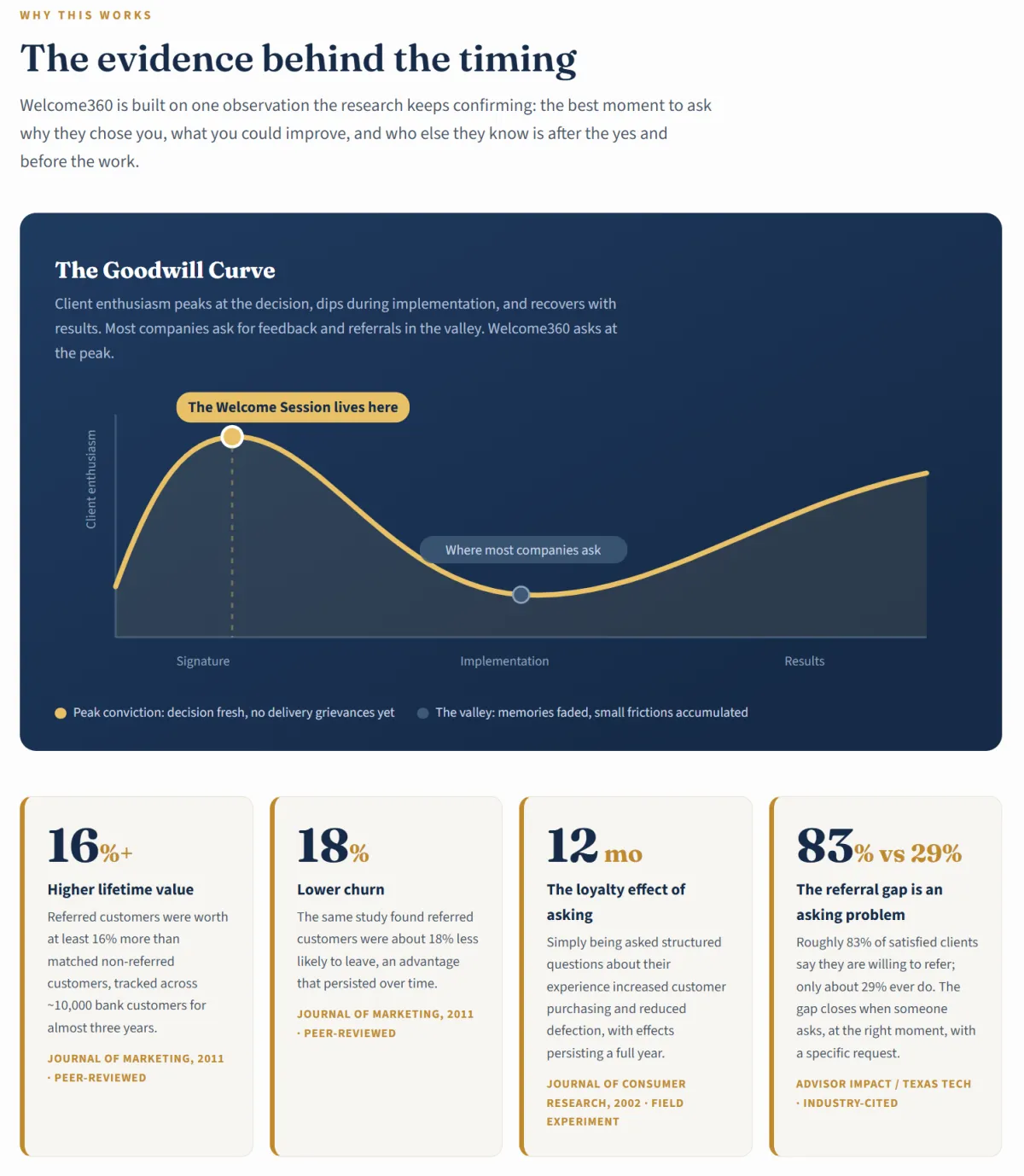
Welcome360 • A Client Growth System: The 45-Minute Meeting That Turns Every New Client Into Referrals.
Discover how the Welcome360 System reveals the exact strategies to:
Ask for Referrals at Peak Goodwill — Before the Honeymoon Ever Fades
FREE AI Insight Miner: Turn One Client Conversation Into 7 Finished Business Assets
Capture the Exact Words Clients Use to Sell You (Then Reuse Them Everywhere)
Close the Feedback Loop That Makes Clients Refer Twice
Sellthrough360 - Flows, Bundling, Upselling Systems for Revenue Generation
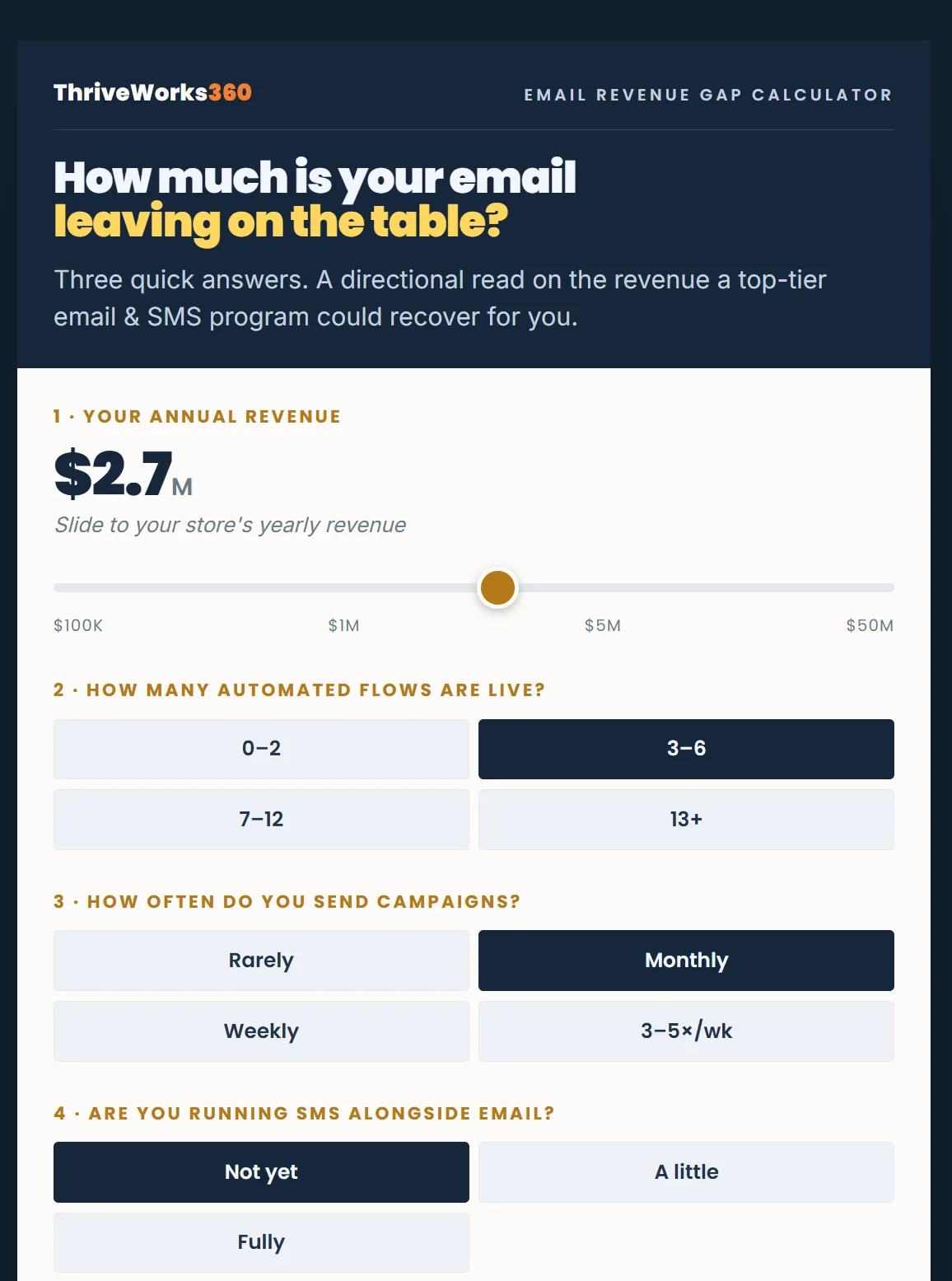
How much is your email leaving on the table?
Three quick answers. A directional read on the revenue a top-tier email & SMS program could recover for you.
Your annual revenue
How many automated flows are live?
How often do you send campaigns?
Are you running SMS alongside email?
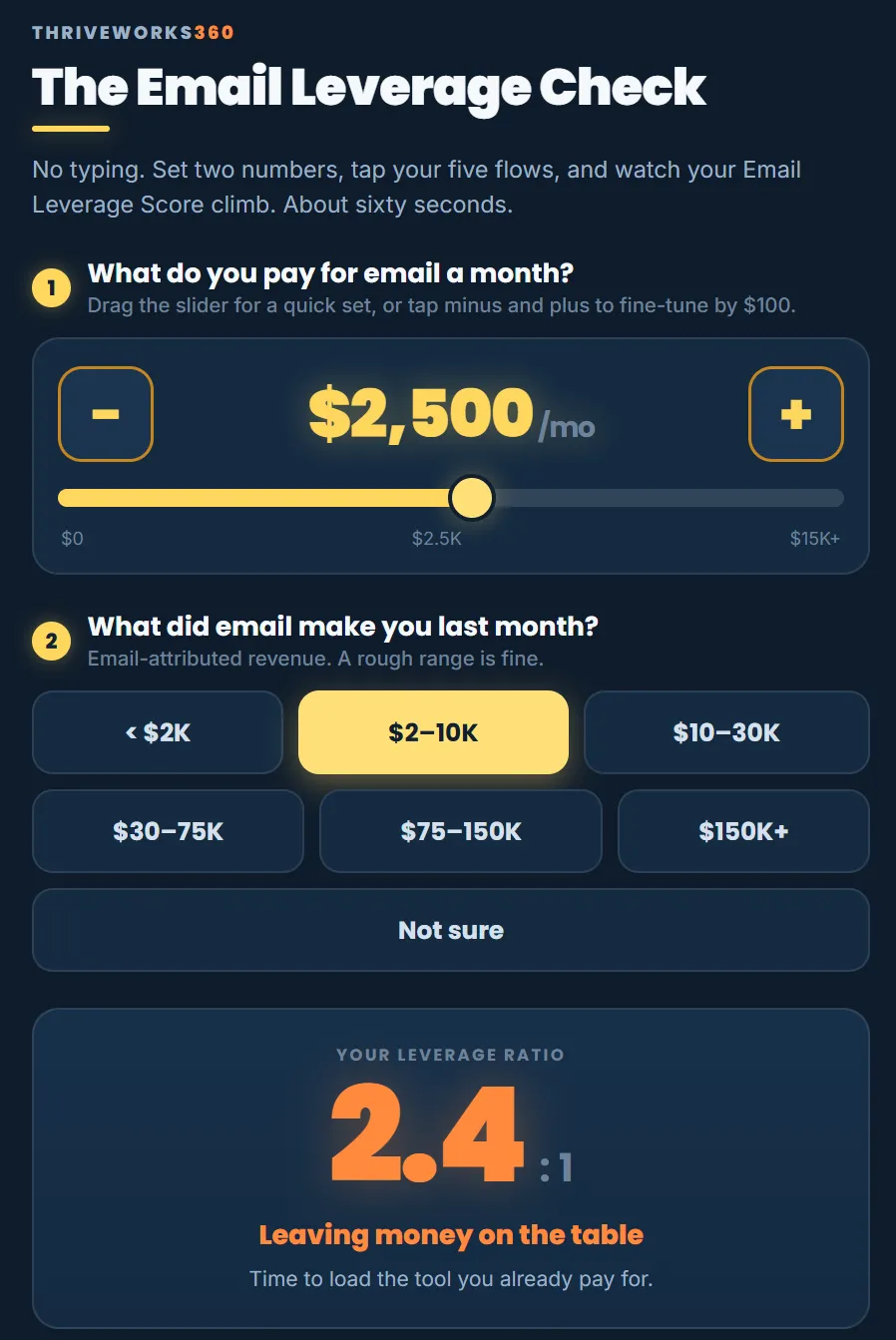
The Email Leverage Check
No typing. Set two numbers, tap your five flows, and watch your Email Leverage Score climb. About sixty seconds.
What do you pay for email a month?
What did email make you last month?
Which of these 5 are running?
Download a printable form
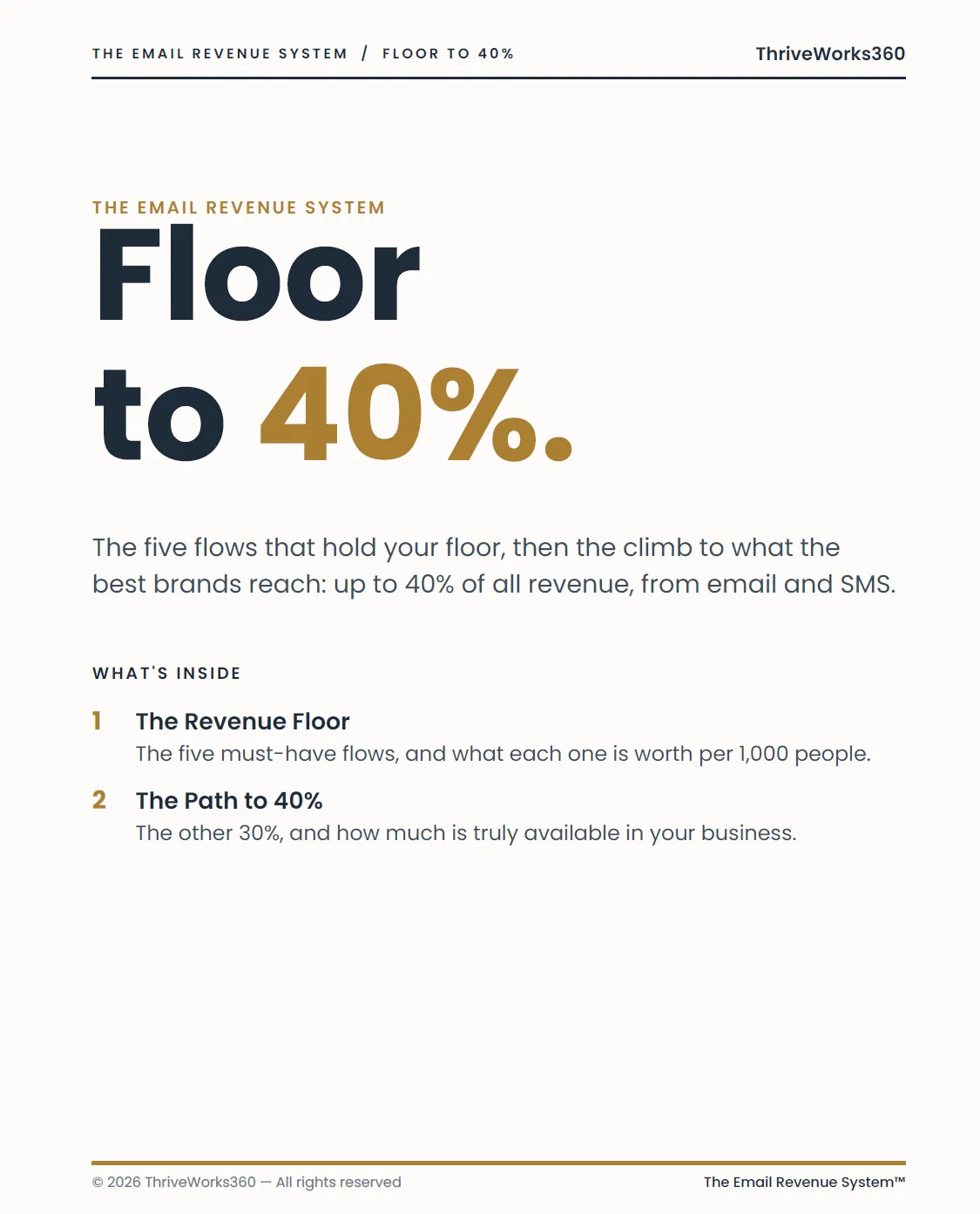
The Email Revenue System Floor to 40%.
The five flows that hold your floor, then the climb to what the best brands reach: up to 40% of all revenue, from email and SMS.
The Revenue Floor - The five must-have flows, and what each one is worth per 1,000 people.What did email make you last month?
The Path to 40% - The other 30%, and how much is truly available in your business.
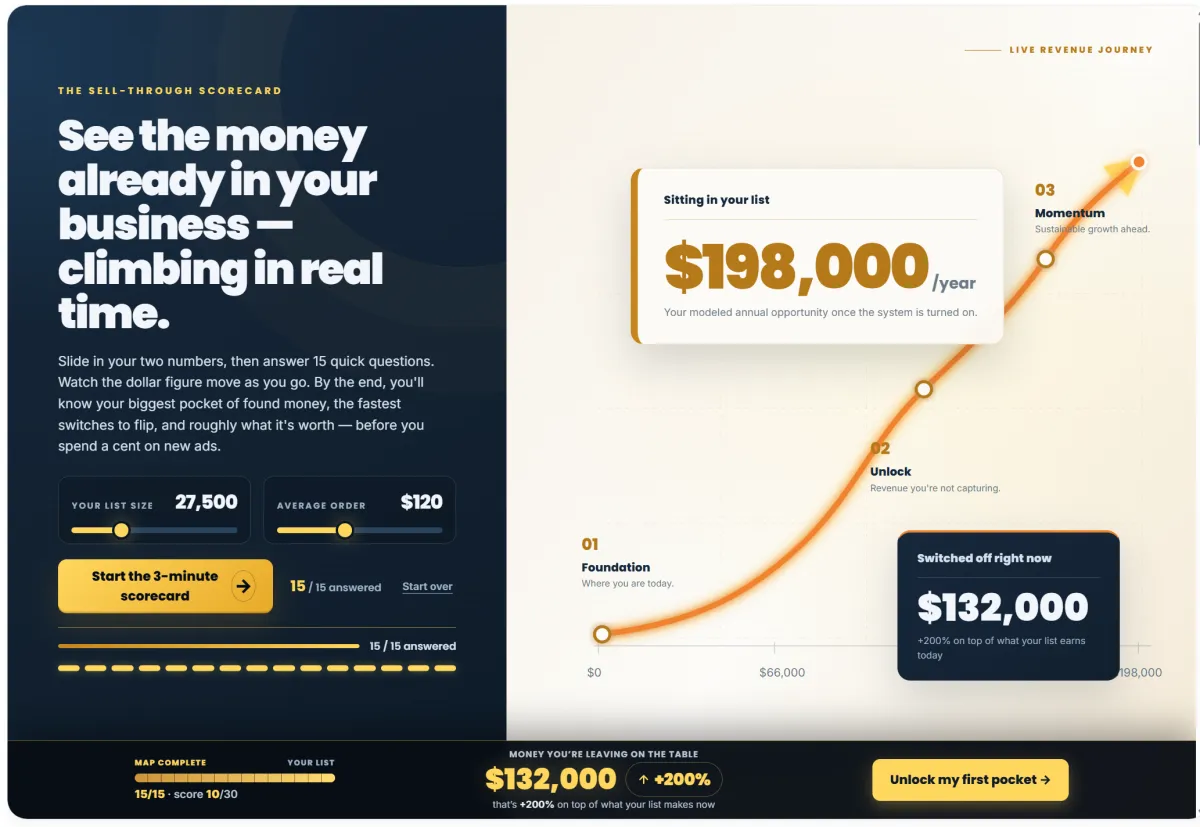
See the money already in your business, climbing in real time.
Slide in your two numbers, then answer 15 quick questions. Watch the dollar figure move as you go. By the end, you'll know your biggest pocket of found money, the fastest switches to flip, and roughly what it's worth — before you spend a cent on new ads.
Your List
Your Automations
Your Repeat Buyers
Your Offers & Pricing
Your Between-Launch Revenue
Answer all 15 to lock your result
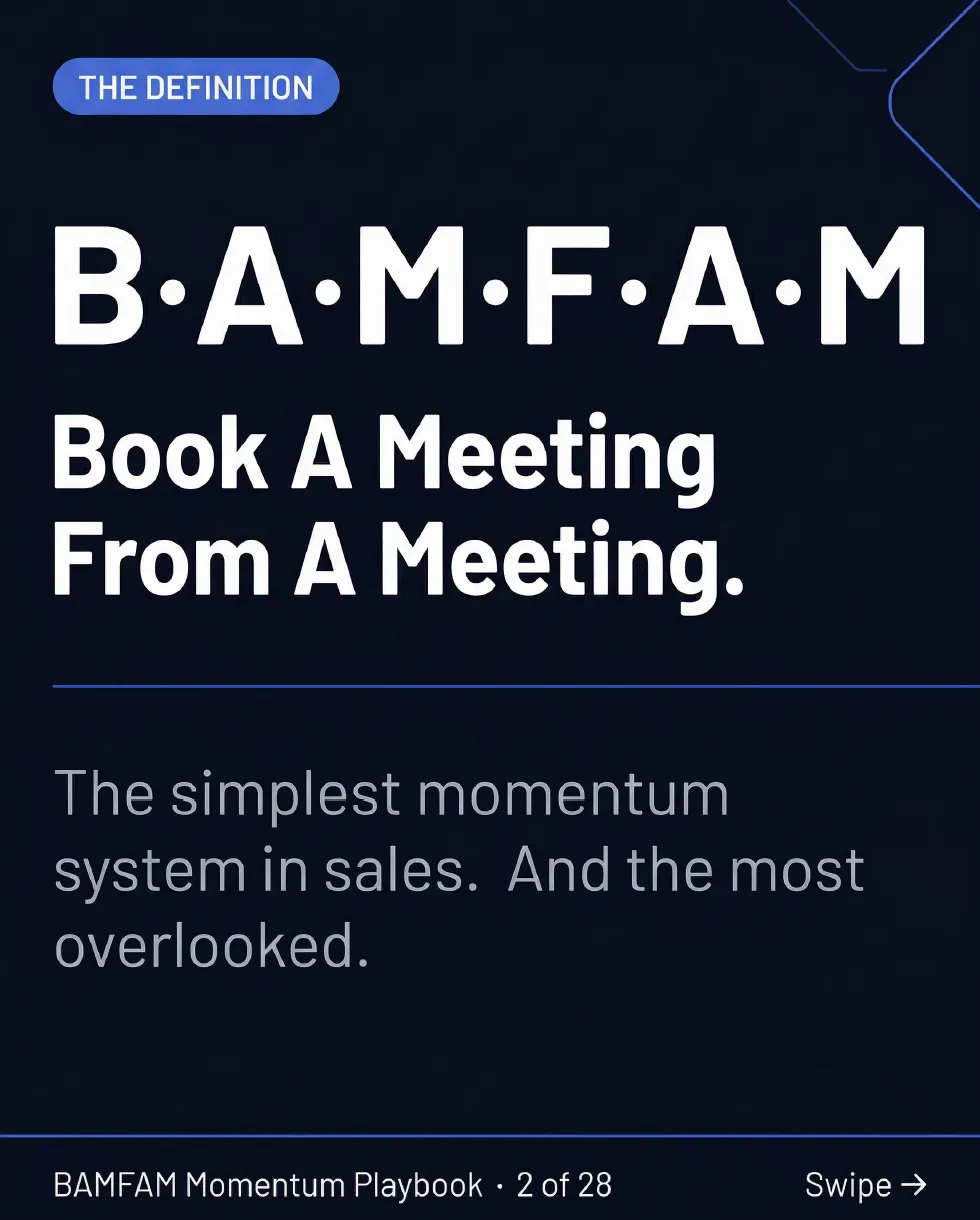
Connect • Clarify • Confirm • Calendar: The 4-Beat Playbook That Ends the Follow-Up Chase.
Discover how the BAMFAM Momentum Playbook reveals the exact strategies to:
Book the Next Meeting While You're Still in the Meeting
Turn "Let Me Get Back to You" Into a Yes (It's Friction, Not Rejection)
Kill the "Just Bumping This Up" Email Forever
Make Momentum Measurable With the Team Scorecard
Stop • Scan • Decide: The 3-Step Playbook to Win the First 51 Seconds.
Discover how the FOCUS360 Playbook reveals the exact strategies to:
FREE GPT Agent to test and build your content
Stop the Scroll on Command
Hold Attention for the First 51 Seconds:
Multiply Conversions With a Single Clear Path:
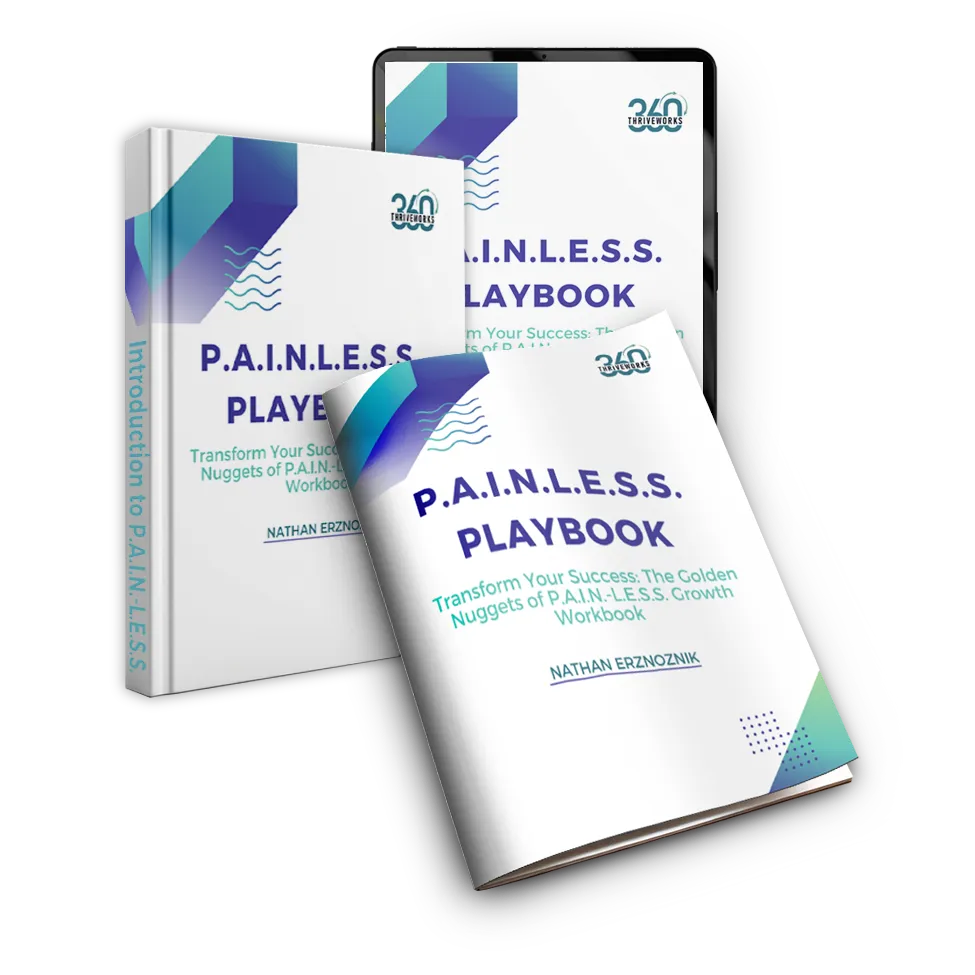
Unlock Your Business’s Full Potential – Without the Pain
Step into the realm of effortless growth with our P.A.I.N.-L.E.S.S. Playbook.
Designed for entrepreneurs who seek the "Golden Nuggets" that transform them and their businesses without the overwhelming stress. This tool shows a simple and streamlined path toward business success.
Take Control of Your Journey with Our Ultimate FREE Autopilot 360 System Masterclass and Cheat Sheet.
Build A Self-Managed Business And Break Through 6-7 Figures To 8 Figures While Seamlessly Producing Huge Profits!


Uncover Hidden Revenue in 3 Simple Steps
See more details about how this impacts business performance.
PAID COURSE
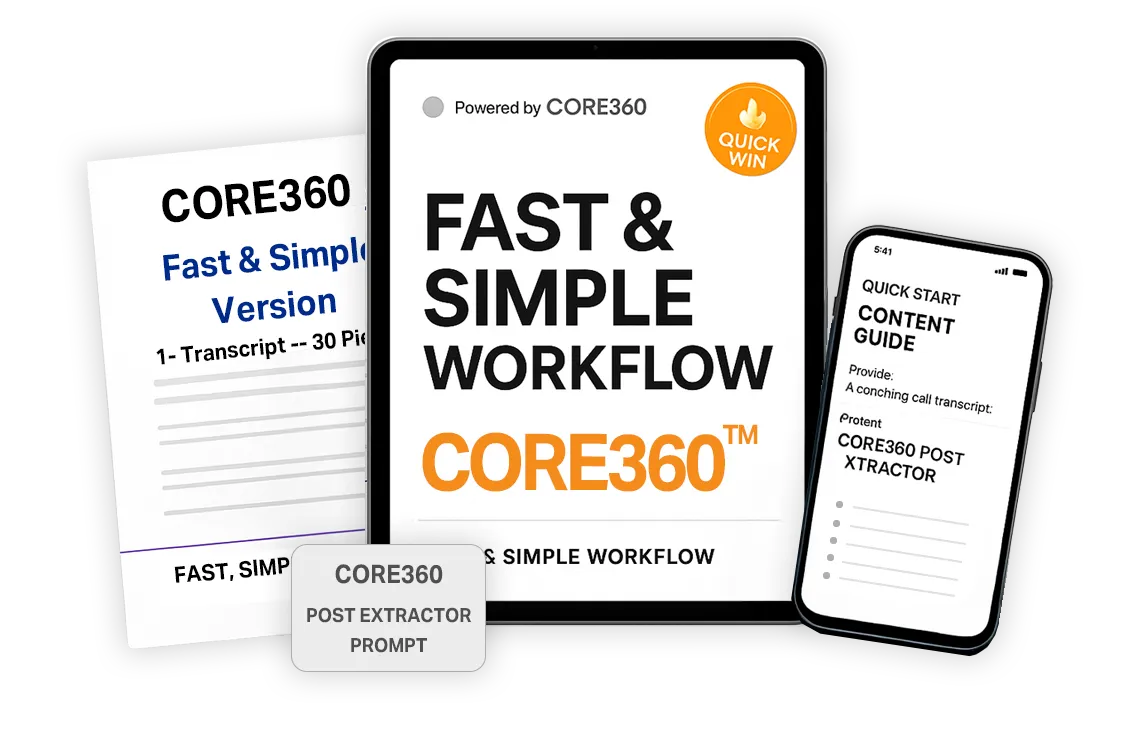
CORE360: Multiply Your Message — Without Writing a Single Word
See how to easliy increase your visibility with the CORE360 System and AI-driven Prompt Booster Pack™
Built for founders and entrepreneurs who already say brilliant things — this AI-optimized vault gives you the exact prompts to turn one voice note into days of content across Instagram, LinkedIn, TikTok, YouTube Shorts, and Facebook.
No burnout. No blank pages. Just scroll-stopping content formulas that match your voice and work on every platform.
A simple upgrade with exponential reach.
BLOG
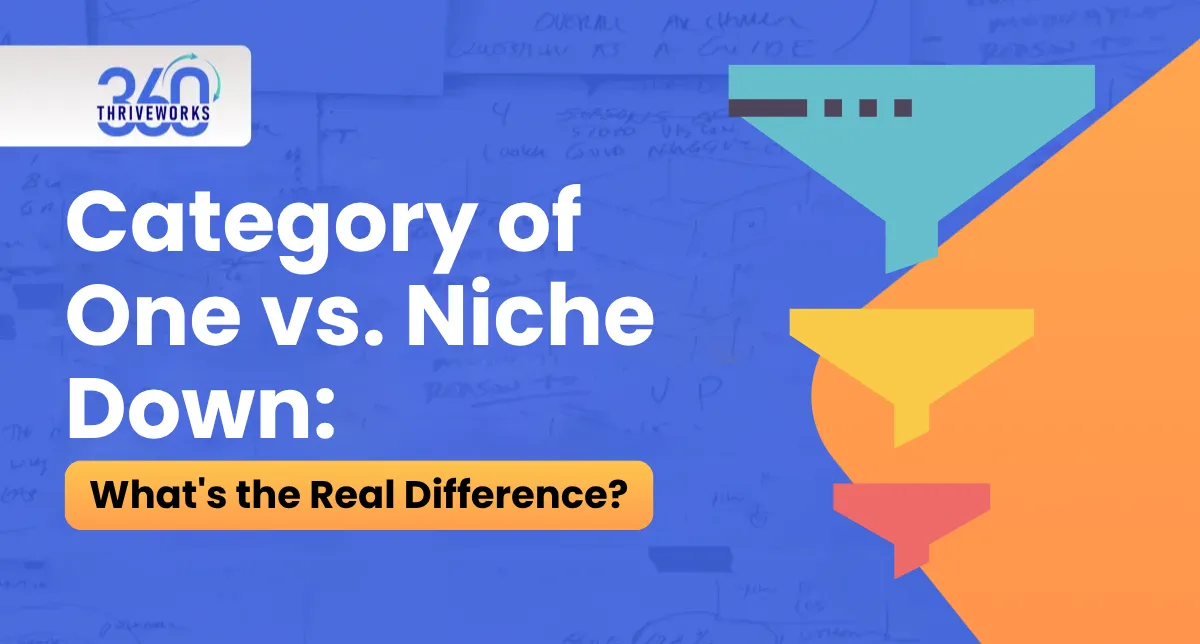
Category of One vs. Niche Down: What's the Real Difference?
Narrowing your audience tells the market who you serve. It doesn't tell them why you're the only real choice. Those are two different jobs.
You followed the advice.
You narrowed your audience. You picked an industry. You updated the website so anyone could see exactly who you serve.
And prospects are still comparing your prices.
They still ask how you're different from three other companies that seem to do the same thing. Your proposals still get lined up side by side. Your team is still explaining why you cost more.
That's usually the moment a founder starts wondering if the business needs to niche down even further. Maybe the audience is still too broad. Maybe you need a smaller industry, a tighter customer type, a narrower service.
Sometimes that helps.
But often the problem isn't that your niche is too broad. It's that a niche and a Category of One are not the same thing.
Niching down changes the market you compete in. Building a Category of One changes what you're competing on.
That difference matters. One makes your business more relevant while still leaving you open to price comparison. The other gives buyers a reason to see you as the only logical fit.
What Niching Down Actually Means
Niching down means picking a more specific market to serve.
Instead of offering marketing to every kind of company, an agency focuses on manufacturers. Instead of financial consulting for all small businesses, a firm works only with construction companies.
The logic is solid. A narrower audience sharpens your message. Your team understands the buyer more deeply. Referrals improve, services get tighter, and you waste less marketing effort.
A niche answers an important question: who do we serve?
That clarity is genuinely valuable. But it doesn't automatically answer the next question, which is the one buyers actually care about: why should we pick you over another company serving the same niche?
That's where a lot of niche strategies run out of road.
Because once a market looks attractive, more companies start specializing in it. Before long you've got several competitors using the same industry language, naming the same pain points, and making nearly identical promises. Everyone understands the customer. Everyone claims deep expertise. Everyone offers personalized service, measurable results, and a proven process.
The niche gets crowded, even though the niche is narrow.
Why Niching Down Doesn't End Price Competition
Picture five agencies that all specialize in marketing for manufacturers.
Each one offers websites, SEO, content, paid ads, and lead generation. Each one says it understands long sales cycles and complex products.
To a buyer, they might look different in style, team size, or polish. Strategically, they're still easy to compare. The buyer can line up services, prices, timelines, case studies, and team experience in a spreadsheet.
And once a buyer can drop several businesses into the same mental box, price becomes the easiest way to pick between them.
That doesn't mean the cheapest always wins. It means every company in that box has to keep justifying why it deserves more. Over and over.
That's the hidden limit of niching down. A niche can shrink the number of competitors you face. It doesn't remove the comparison.
So What Is a Category of One?
A Category of One isn't a smaller niche, a clever slogan, or a claim that you're better.
It's a market position that makes direct comparison hard, because the company brings several things together in a way competitors don't. A clearly defined buyer. A high-value problem. A distinct point of view. A specialized method. A specific outcome.
Put together, those create a position the buyer can grasp and remember.
Take that manufacturing agency. Instead of positioning as a full-service agency for manufacturers, it becomes the company that helps complex manufacturers shorten long B2B sales cycles through a buyer-education system built for technical products.
More specific, yes. But specificity isn't the whole story.
The agency has stopped competing on a list of marketing services. It's organized itself around a valuable problem, a distinct approach, and a measurable result. The buyer stops asking "which manufacturing marketing agency should we use?" and starts asking "who actually understands how to shorten a technical sales cycle?"
That shift is where a Category of One begins.
Niche Down vs. Category of One, Side by Side
The cleanest way to see it is to look at the job each one does.
Niching down defines your audience. It tells the market who you're built to serve. A Category of One defines your relevance. It tells the market why you're uniquely suited to solve a specific problem.
Niching shrinks the competitive field. You stop competing with every generalist. A Category of One changes the comparison. You get harder to judge by the same criteria as everyone else.
Niching improves focus. Your marketing, delivery, and customer understanding all get more concentrated. A Category of One improves preference. The buyer sees a real link between your expertise, your method, and the result they want.
Niching may support higher prices. Specialists usually charge more than generalists. A Category of One helps you defend those prices. The buyer is paying for a specific approach and outcome, not a familiar bundle of services.
A strong business often uses both. A niche can be an important piece of a Category of One. It's just the starting point, not the finished position.
The Common Mistake: Calling Familiarity "Differentiation"
Plenty of businesses mistake familiarity for differentiation.
They know the industry. They use the right terms. They understand the buyer's headaches. They may have years of experience with exactly this kind of customer.
All of that builds credibility. None of it creates separation.
Here's a quick test. Take your company name off your positioning statement. Could a competitor make the same claim word for word?
Think about lines like these. We provide customized solutions. We become an extension of your team. We deliver measurable results. We combine strategy with execution. We put the customer first.
They might all be true. The trouble is they're also true for thousands of other companies, so they give the buyer nothing to decide with.
Real differentiation isn't a louder claim. It's a clearer position.
The Five Pieces of a Category of One
A strong position usually pulls five decisions together.
1. The right customer. Not every buyer is equally valuable or equally suited to how you work. Start with the customers who get the most out of your particular way of doing things.
2. The right problem. Broad problems invite broad competition. "Helping companies grow" sounds good and is far too vague to own. Something sharper, like reducing the revenue leaking out of disconnected sales and operations systems, gives you something real to stand on.
3. A distinct point of view. You need a clear belief about why the problem exists and why the usual fixes fail. That's what shows buyers you don't just do the work differently. You see the problem differently.
4. A recognizable method. A defined process makes expertise tangible. It proves the result isn't luck, improvisation, or a pile of loosely related services. You have a structured way to diagnose the problem and move the customer forward.
5. A valuable outcome. The position has to connect to something the buyer genuinely wants. Stronger margins. Shorter sales cycles. Cleaner operations. Less risk. Better retention. Higher-quality growth.
When those five reinforce each other, the business gets hard to compare. That's the point.
How Position DNA Builds the Category
This is where Position DNA comes in.
Position DNA isn't about inventing a dramatic new identity or forcing your business into some artificial category. It's about finding the credible position already sitting inside your strengths, your customer insight, your point of view, your process, and your results. The work usually happens in three stages.
Stabilize the current position. Start by finding where you sound generic. Read your website, your proposals, your service descriptions, and listen to your sales conversations. Hunt for the claims a competitor could copy without changing a word. This stage strips out the language that makes you look interchangeable.
Catalyze the difference. Then get clear on the customer, the problem, the perspective, the method, and the transformation you can credibly own. This isn't only a messaging exercise. It may mean refining the offer, repackaging services, or rebuilding the sales process around a more valuable problem.
Maximize the position. A Category of One can't live on your homepage alone. The position should shape your content, your pricing, your sales conversations, your customer experience, your partnerships, and how you build new offers. Consistency is what turns a marketing message into an actual business advantage.
Do You Have a Niche or a Category?
Five questions will tell you.
Can a prospect clearly explain why you're different?
Do prospects compare you mainly on price and deliverables?
Could several competitors use your positioning statement?
Do you have a clear point of view on why the customer's problem exists?
Is your method tied to a specific, valuable result?
If most of your answers circle back to your services, your industry, or your years of experience, you've got a niche. If they reveal a distinct customer, problem, perspective, method, and outcome, you're building a Category of One.
You Don't Need to Invent a New Industry
"Category of One" can sound bigger than it needs to be.
It doesn't mean creating a market nobody's heard of. It doesn't mean claiming you have no competitors, which nobody believes anyway. And it definitely doesn't mean walking away from a profitable niche.
It means building a position that helps the right buyer understand why you're uniquely relevant to their situation.
Your competitors still exist. They just stop feeling equivalent.
Stop Narrowing. Start Differentiating.
Niching down is often a smart move. It creates focus, improves relevance, and builds deeper expertise.
But there's a point where narrowing further gives you less and less back. You end up serving fewer people without becoming any more distinctive. That's the trap, and it's an easy one to fall into, because narrowing feels like progress.
A Category of One takes the next step. It turns specialization into a position buyers can understand, value, and prefer.
The question stops being "who do we serve?" It becomes something better. What do we understand, believe, and deliver in a way the right customer can't easily find anywhere else?
That's the foundation of Position DNA. And it's how a business stops fighting to look better inside someone else's category and starts owning one of its own.
Already niched down and still getting compared on price? Then the issue probably isn't your market. It's your position. Book a free 30-minute discovery call and we'll map out where your positioning still sounds interchangeable and what it would take to own a category buyers can't compare you out of.
ThriveWorks360

Free Weekly Productivity Insights
Sign up for Sunday Snippets - my weekly newsletter where I I share actionable productivity tips, practical life advice, and high-quality insights from across the web, directly to your inbox.
What People Are Saying

Driving Growth, Amplifying Impact

Grace Company

8th to 2nd most recognized brands in the industry in one year

J&B Sewing
Launched new product line and grew 300% in two years

Sewrite
Increased national distribution, D2C Revenue by 400%.
Get In Touch
Email: [email protected]
Address
Office: 14881 S. Auburn Sky Dr
Assistance Hours
Mon – Sat 9:00am – 8:00pm
Sunday – CLOSED
Phone Number:
(888) 870-7314
Contact Us:
BECOME AN TW360 INSIDER
Sign up for exlcusive content, emails, & things Nathan doesn't share anywhere else.
Unleash Your Business Brilliance.
Reach out and connect for your opportunity to shine!
© 2026 ThriveWorks360 - All Rights Reserved, copyright 2024