FREE Tools
Select from below to learn more!
Free Tools
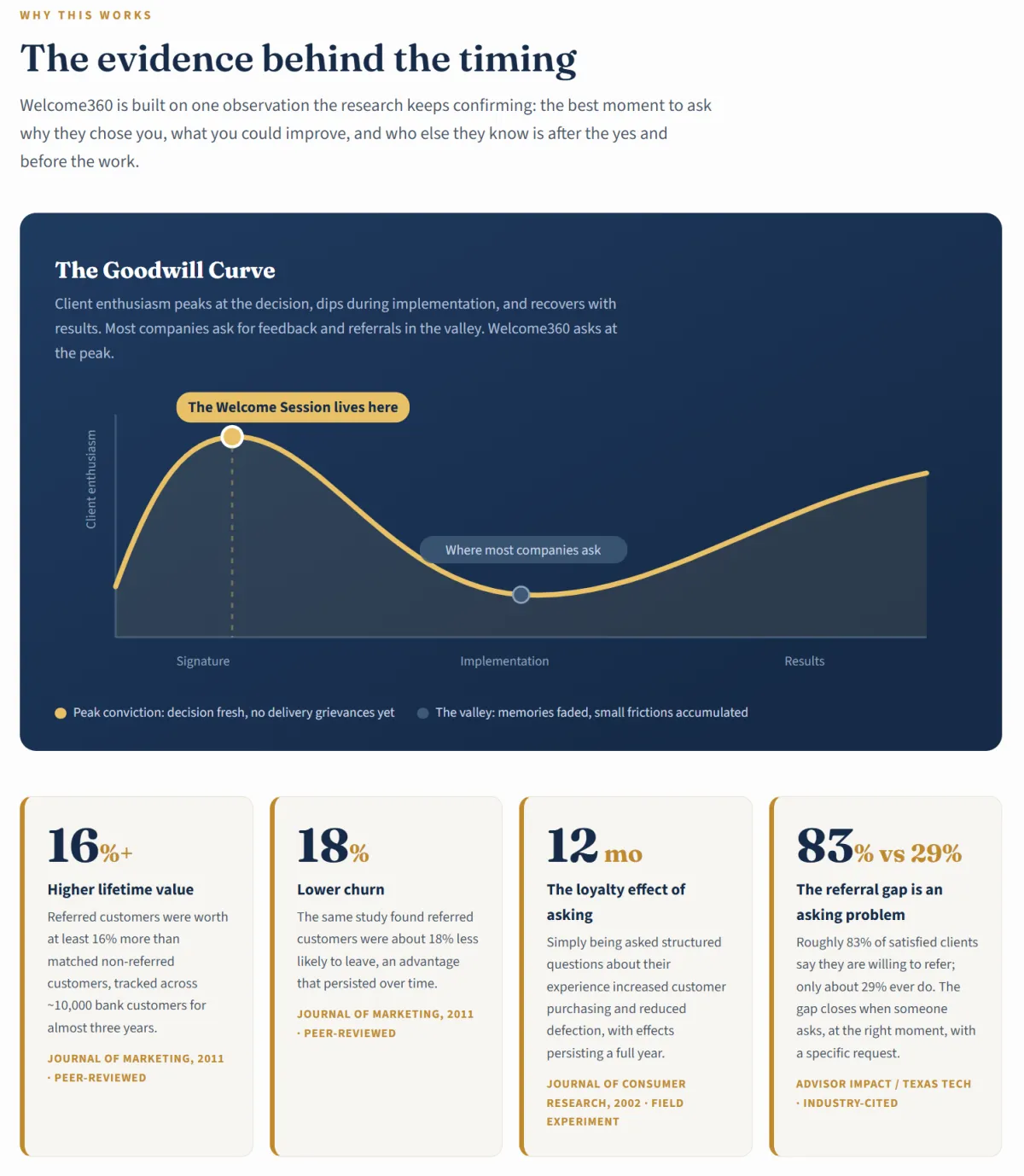
Welcome360 • A Client Growth System: The 45-Minute Meeting That Turns Every New Client Into Referrals.
Discover how the Welcome360 System reveals the exact strategies to:
Ask for Referrals at Peak Goodwill — Before the Honeymoon Ever Fades
FREE AI Insight Miner: Turn One Client Conversation Into 7 Finished Business Assets
Capture the Exact Words Clients Use to Sell You (Then Reuse Them Everywhere)
Close the Feedback Loop That Makes Clients Refer Twice
Sellthrough360 - Flows, Bundling, Upselling Systems for Revenue Generation
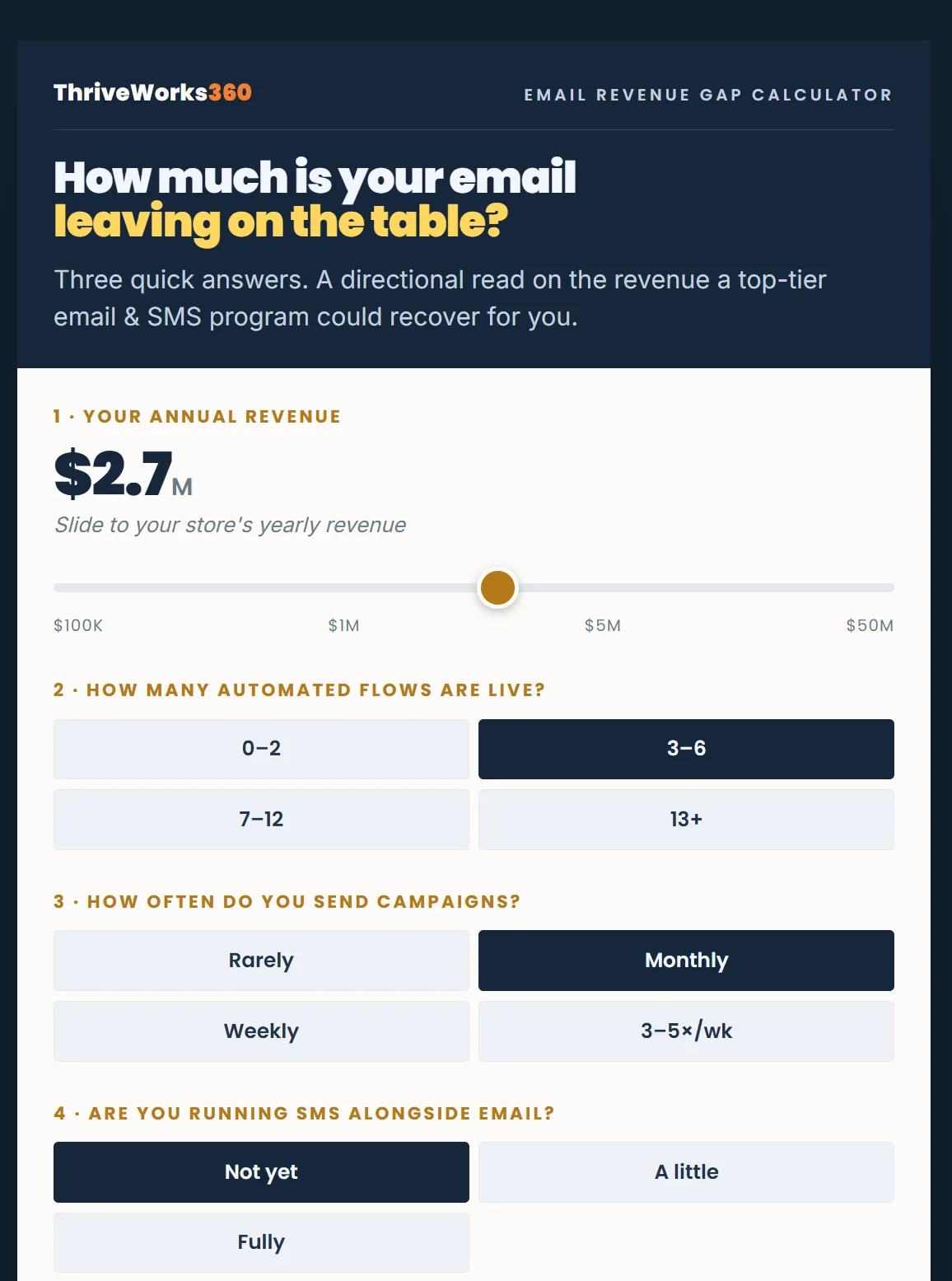
How much is your email leaving on the table?
Three quick answers. A directional read on the revenue a top-tier email & SMS program could recover for you.
Your annual revenue
How many automated flows are live?
How often do you send campaigns?
Are you running SMS alongside email?
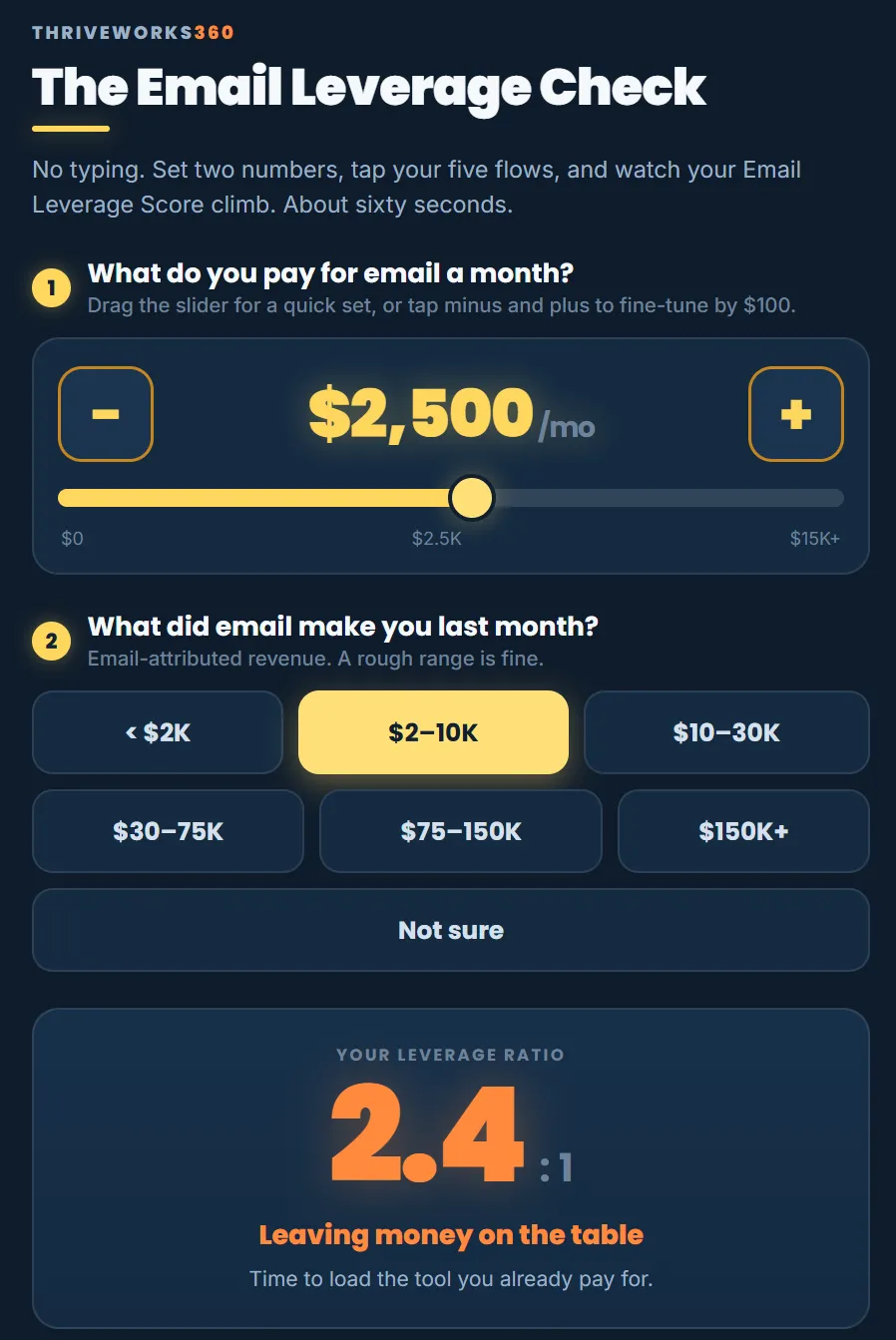
The Email Leverage Check
No typing. Set two numbers, tap your five flows, and watch your Email Leverage Score climb. About sixty seconds.
What do you pay for email a month?
What did email make you last month?
Which of these 5 are running?
Download a printable form
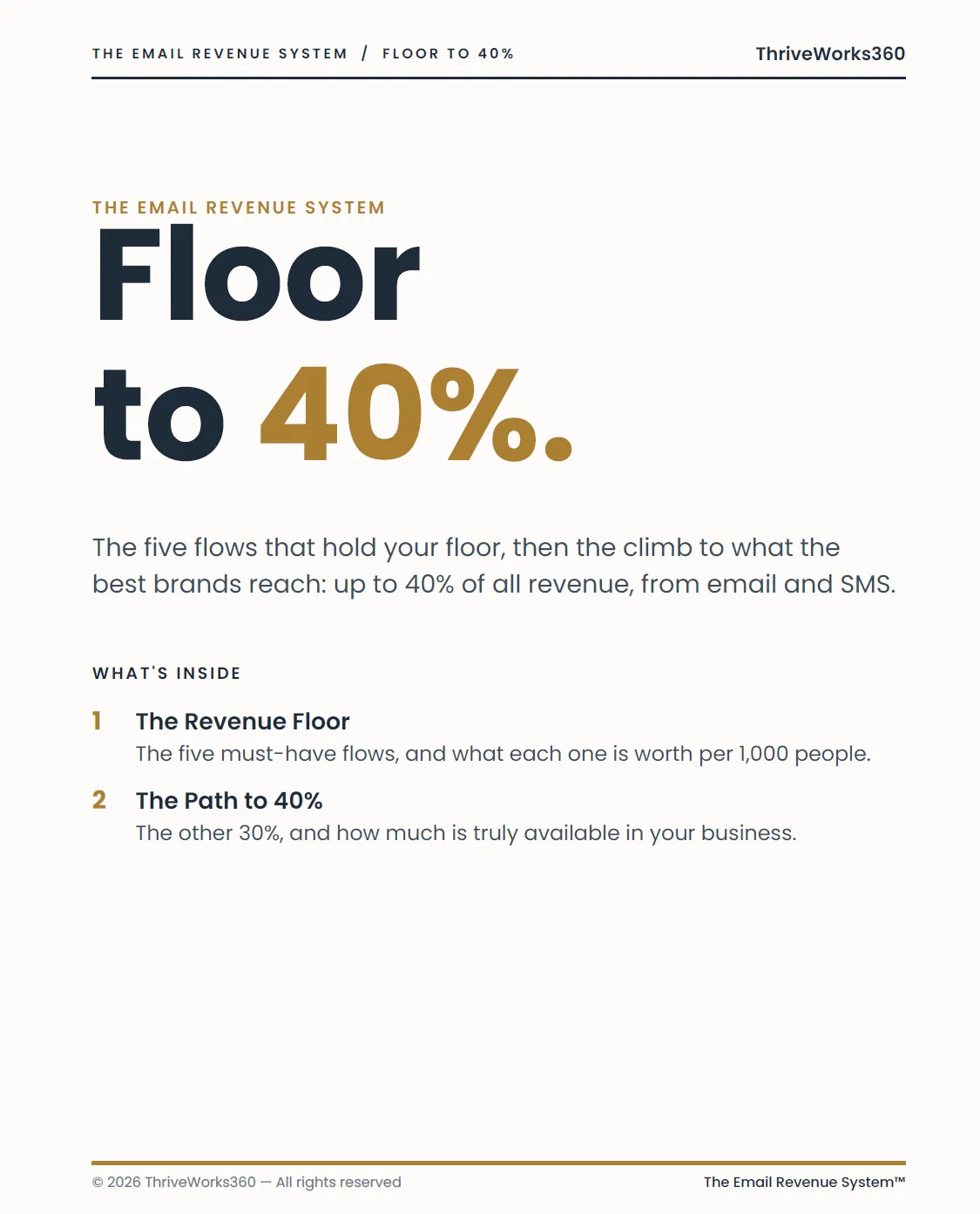
The Email Revenue System Floor to 40%.
The five flows that hold your floor, then the climb to what the best brands reach: up to 40% of all revenue, from email and SMS.
The Revenue Floor - The five must-have flows, and what each one is worth per 1,000 people.What did email make you last month?
The Path to 40% - The other 30%, and how much is truly available in your business.

See the money already in your business, climbing in real time.
Slide in your two numbers, then answer 15 quick questions. Watch the dollar figure move as you go. By the end, you'll know your biggest pocket of found money, the fastest switches to flip, and roughly what it's worth — before you spend a cent on new ads.
Your List
Your Automations
Your Repeat Buyers
Your Offers & Pricing
Your Between-Launch Revenue
Answer all 15 to lock your result
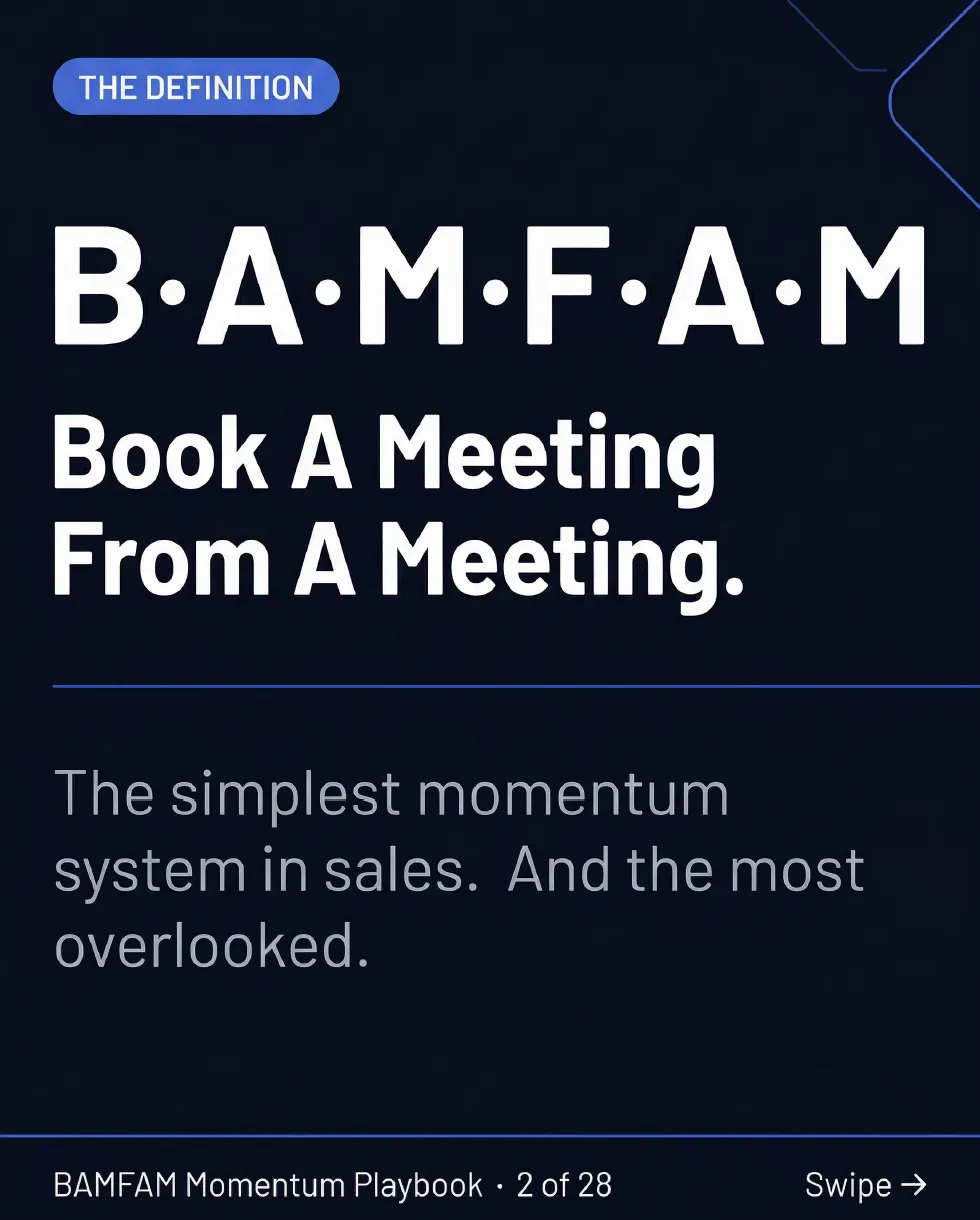
Connect • Clarify • Confirm • Calendar: The 4-Beat Playbook That Ends the Follow-Up Chase.
Discover how the BAMFAM Momentum Playbook reveals the exact strategies to:
Book the Next Meeting While You're Still in the Meeting
Turn "Let Me Get Back to You" Into a Yes (It's Friction, Not Rejection)
Kill the "Just Bumping This Up" Email Forever
Make Momentum Measurable With the Team Scorecard
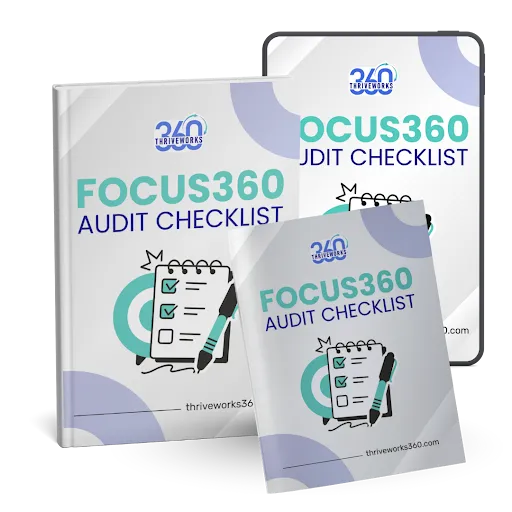
Stop • Scan • Decide: The 3-Step Playbook to Win the First 51 Seconds.
Discover how the FOCUS360 Playbook reveals the exact strategies to:
FREE GPT Agent to test and build your content
Stop the Scroll on Command
Hold Attention for the First 51 Seconds:
Multiply Conversions With a Single Clear Path:
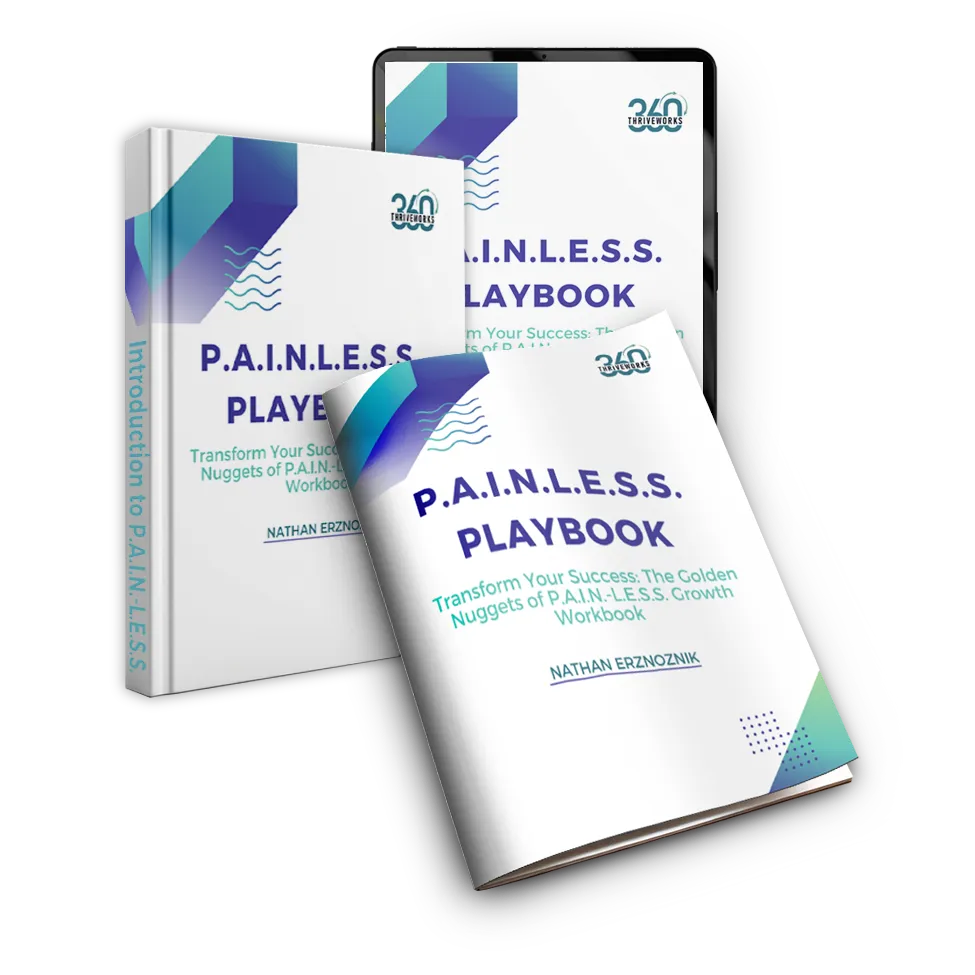
Unlock Your Business’s Full Potential – Without the Pain
Step into the realm of effortless growth with our P.A.I.N.-L.E.S.S. Playbook.
Designed for entrepreneurs who seek the "Golden Nuggets" that transform them and their businesses without the overwhelming stress. This tool shows a simple and streamlined path toward business success.
Take Control of Your Journey with Our Ultimate FREE Autopilot 360 System Masterclass and Cheat Sheet.
Build A Self-Managed Business And Break Through 6-7 Figures To 8 Figures While Seamlessly Producing Huge Profits!


Uncover Hidden Revenue in 3 Simple Steps
See more details about how this impacts business performance.
PAID COURSE
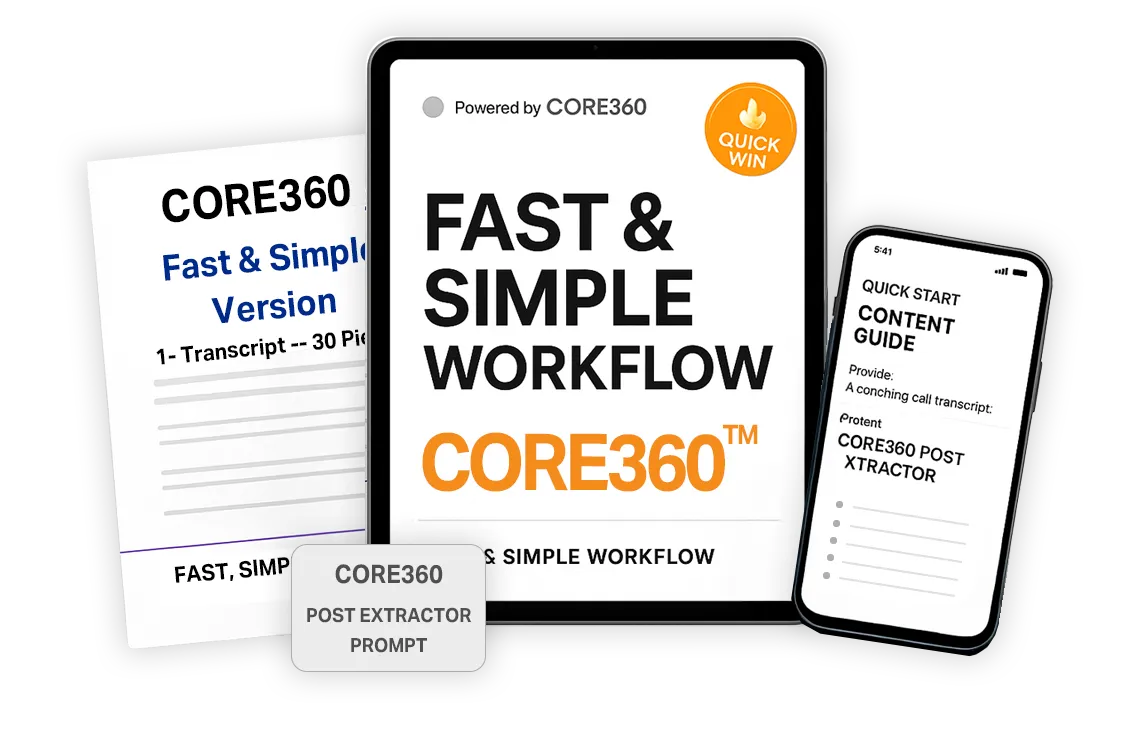
CORE360: Multiply Your Message — Without Writing a Single Word
See how to easliy increase your visibility with the CORE360 System and AI-driven Prompt Booster Pack™
Built for founders and entrepreneurs who already say brilliant things — this AI-optimized vault gives you the exact prompts to turn one voice note into days of content across Instagram, LinkedIn, TikTok, YouTube Shorts, and Facebook.
No burnout. No blank pages. Just scroll-stopping content formulas that match your voice and work on every platform.
A simple upgrade with exponential reach.
BLOG
AutoPilot Isn't Automation: The Difference That Actually Matters
Automation makes actions happen faster. Systems make sure the right actions happen. Bolt one onto a business without the other, and you just speed up the chaos.
You bought the software.
You connected the apps. You built the automated emails, the task reminders, the dashboards, the forms, the workflows.
So why does your business still need you to keep everything moving?
Why do employees still ask what happens next? Why do client handoffs still break? Why do you still have to jump in the moment something falls outside the "normal" path?
Because automation and autopilot are not the same thing.
Automation can move information, create tasks, send notifications, and knock out repetitive actions. What it can't do is decide how your business should operate. It can't repair unclear responsibilities. It can't replace missing standards. And it can't turn the knowledge locked in your head into a reliable way of working.
That's the real issue underneath automation versus systems.
Automation makes actions happen faster. Systems make sure the right actions happen, in the right order, for the right reason. Without the system, automation just helps the chaos move faster.
Why More Automation Hasn't Made Things Easier
Most growing businesses hit the same frustrating stage. The company has more tools than ever, and the work still feels heavy.
Sales lives in a CRM. Delivery runs on project software. Finance has its accounting tools. Marketing has automated campaigns. Internal communication is scattered across email, chat, spreadsheets, and shared docs.
On paper, the business looks modern. Inside, people are still running on memory.
One person knows how to handle a difficult client. Another knows which steps can be skipped when a deadline is tight. You know how to approve the unusual request, sort out the pricing problem, and catch trouble before it gets expensive.
The tools automate parts of the work. But the business still leans on judgment that lives in people's heads and has never been written down as a shared system. That's why adding one more app rarely fixes the real problem. You don't need more technology. You need more clarity about how work should move through the business.
The Core Difference
It gets easier to see once you look at what each one is built to do.
Automation performs an action with less manual effort. A system defines how a result should be produced, the same way, every time.
An automation can send a welcome email when a new client signs. A system answers the bigger questions. Who confirms the signed agreement? What has to pass from sales to delivery? Who owns the relationship after the sale? What must be done before the kickoff call? What happens when key information is missing? How do you even know the client is ready to begin?
The email is one automated action. The whole onboarding process is the system.
This matters because a business can't run on autopilot when only isolated tasks are automated. It needs connected systems that guide the people, the decisions, the handoffs, and the outcomes.
What a Real System Actually Includes
A real system is more than a checklist or an SOP buried in a folder. A useful one defines a few things clearly.
It needs a trigger. Something has to start the process. It needs an owner. Someone is responsible for the outcome, not just their one task. It needs a sequence, so the team knows what comes first, what follows, and what can't move forward until a requirement is met. It needs standards, so people know what "complete," "approved," and "ready" actually mean. It needs decision rules for when a situation doesn't match the usual path. It needs clean handoffs, so information and responsibility move clearly from one person to the next. And it needs a result you can measure, so you can tell whether the thing is even working.
Miss those, and a workflow can look organized while still depending on constant interpretation. That's not autopilot. That's a pile of tasks held together by experienced people and founder rescue.
What Happens When You Automate a Broken Process
Picture a professional services firm that wants to fix its client onboarding. Deadlines get missed. Information gets lost between sales and delivery. Clients keep repeating details they already gave.
So the company adds automation. A signed proposal creates a project. The project fires off a welcome email. Tasks get assigned to the delivery team. A reminder nudges the account manager to book the kickoff call. Everything happens fast.
But sales still doesn't collect the same information every time. Nobody agrees on when a project is actually ready for delivery. The account manager assumes operations reviewed the scope. Operations assumes sales explained the timeline. And the welcome email goes out before anyone is prepared.
The company didn't solve the onboarding problem. It sped it up. Now the confusion reaches the client sooner.
That's the biggest risk in this whole conversation. Automation can make a weak process look advanced while hiding the fact that the logic underneath is still broken.
Six Signs You're Automating Chaos
You might be automating chaos when:
Employees get automated tasks and still ask what they're supposed to do.
The same process gives different results depending on who runs it.
Automations regularly need manual fixes and workarounds.
Big decisions still wait for you, even with the workflow running.
Teams use different definitions of "done."
Nobody owns the whole process from start to result.
These aren't really software problems. They're signs the business hasn't defined its own operating rules clearly enough. The fix isn't to automate more steps. It's to build the system those steps are supposed to support.
Build the System Before You Automate It
A better order starts with the outcome, not the tool.
Clarify the result you want. Start with what the process has to achieve. Not "send the client an email." The real result might be: every new client enters delivery with a confirmed scope, clear expectations, complete information, and an assigned owner. That gives the system a direction.
Map what actually happens now. Write down the real process, including the informal steps. Notice where people pause, make judgment calls, hunt for information, fix mistakes, or wait on approval. The messy spots are usually where the most important system decisions are hiding.
Define ownership. Every process needs one person accountable for the result. Plenty of people can do tasks, but one person should be able to see whether it's moving, where it's stuck, and what needs attention. Shared responsibility has a way of becoming no responsibility.
Set standards and decision rules. Your team should know what good looks like and how to handle the common exceptions. When should a project stop? When can someone proceed without approval? What information is required? What has to be escalated? These rules quietly cut down how often people come to you, because they stop needing to ask the same questions.
Measure it. Pick a few useful signals. Onboarding time, errors, missed handoffs, rework, client questions, decisions kicked up to leadership. Measurement is how you know the system is producing what you wanted.
Then automate the repeatable parts. Only once the process is clear should you automate it. Now automation gets powerful, because it's supporting a system the team already understands. It can assign tasks, move information, send reminders, update records, generate documents, and flag anything that falls outside the expected path. The technology isn't trying to create order anymore. It's reinforcing order that already exists.
What a Business on Autopilot Really Looks Like
Autopilot isn't a business without people. It isn't the founder vanishing while software runs everything.
It's a business where the routine work doesn't depend on constant rescue. People know what they own. They know the standards. Information moves cleanly between roles. Common decisions follow clear rules. And leaders spend their time on exceptions, improvement, and strategy instead of solving the same operational problem for the hundredth time.
That's a more honest definition of autopilot. You may still be involved. The business just doesn't stop every time you step away.
Where Expression DNA Fits
This is where Expression DNA comes in.
Before a business can build reliable systems, it needs to be clear about how it expresses its value through its decisions, its communication, its service, and its customer experience. You can't standardize a process well when you haven't defined what that process is meant to protect. What should every client experience? How should the team communicate when something goes wrong? Which standards are non-negotiable? What should people be able to decide without you?
Expression DNA turns those expectations into a shared foundation. You start by stabilizing the areas that run on memory, personal preference, or founder rescue. Then you turn those expectations into clearer systems, roles, and decision rules. And once those systems are reliable, automation can add speed and capacity without watering down the experience you're trying to deliver.
The goal was never more automation. It's a business that knows how it should operate before it asks software to operate it faster.
A Quick Systems Readiness Check
Before you automate your next process, ask yourself six questions. Can we explain the result we want clearly? Does the process have one accountable owner? Are the steps consistent no matter who runs them? Have we defined what "done" means? Do people know how to handle the common exceptions? Can we measure whether it's working?
If several answers are no, the process probably isn't ready to automate. That's not a reason to delay improvement. It's a reason to fix the right layer first.
Build Autopilot From the Inside Out
The biggest mistake businesses make is treating autopilot like a purchase. It isn't.
Autopilot is what you get from clear expectations, repeatable systems, defined ownership, useful decision rules, and carefully chosen automation. Software can support that structure. It can't create it for you.
So before you connect another app or automate another workflow, look hard at the business underneath it. Is the process clear? Does the team understand it? Can it produce a reliable result without you interpreting every situation?
When the answer is yes, automation becomes a multiplier. When the answer is no, automation multiplies the confusion.
Not sure which parts of your business are real systems and which are just running on memory? Grab the free AutoPilot 360 Masterclass and Cheat Sheet — a step-by-step guide to building a self-managed business that scales from 6-7 figures to 8, without you being the glue holding every process together.
ThriveWorks360


Free Weekly Productivity Insights
Sign up for Sunday Snippets - my weekly newsletter where I I share actionable productivity tips, practical life advice, and high-quality insights from across the web, directly to your inbox.
What People Are Saying

Driving Growth, Amplifying Impact

Grace Company

8th to 2nd most recognized brands in the industry in one year

J&B Sewing
Launched new product line and grew 300% in two years

Sewrite
Increased national distribution, D2C Revenue by 400%.
Get In Touch
Email: [email protected]
Address
Office: 14881 S. Auburn Sky Dr
Assistance Hours
Mon – Sat 9:00am – 8:00pm
Sunday – CLOSED
Phone Number:
(888) 870-7314
Contact Us:
BECOME AN TW360 INSIDER
Sign up for exlcusive content, emails, & things Nathan doesn't share anywhere else.
Unleash Your Business Brilliance.
Reach out and connect for your opportunity to shine!
© 2026 ThriveWorks360 - All Rights Reserved, copyright 2024