Free Tools & Resources
Everything You Need to See What's Broken and Fix It.
These tools are used inside real $1M–$20M businesses. Pick the one that matches where you're stuck, and start there.
Free Tools
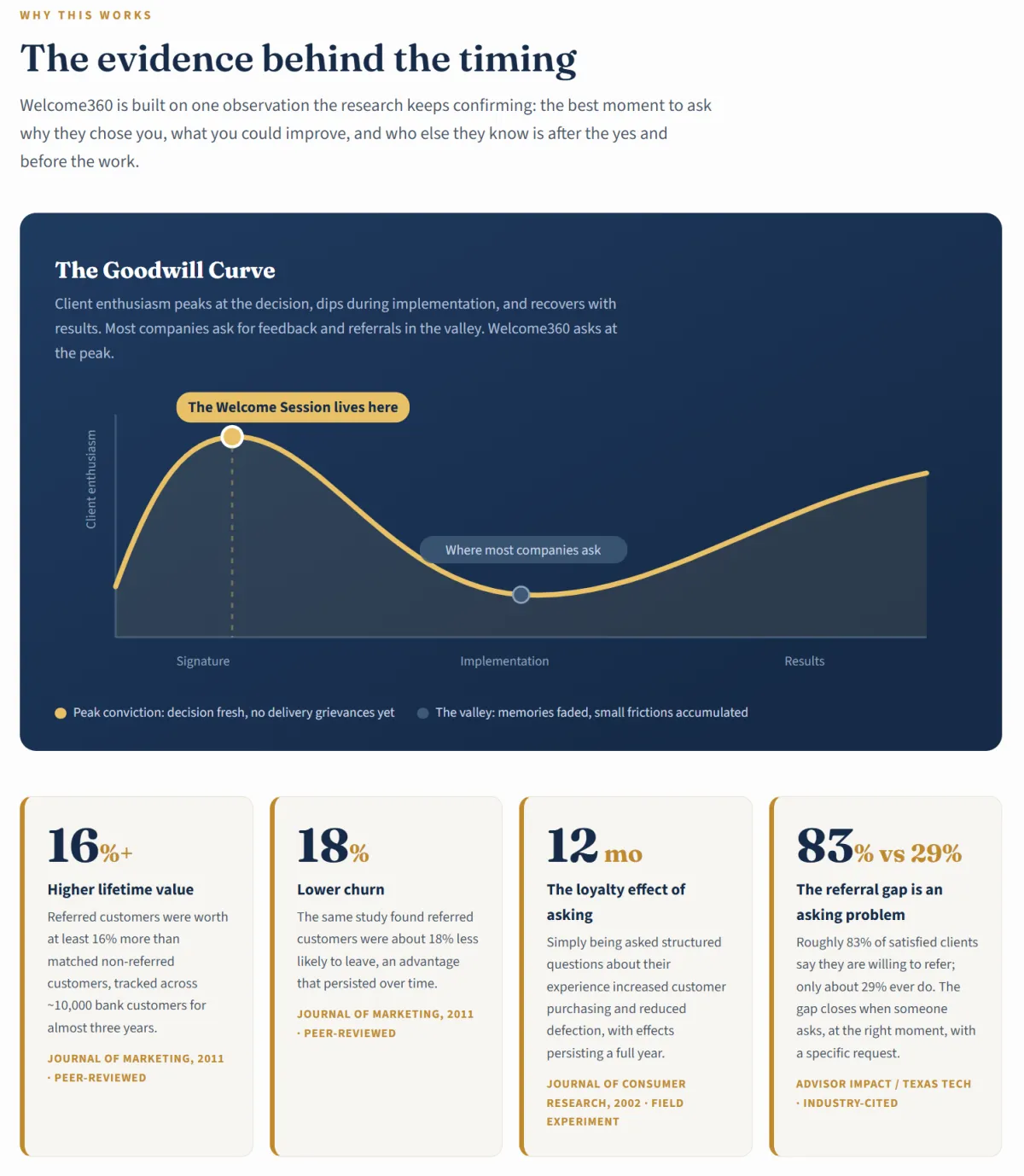
Welcome360 • A Client Growth System: The 45-Minute Meeting That Turns Every New Client Into Referrals.
Discover how the Welcome360 System reveals the exact strategies to:
Ask for Referrals at Peak Goodwill — Before the Honeymoon Ever Fades
FREE AI Insight Miner: Turn One Client Conversation Into 7 Finished Business Assets
Capture the Exact Words Clients Use to Sell You (Then Reuse Them Everywhere)
Close the Feedback Loop That Makes Clients Refer Twice
Sellthrough360 - Flows, Bundling, Upselling Systems for Revenue Generation
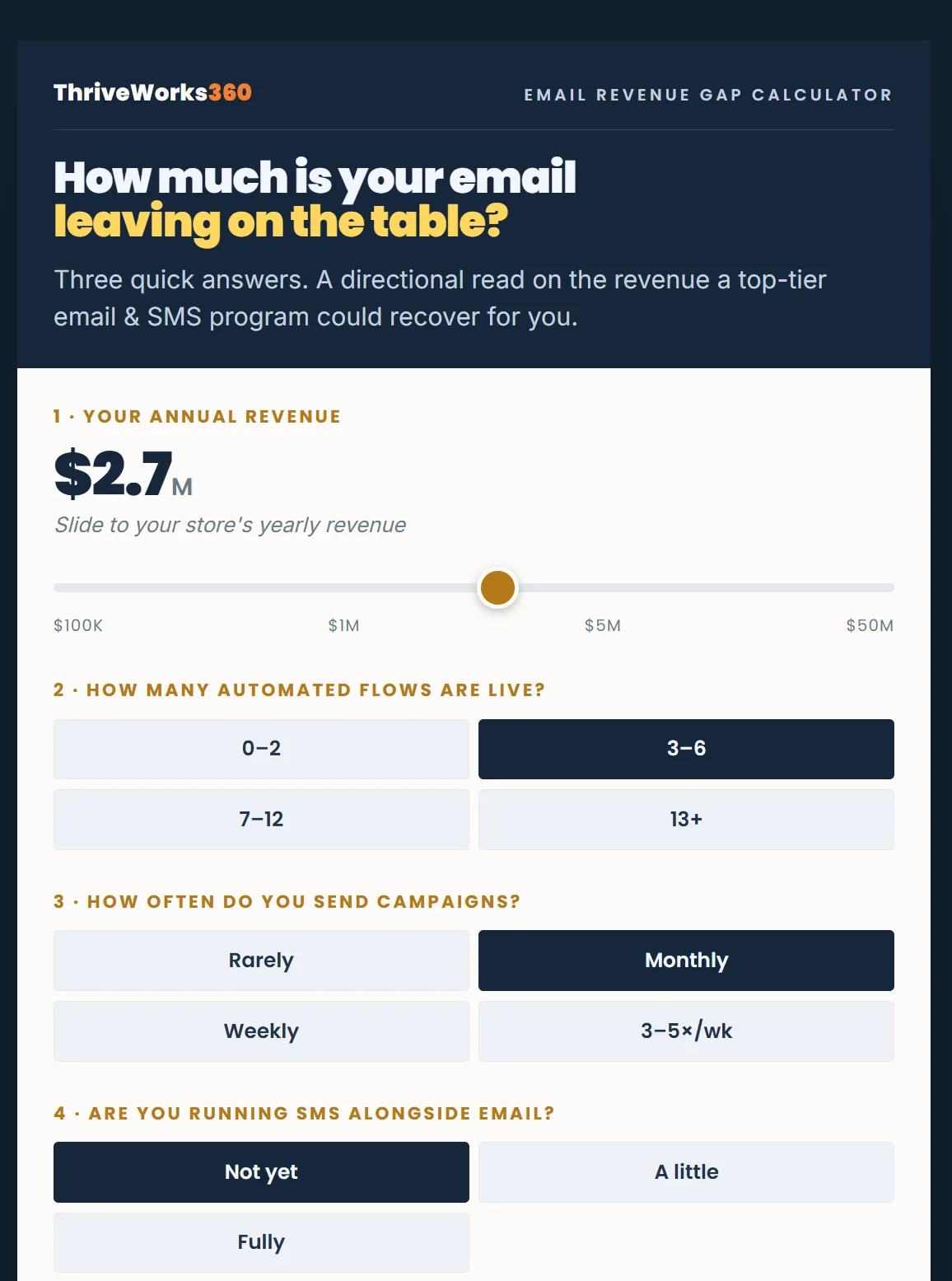
How much is your email leaving on the table?
Three quick answers. A directional read on the revenue a top-tier email & SMS program could recover for you.
Your annual revenue
How many automated flows are live?
How often do you send campaigns?
Are you running SMS alongside email?
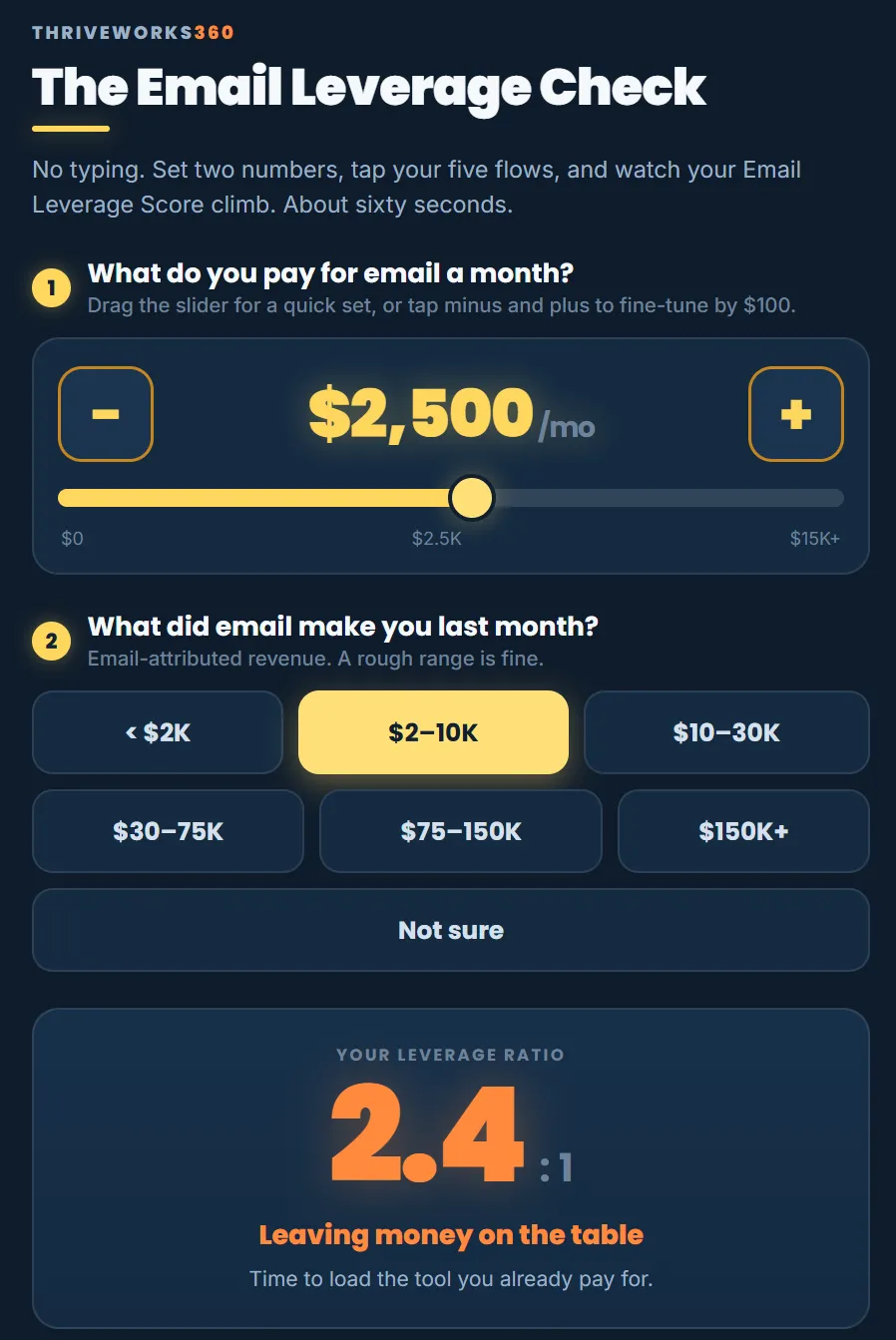
The Email Leverage Check
No typing. Set two numbers, tap your five flows, and watch your Email Leverage Score climb. About sixty seconds.
What do you pay for email a month?
What did email make you last month?
Which of these 5 are running?
Download a printable form
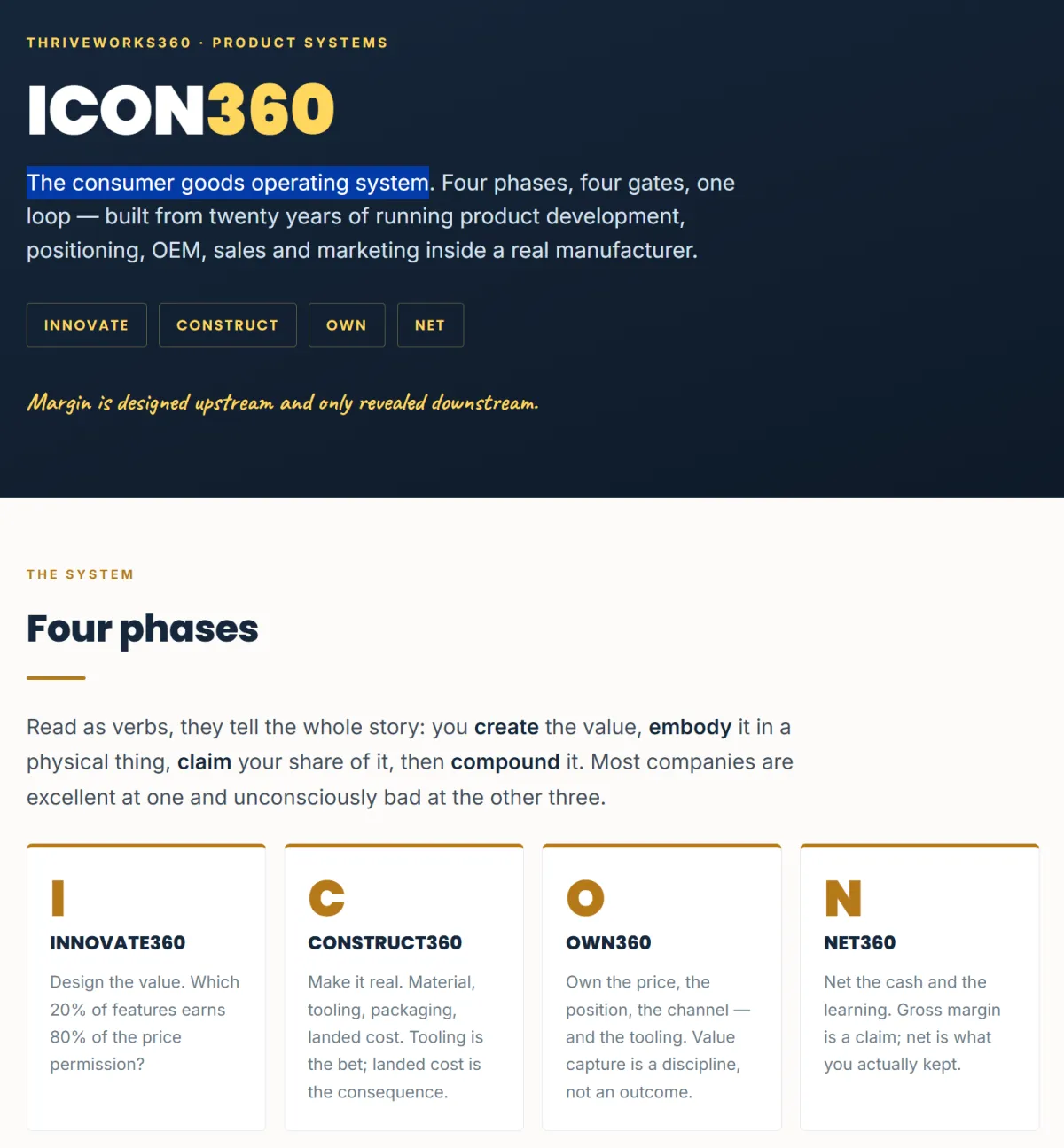
ICON360
The consumer goods operating system.
INNOVATE360 - Design the value. Which 20% of features earns 80% of the price permission?
CONSTRUCT360 - Make it real. Material, tooling, packaging, landed cost. Tooling is the bet; landed cost is the consequence.
OWN360 - Own the price, the position, the channel — and the tooling. Value capture is a discipline, not an outcome.
NET360 - Net the cash and the learning. Gross margin is a claim; net is what you actually kept.
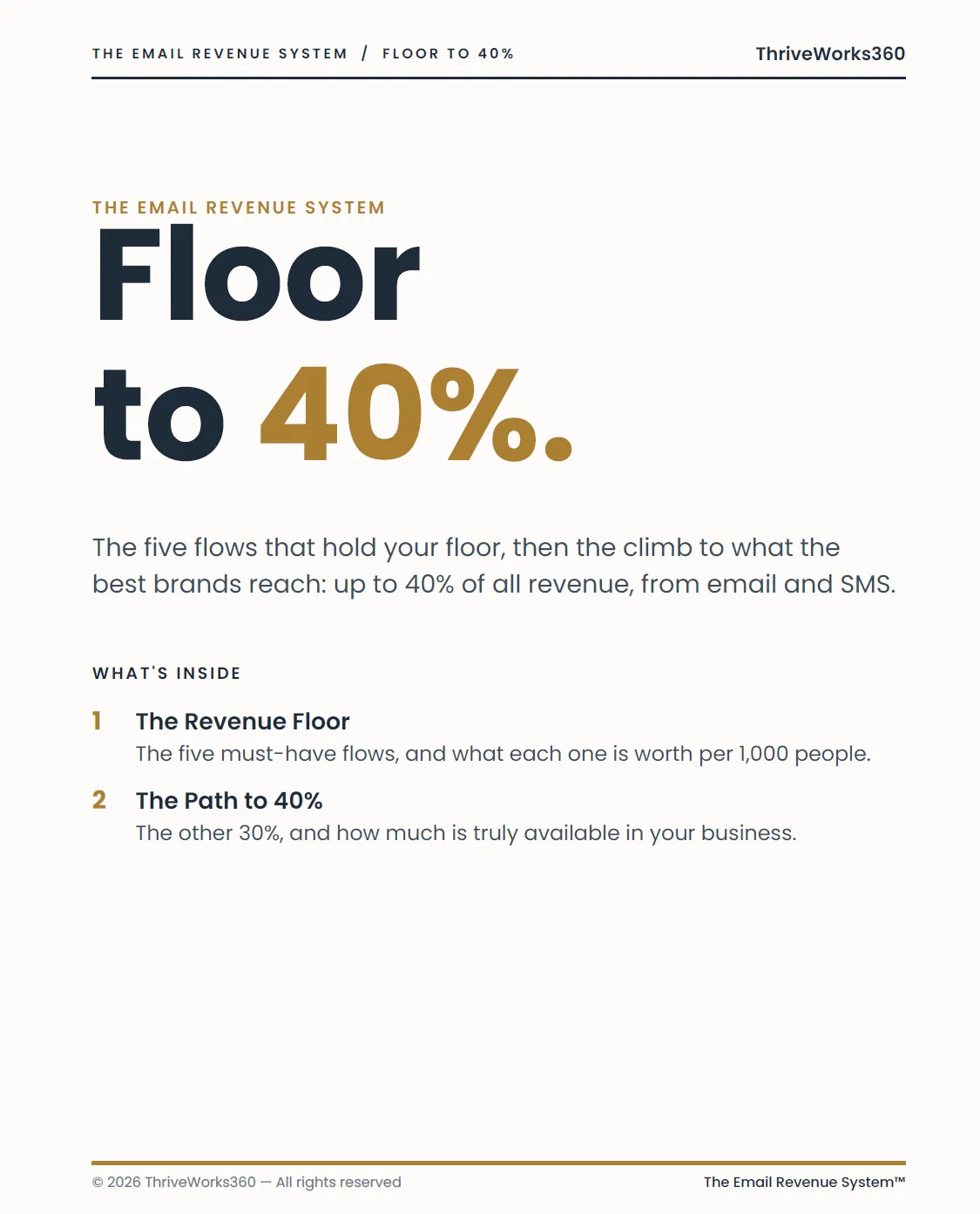
The Email Revenue System Floor to 40%.
The five flows that hold your floor, then the climb to what the best brands reach: up to 40% of all revenue, from email and SMS.
The Revenue Floor - The five must-have flows, and what each one is worth per 1,000 people.What did email make you last month?
The Path to 40% - The other 30%, and how much is truly available in your business.

See the money already in your business, climbing in real time.
Slide in your two numbers, then answer 15 quick questions. Watch the dollar figure move as you go. By the end, you'll know your biggest pocket of found money, the fastest switches to flip, and roughly what it's worth — before you spend a cent on new ads.
Your List
Your Automations
Your Repeat Buyers
Your Offers & Pricing
Your Between-Launch Revenue
Answer all 15 to lock your result
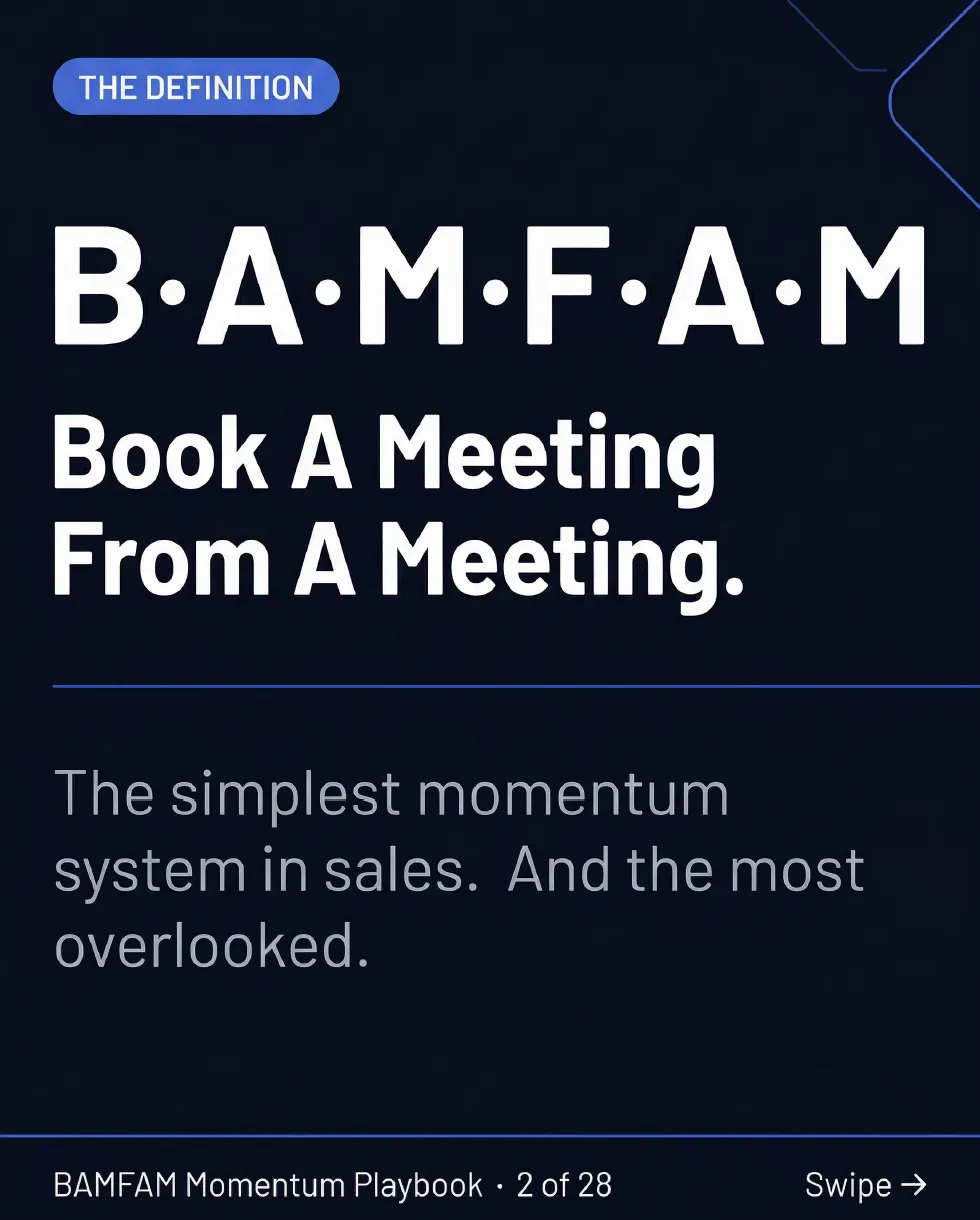
Connect • Clarify • Confirm • Calendar: The 4-Beat Playbook That Ends the Follow-Up Chase.
Discover how the BAMFAM Momentum Playbook reveals the exact strategies to:
Book the Next Meeting While You're Still in the Meeting
Turn "Let Me Get Back to You" Into a Yes (It's Friction, Not Rejection)
Kill the "Just Bumping This Up" Email Forever
Make Momentum Measurable With the Team Scorecard

Stop • Scan • Decide: The 3-Step Playbook to Win the First 51 Seconds.
Discover how the FOCUS360 Playbook reveals the exact strategies to:
FREE GPT Agent to test and build your content
Stop the Scroll on Command
Hold Attention for the First 51 Seconds:
Multiply Conversions With a Single Clear Path:
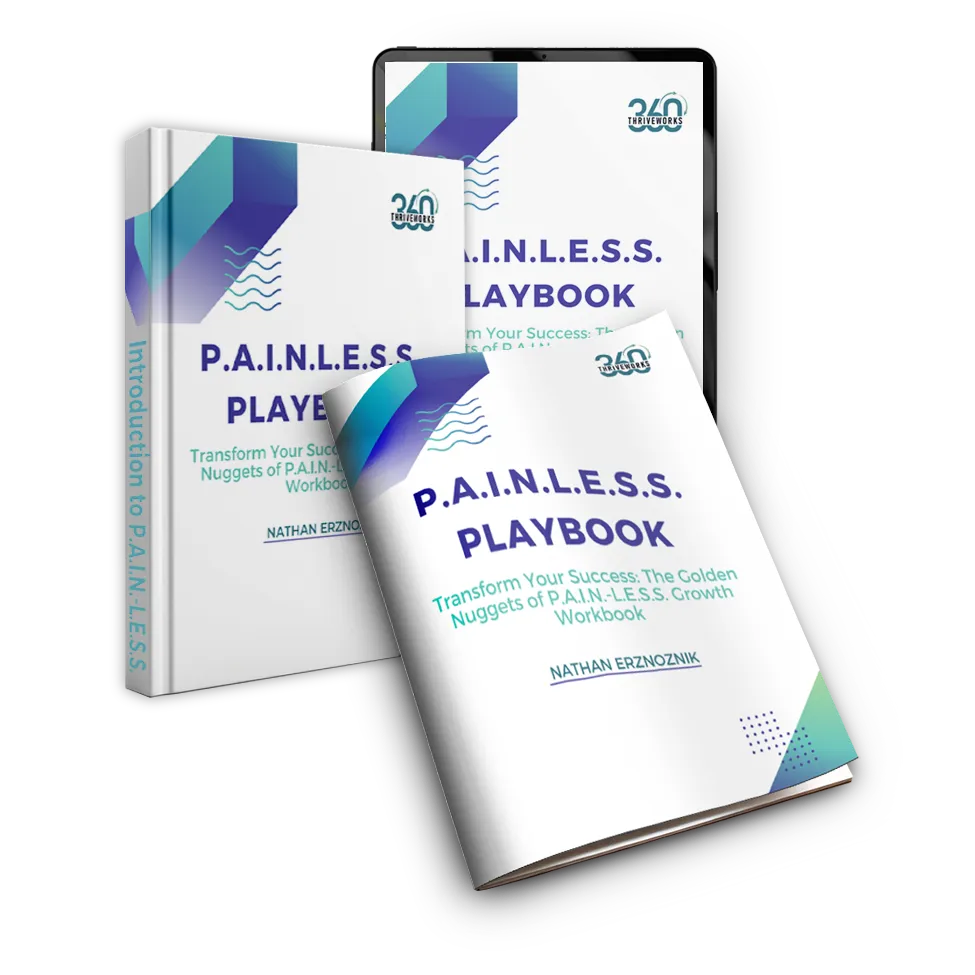
Unlock Your Business’s Full Potential – Without the Pain
Step into the realm of effortless growth with our P.A.I.N.-L.E.S.S. Playbook.
Designed for entrepreneurs who seek the "Golden Nuggets" that transform them and their businesses without the overwhelming stress. This tool shows a simple and streamlined path toward business success.
Take Control of Your Journey with Our Ultimate FREE Autopilot 360 System Masterclass and Cheat Sheet.
Build A Self-Managed Business And Break Through 6-7 Figures To 8 Figures While Seamlessly Producing Huge Profits!


Uncover Hidden Revenue in 3 Simple Steps
See more details about how this impacts business performance.
PAID COURSE
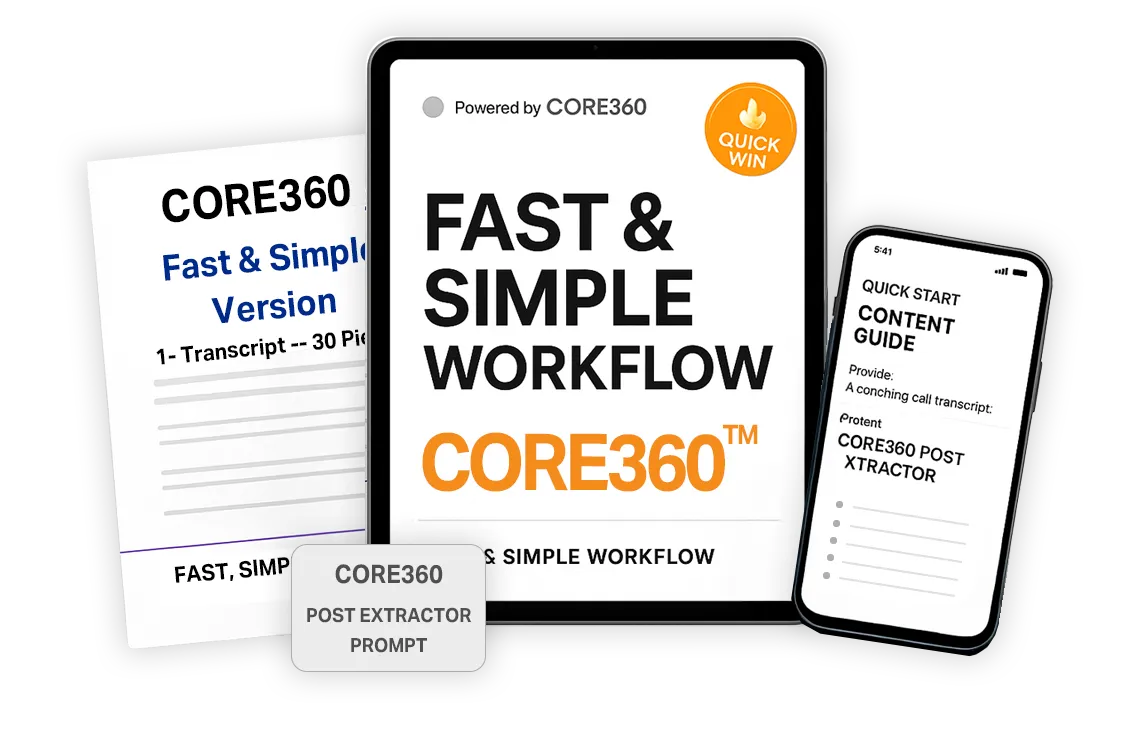
CORE360: Multiply Your Message — Without Writing a Single Word
See how to easliy increase your visibility with the CORE360 System and AI-driven Prompt Booster Pack™
Built for founders and entrepreneurs who already say brilliant things — this AI-optimized vault gives you the exact prompts to turn one voice note into days of content across Instagram, LinkedIn, TikTok, YouTube Shorts, and Facebook.
No burnout. No blank pages. Just scroll-stopping content formulas that match your voice and work on every platform.
A simple upgrade with exponential reach.
BLOG
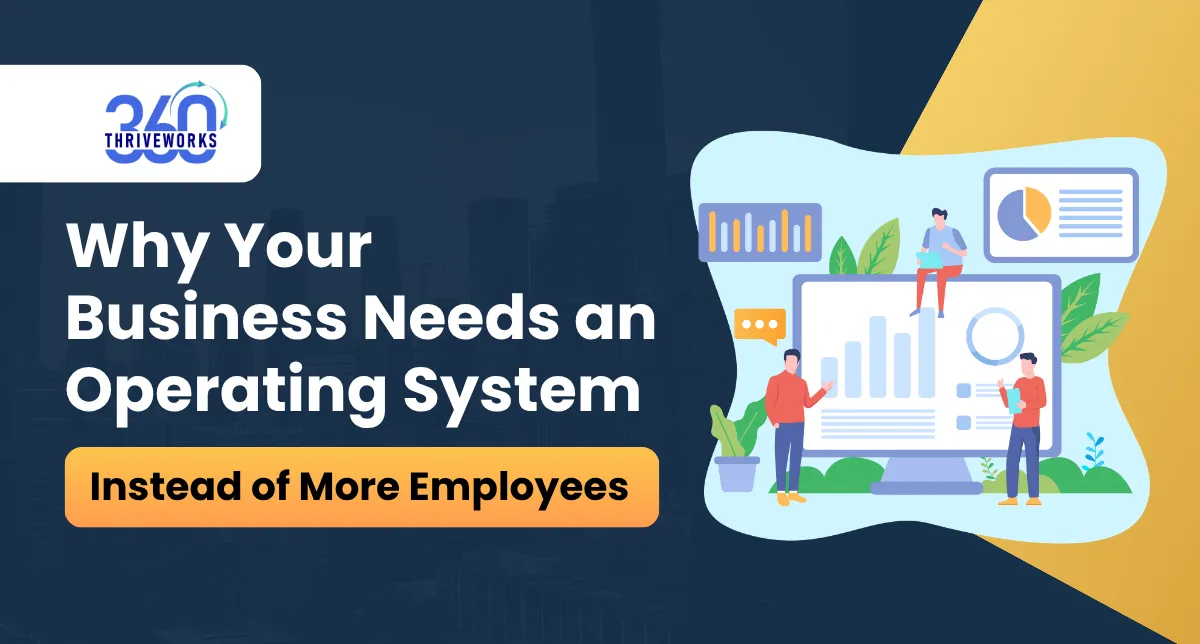
Why Your Business Needs an Operating System Instead of More Employees
When a growing business feels stretched, hiring looks like the obvious fix. But another hire on top of a broken process doesn't remove the problem. It just gives the problem another salary.
When a growing business starts feeling stretched, the answer often looks obvious.
Hire more people.
Operations team overwhelmed? Add another coordinator. Reporting takes too long? Hire another administrator. Customer requests piling up? Expand the support team.
Sometimes hiring really is the right call. But there's an important question businesses tend to skip before opening another role.
Is there actually too much work, or is the way the work gets done creating unnecessary work?
That distinction matters more than it sounds.
If your employees spend their days copying information between systems, chasing approvals, hunting for documents, fixing preventable mistakes, or relying on someone's memory to finish routine tasks, another hire might bring temporary relief. It probably won't solve the real problem.
A stronger business operating system can.
Hiring More People Can Hide an Operational Problem
Growth naturally creates pressure.
More customers mean more transactions. More projects mean more handoffs. More employees mean more communication. More products, services, and departments add new layers of complexity. Eventually, something starts to strain.
The common response is to add headcount so the business can handle the extra load. But picture adding another person to a process that already has five unnecessary steps in it.
You haven't removed the five steps. You've just added another person who now has to do them.
The same thing happens when employees keep entering the same information into different systems, when managers manually approve routine decisions, or when an essential process only works because one experienced person knows what comes next.
Hiring into that environment can lift capacity for a while, but it also lifts payroll, training, communication demands, and management overhead. Before adding another employee, leadership should understand what's actually creating the workload in the first place.
What Is a Business Operating System?
A business operating system is the structure that lets your company run consistently, instead of depending on individual effort to hold everything together.
It brings clarity to the questions that quietly cause friction. How should work move through the business? Who owns each step? What happens when something goes wrong? Which processes should be standardized? Where should technology support the team? What information needs to move between departments? And which repetitive activities could be automated?
The goal isn't to remove people from the business. It's to stop using talented people for work that a better process, a clearer system, or a bit of automation could handle more efficiently.
Think about two growing companies.
Company A solves every capacity problem by hiring. Company B first looks at its processes, removes the unnecessary steps, standardizes how work gets done, and automates the repetitive activities. Then it hires where human expertise genuinely creates more value.
Both companies may grow. But Company B is far more likely to understand exactly why it needs each additional employee. That's the difference between adding headcount and building capacity.
Your Team May Not Be the Bottleneck
When employees look busy all day, it's easy to assume you need more people. But activity and productive capacity aren't always the same thing.
An operations employee might spend hours moving information from one platform to another. A manager might answer the same internal questions over and over because nothing's documented. A finance team might spend days building reports because the data lives across a dozen spreadsheets. A support employee might manually send updates that could be triggered automatically.
Everyone's working. The problem is that the system around them is generating unnecessary work.
This is where business automation becomes valuable. Automation isn't just swapping manual tasks for software. Used well, it lets information, notifications, approvals, reporting, and repetitive admin move with less human involvement.
But there's an important catch. You shouldn't automate a bad process. If a workflow has ten steps and four of them don't need to exist, automating all ten just makes an inefficient process run faster. The process has to come first.
Simplify First. Automate Second. Hire Third.
Before you approve another hire, look hard at the work the new person would actually do. Then ask four questions.
1. Can we eliminate it? Some tasks exist because "that's how we've always done it." They may have made sense three years ago, when the company was smaller or used different tools. Today they may add almost nothing. Remove the unnecessary work before you hand it to someone else.
2. Can we simplify it? A process that runs through six people might only need three. A five-step approval might only need two. A pile of spreadsheets might be replaceable with one shared source of information. Simplifying cuts the workload without sacrificing the outcome.
3. Can we automate it? Once a process is clear and repeatable, find the steps that don't need judgment or expertise. Routine notifications, data transfers, reminders, reporting, task creation. Those are often candidates for automation. It creates capacity by letting people spend less time maintaining the process and more time on work that actually needs them.
4. Does this still require another person? After you've removed the unnecessary work, simplified the workflows, and automated the repetitive pieces, you may find you still need more talent. That's fine. Now you're hiring for a real capacity requirement instead of hiring around an operational problem, and that tends to make for a much stronger role.
Signs You Need Better Systems Before More Employees
You don't need a complicated audit to catch the early warning signs. Just pay attention to the daily frustrations your team has quietly learned to accept.
You may need stronger systems if employees keep entering the same information in multiple places, important processes depend on one person's memory, managers constantly chase people for status updates, teams lean on spreadsheets to move work between departments, employees spend real time searching for information, mistakes regularly require rework, every jump in customers immediately creates pressure to hire, people are busy but leadership can't explain where the time goes, or different employees do the same task in completely different ways.
Any one of these on its own doesn't mean your operations are broken. But several of them together usually signal something deeper than a staffing problem.
A Simple Example: The Hire You Might Not Need
Picture a growing service company.
The operations team says it's overwhelmed, and leadership starts planning to hire two more coordinators. At first, the workload seems to justify it.
But when the company actually examines the workflow, it finds something different. Team members manually collect information from several sources. They copy it into another system. Managers approve routine requests one at a time. Employees send status updates by hand. And reporting means pulling data from several spreadsheets every week.
The team isn't overloaded simply because the company grew. It's overloaded because growth exposed the weaknesses in how work moves through the organization.
So instead of immediately hiring two people, leadership redesigns the process. Duplicate steps get removed. Responsibilities get clearer. Information gets standardized. Systems get connected where possible. Repetitive admin gets automated.
Now leadership can see the true capacity of the existing team. Maybe they still need one more person. Maybe they don't. Either way, the decision is based on what the business actually needs, not on the symptoms of an inefficient process.
Build a Business That Can Carry More Weight
The purpose of better systems isn't a company with fewer people. It's a company where people can do more meaningful work.
Your best employees shouldn't spend their days copying data, chasing updates, correcting preventable errors, or remembering processes that should already be written down. They should be solving problems, helping customers, making decisions, improving products, building relationships, and driving growth.
A strong operating system gives them the structure to do that. And when automation is added thoughtfully, it removes much of the repetitive work that quietly eats capacity.
That's how a business becomes more scalable. Not by refusing to hire. By making sure hiring isn't the only tool you reach for every time growth creates pressure.
Where FLOW360 Fits
The tricky part is that businesses living inside their operations every day don't always see where the friction is coming from.
A broken handoff becomes normal. A spreadsheet workaround becomes permanent. A temporary manual process quietly turns into somebody's full-time job.
That's why the first step is understanding the system before trying to fix individual symptoms. FLOW360 is built around that idea. It starts by identifying the barriers and the operational friction. Then it focuses on refining the systems behind the work: the processes, the ownership, the handoffs, and the opportunities for automation. From there, the business can build an operating structure that supports growth instead of constantly reacting to the next capacity problem.
In simple terms: stabilize what's creating friction, catalyze better systems and processes, then maximize the capacity those systems create. The sequence matters, because it keeps you from hiring around a broken process or automating something that shouldn't exist in the first place.
Before You Post That Next Job Opening
Hiring is essential to growth. But hiring should solve a talent or capacity problem, not paper over operational confusion.
So before you add another salary to payroll, ask what work you're actually hiring this person to do. Then look closer. Can some of it disappear? Can some of it get simpler? Can some of it be standardized? Can automation handle the repetitive pieces? And after all of that, what work truly requires another person?
The answers might confirm that you need to hire. Or they might reveal that what your business really needs first is a better way to operate.
If growth keeps creating more work, more complexity, and more pressure to add headcount, book a call here. I'd like to hear where the pressure is coming from and help you find the operational gaps behind it, so your next hire solves a real need instead of hiding a fixable problem.
Not ready to talk yet? Join our free community here for more on building a business that can carry more weight without the chaos.
ThriveWorks360


Free Weekly Productivity Insights
Sign up for Sunday Snippets - my weekly newsletter where I I share actionable productivity tips, practical life advice, and high-quality insights from across the web, directly to your inbox.
What People Are Saying

Driving Growth, Amplifying Impact

Grace Company

8th to 2nd most recognized brands in the industry in one year

J&B Sewing
Launched new product line and grew 300% in two years

Sewrite
Increased national distribution, D2C Revenue by 400%.
Get In Touch
Email: [email protected]
Address
Office: 14881 S. Auburn Sky Dr
Assistance Hours
Mon – Sat 9:00am – 8:00pm
Sunday – CLOSED
Phone Number:
(888) 870-7314
Contact Us:
BECOME AN TW360 INSIDER
Sign up for exlcusive content, emails, & things Nathan doesn't share anywhere else.
Unleash Your Business Brilliance.
Reach out and connect for your opportunity to shine!
© 2026 ThriveWorks360 - All Rights Reserved, copyright 2024