Free Tools & Resources
Everything You Need to See What's Broken and Fix It.
These tools are used inside real $1M–$20M businesses. Pick the one that matches where you're stuck, and start there.
Free Tools
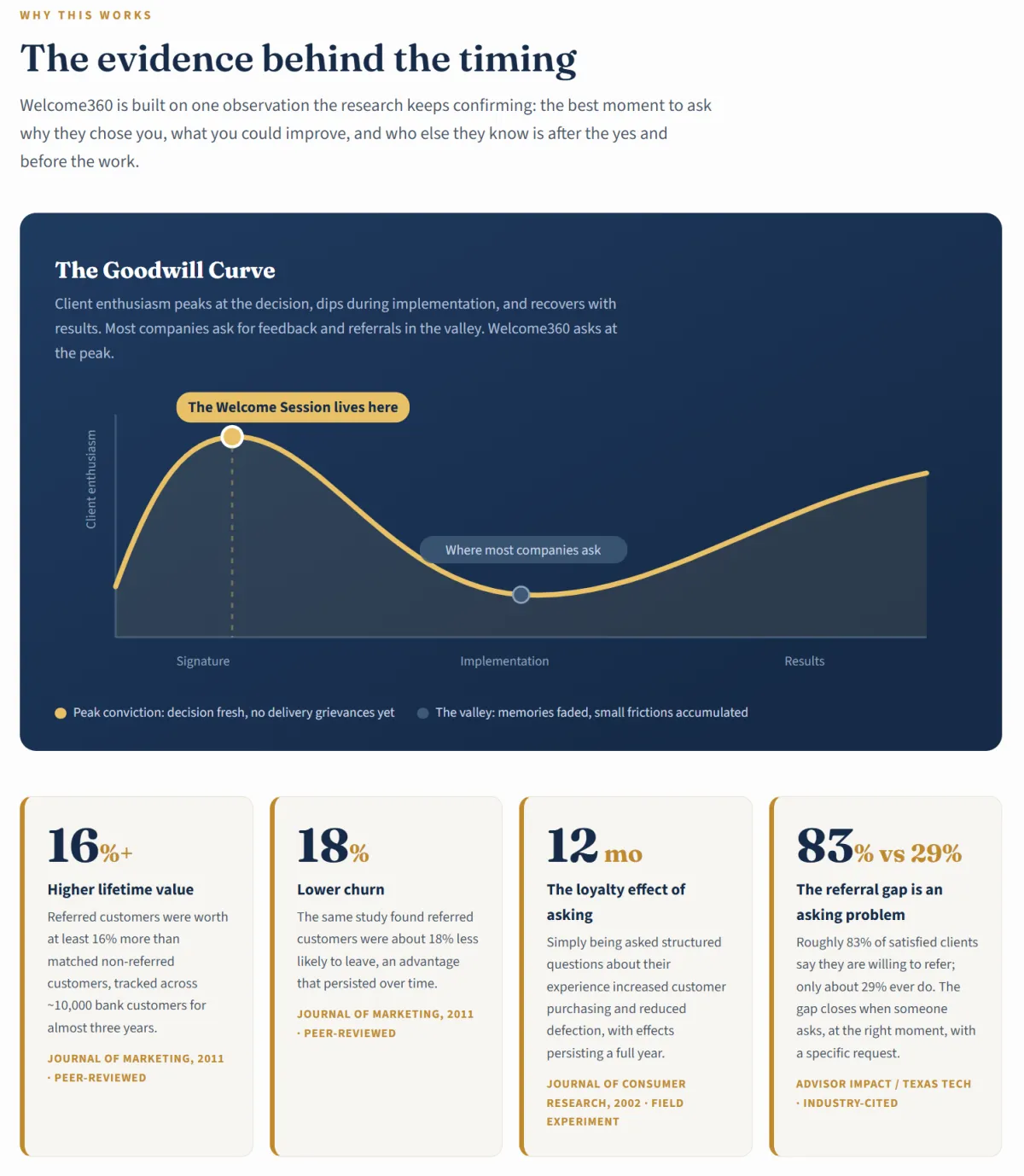
Welcome360 • A Client Growth System: The 45-Minute Meeting That Turns Every New Client Into Referrals.
Discover how the Welcome360 System reveals the exact strategies to:
Ask for Referrals at Peak Goodwill — Before the Honeymoon Ever Fades
FREE AI Insight Miner: Turn One Client Conversation Into 7 Finished Business Assets
Capture the Exact Words Clients Use to Sell You (Then Reuse Them Everywhere)
Close the Feedback Loop That Makes Clients Refer Twice
Sellthrough360 - Flows, Bundling, Upselling Systems for Revenue Generation
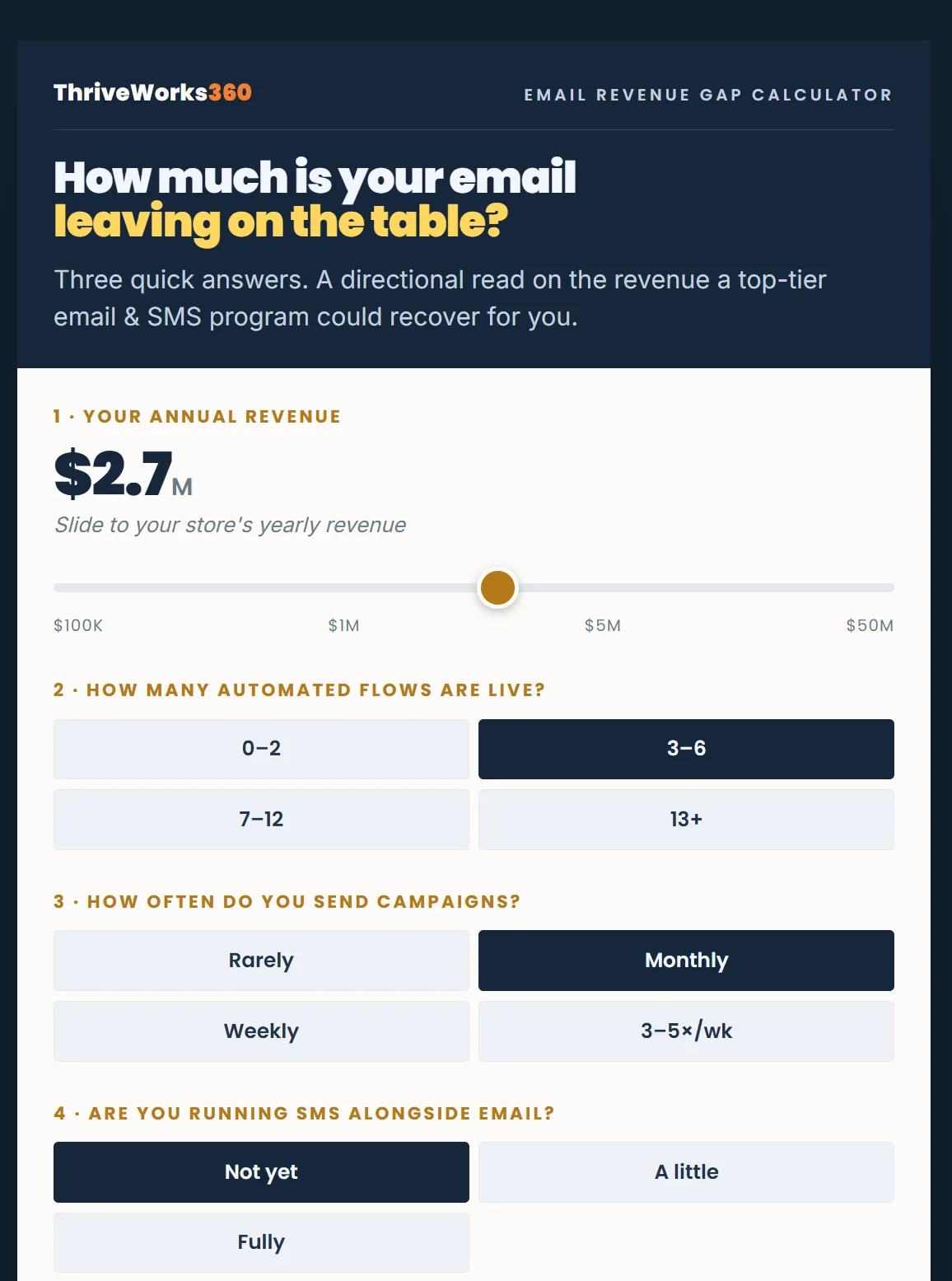
How much is your email leaving on the table?
Three quick answers. A directional read on the revenue a top-tier email & SMS program could recover for you.
Your annual revenue
How many automated flows are live?
How often do you send campaigns?
Are you running SMS alongside email?
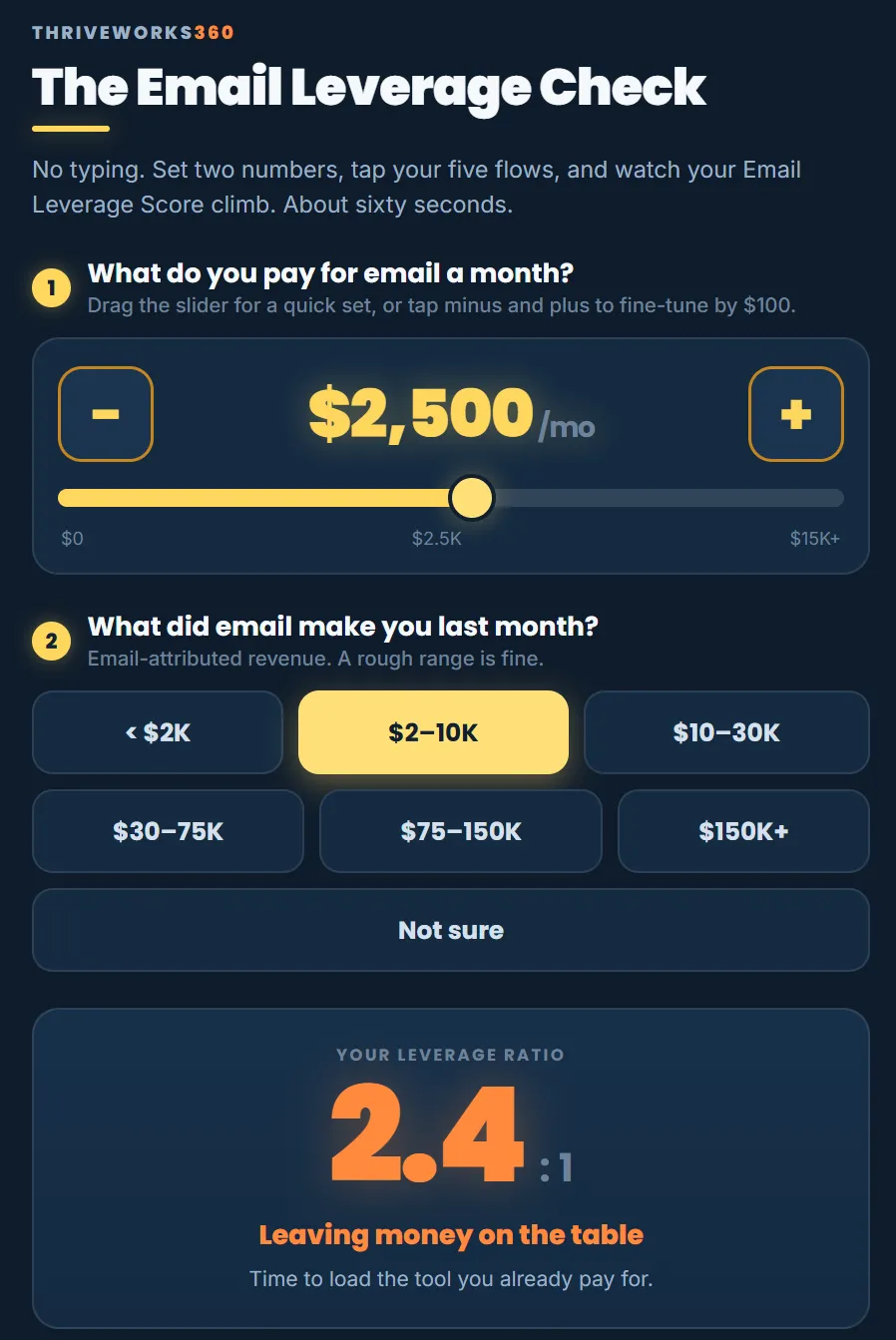
The Email Leverage Check
No typing. Set two numbers, tap your five flows, and watch your Email Leverage Score climb. About sixty seconds.
What do you pay for email a month?
What did email make you last month?
Which of these 5 are running?
Download a printable form
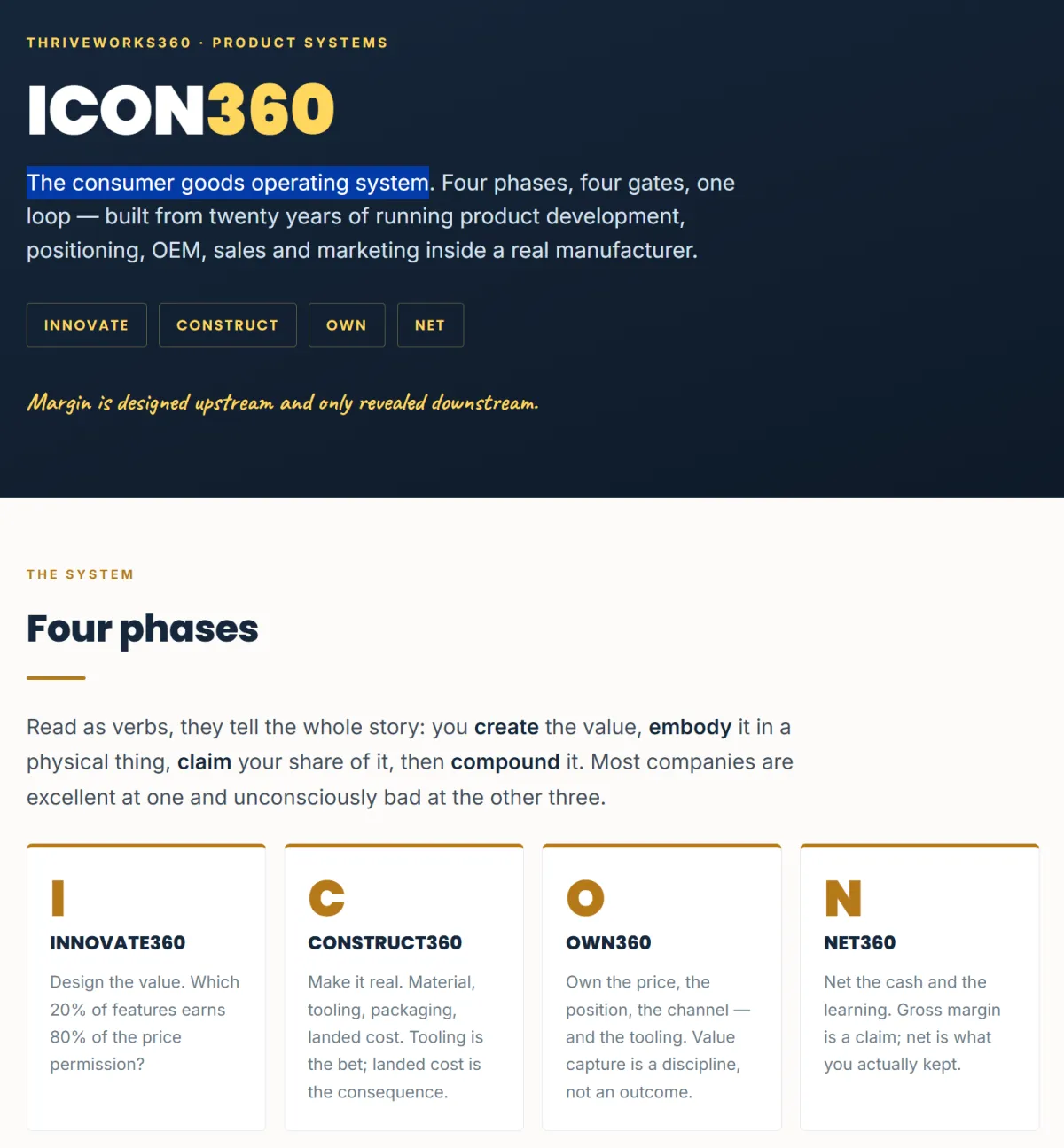
ICON360
The consumer goods operating system.
INNOVATE360 - Design the value. Which 20% of features earns 80% of the price permission?
CONSTRUCT360 - Make it real. Material, tooling, packaging, landed cost. Tooling is the bet; landed cost is the consequence.
OWN360 - Own the price, the position, the channel — and the tooling. Value capture is a discipline, not an outcome.
NET360 - Net the cash and the learning. Gross margin is a claim; net is what you actually kept.
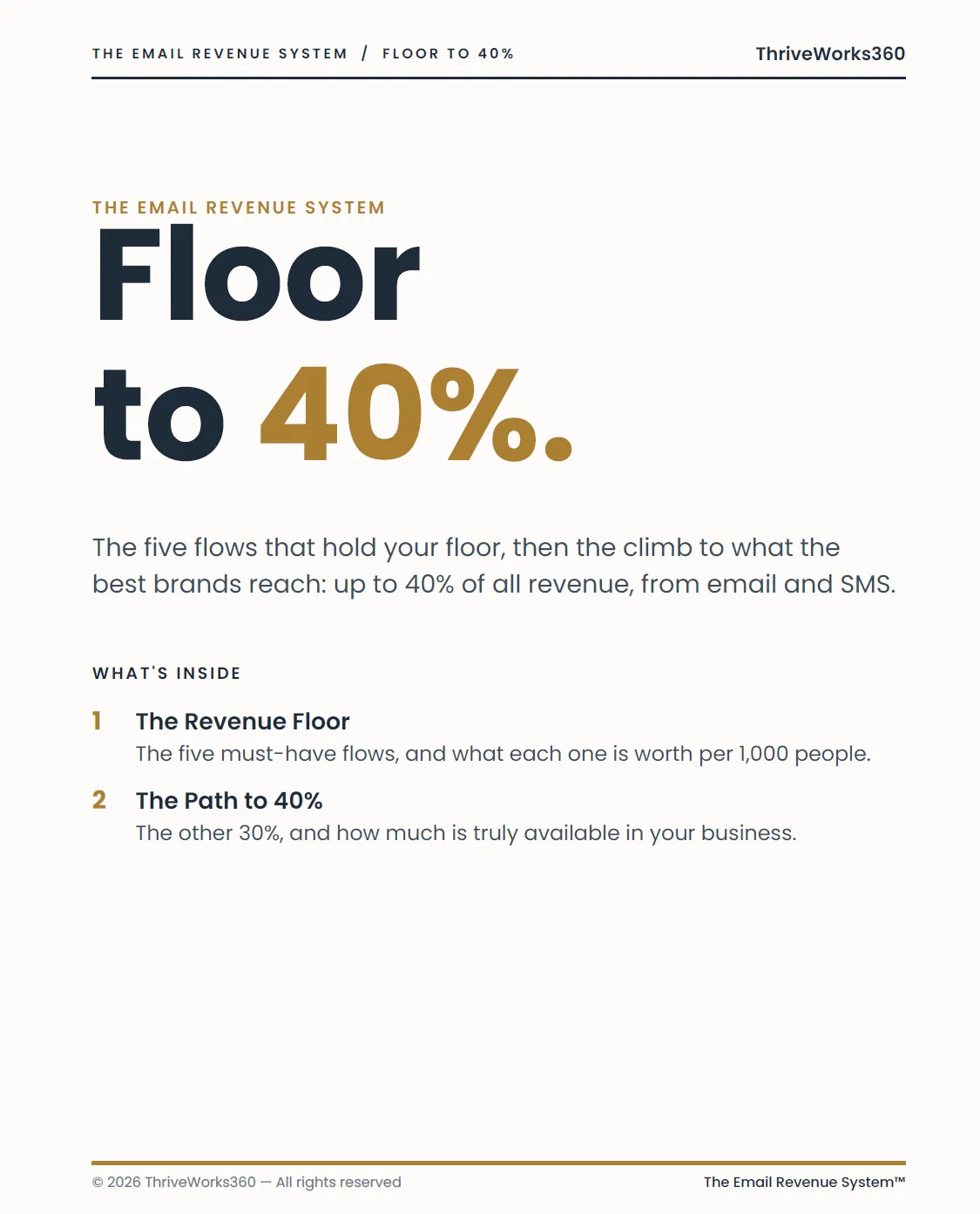
The Email Revenue System Floor to 40%.
The five flows that hold your floor, then the climb to what the best brands reach: up to 40% of all revenue, from email and SMS.
The Revenue Floor - The five must-have flows, and what each one is worth per 1,000 people.What did email make you last month?
The Path to 40% - The other 30%, and how much is truly available in your business.

See the money already in your business, climbing in real time.
Slide in your two numbers, then answer 15 quick questions. Watch the dollar figure move as you go. By the end, you'll know your biggest pocket of found money, the fastest switches to flip, and roughly what it's worth — before you spend a cent on new ads.
Your List
Your Automations
Your Repeat Buyers
Your Offers & Pricing
Your Between-Launch Revenue
Answer all 15 to lock your result
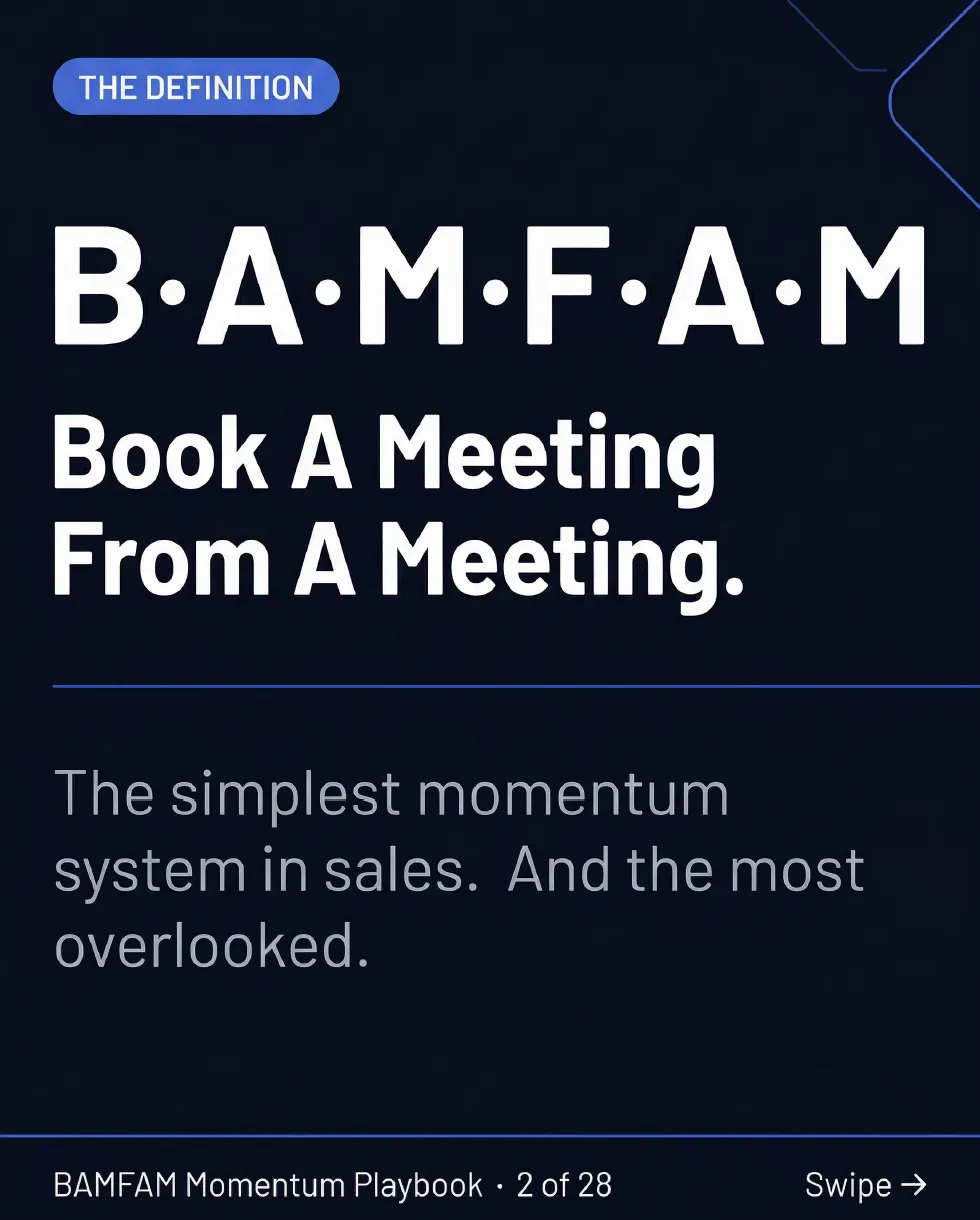
Connect • Clarify • Confirm • Calendar: The 4-Beat Playbook That Ends the Follow-Up Chase.
Discover how the BAMFAM Momentum Playbook reveals the exact strategies to:
Book the Next Meeting While You're Still in the Meeting
Turn "Let Me Get Back to You" Into a Yes (It's Friction, Not Rejection)
Kill the "Just Bumping This Up" Email Forever
Make Momentum Measurable With the Team Scorecard

Stop • Scan • Decide: The 3-Step Playbook to Win the First 51 Seconds.
Discover how the FOCUS360 Playbook reveals the exact strategies to:
FREE GPT Agent to test and build your content
Stop the Scroll on Command
Hold Attention for the First 51 Seconds:
Multiply Conversions With a Single Clear Path:
Unlock Your Business’s Full Potential – Without the Pain
Step into the realm of effortless growth with our P.A.I.N.-L.E.S.S. Playbook.
Designed for entrepreneurs who seek the "Golden Nuggets" that transform them and their businesses without the overwhelming stress. This tool shows a simple and streamlined path toward business success.

Take Control of Your Journey with Our Ultimate FREE Autopilot 360 System Masterclass and Cheat Sheet.
Build A Self-Managed Business And Break Through 6-7 Figures To 8 Figures While Seamlessly Producing Huge Profits!


Uncover Hidden Revenue in 3 Simple Steps
See more details about how this impacts business performance.
PAID COURSE
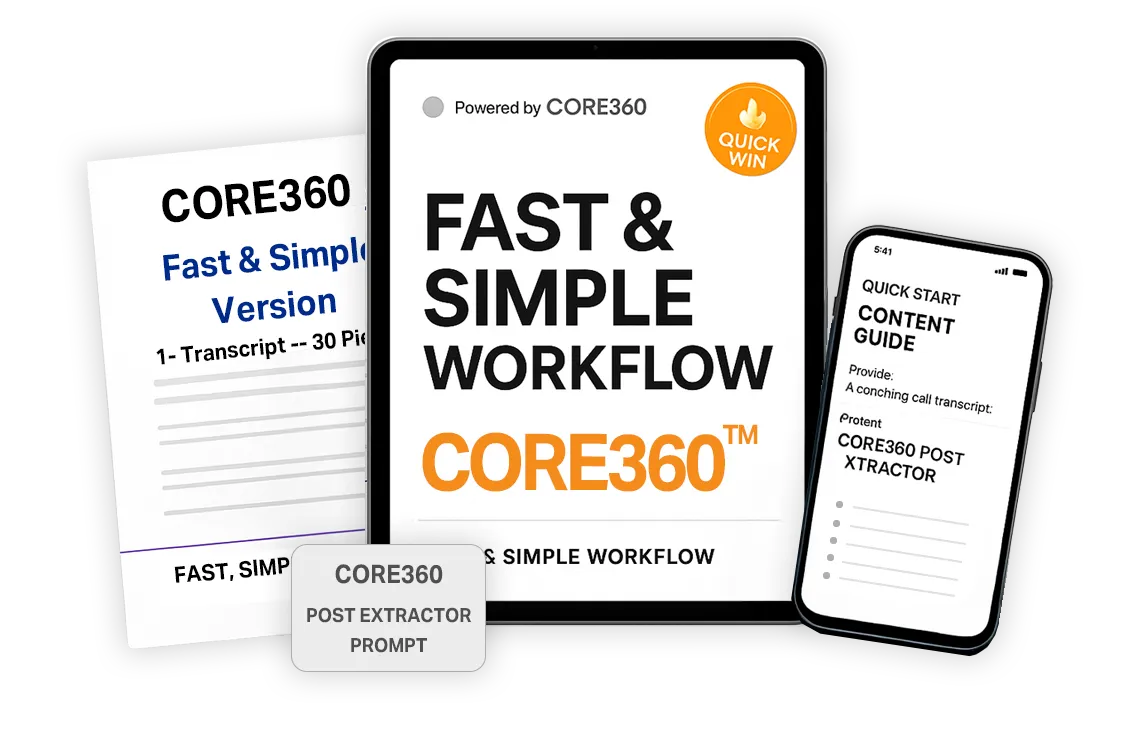
CORE360: Multiply Your Message — Without Writing a Single Word
See how to easliy increase your visibility with the CORE360 System and AI-driven Prompt Booster Pack™
Built for founders and entrepreneurs who already say brilliant things — this AI-optimized vault gives you the exact prompts to turn one voice note into days of content across Instagram, LinkedIn, TikTok, YouTube Shorts, and Facebook.
No burnout. No blank pages. Just scroll-stopping content formulas that match your voice and work on every platform.
A simple upgrade with exponential reach.
BLOG
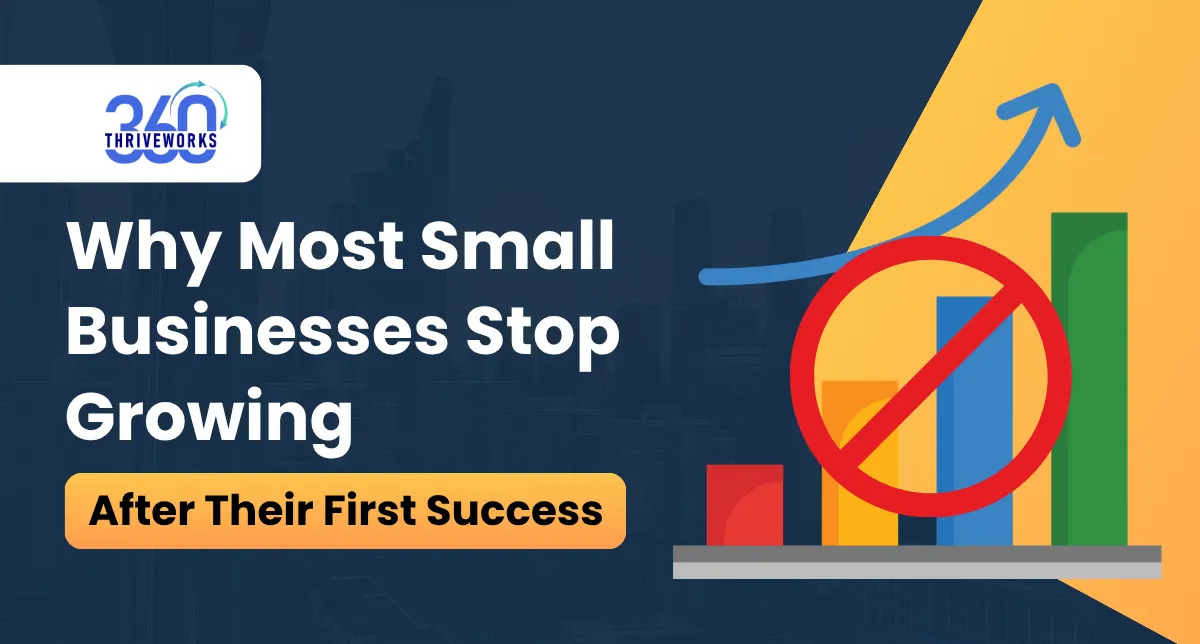
Why Most Small Businesses Stop Growing After Their First Success
A revenue plateau usually doesn't mean the demand is gone. It means you've hit the ceiling of the way you currently operate.
The first stage of growth can feel almost magical.
A few customers say yes. Referrals start rolling in. Revenue moves in the right direction. The team gets busier, the founder feels validated, and the business finally seems to have real momentum.
Then something shifts.
The company keeps working harder, but growth slows. Revenue gets choppy. The founder gets pulled into more and more decisions. Everyone stays busy, and yet important things still fall through the cracks.
The business isn't failing. It's just not moving the way it used to.
This is one of the most common growth problems small companies hit. Early success creates momentum, but it can also hide weak processes, fuzzy responsibilities, and systems that were never built for a bigger operation. The methods that got you to your first level of success are rarely the ones that get you to the next.
Early Success Usually Runs on the Founder
Most small businesses don't start with formal systems. They start with effort.
The founder sells the service, chases the leads, answers the customer questions, fixes the delivery problems, checks the finances, approves the decisions, and remembers what's supposed to happen next.
At first, it works. The founder knows the customers. The team is small. Communication is fast. Problems get solved with a quick message, a short meeting, or a late night at the computer.
But as the business grows, that gets hard to hold together. More customers mean more questions. More employees mean more decisions. More services mean more handoffs. More marketing means more leads to track, follow up with, and convert.
Eventually, the founder becomes the system. And that's exactly where growth starts to slow. When every important decision, approval, relationship, and process runs through one person, the company can only move as fast as that person's time allows.
A Plateau Doesn't Always Mean the Demand Is Gone
When a business hits a plateau, the first instinct is to blame the market. Maybe customers aren't interested anymore. Maybe competitors are winning. Maybe marketing just isn't pulling its weight.
Sometimes that's true. But often the real problem is internal capacity.
The business may already have plenty of leads, customers, and opportunities. It just doesn't have the systems to handle them consistently.
Think about what happens when leads don't get followed up on time. When proposals sit unfinished. When customer information is scattered across different places. When nobody's sure who owns the next step. When projects run on verbal instructions. When the founder has to approve routine decisions. When past customers never hear from you again.
None of those point to weak demand. They point to a business that has reached the limit of its current operating model.
More leads won't fix missed follow-up. More employees won't fix unclear ownership. More software won't fix a process nobody ever defined. Before you try to create more demand, you have to understand where the demand you already have is leaking out.
The Most Common Growth Problems
Every company is different, but a handful of bottlenecks show up again and again in businesses that stall after early success.
1. The founder is still involved in everything
Founder involvement is valuable early on. Nobody understands the vision, the customer, and the standards better. The trouble starts when involvement turns into dependency.
If your people can't move without your approval, the business will always run at the speed of your availability. Routine decisions pile up. Customers wait. Team members lose confidence. And strategic work quietly gets swapped out for daily firefighting. The founder stays busy. The company stays stuck.
2. Sales run on memory and personal effort
A lot of businesses win their early sales through relationships, referrals, networking, and the founder's own hustle. That can create strong early growth. It's also hard to predict or scale.
A sales system that scales needs clear stages, consistent follow-up, defined ownership, and visibility across the pipeline. Without that, every opportunity gets handled a little differently. Some leads get five follow-ups, others get one. Some proposals go out same-day, others sit. Some past customers hear from you again, most don't. Revenue gets inconsistent because the process is inconsistent.
3. The processes live in people's heads
A team can know how to do the work without the business having a repeatable process. When the how gets passed along through meetings, messages, and memory, everybody develops their own slightly different version of the same task.
That creates variation. Customers get different experiences. Mistakes get harder to spot. Training drags on. Managers spend their time answering questions that should already have clear answers. And when a key employee leaves, a piece of the business walks out with them.
4. The business adds tools without fixing the workflow
Technology helps a business grow, but only when it supports a clear process. Under pressure, small businesses often just add more software. One tool for leads. One for projects. One for email. One for tasks. One for customer info.
Before long the team is copying data between platforms, checking five dashboards, and trying to remember which system holds the latest version. The company has more technology and no more clarity. Automation can't repair a broken workflow. It just makes the broken workflow run faster.
5. Growth creates more work but not more capacity
Revenue growth isn't the same as healthy scaling. A company can grow its sales while also growing its stress, delays, costs, and founder involvement. That's growth without scale.
Real scaling means serving more customers without the same jump in manual work, management attention, or overhead. The goal was never to make the company busier. It's to make it more capable.
Why More Marketing Isn't Always the Answer
When revenue slows, plenty of businesses respond by cranking up ads, publishing more content, or launching another campaign. That can create more opportunities. It can also pile more pressure onto a system that's already strained.
Picture pouring more water into a leaking bucket. The problem was never the amount of water. It's the holes.
So before you spend on more traffic, ask a few honest questions. Are leads getting timely follow-up? Are proposals going out consistently? Is the pipeline actually visible? Are customers moving smoothly from sales into delivery? Are past customers being contacted again? Does the team know who owns each step? Can managers see where opportunities are getting lost?
A business often doesn't need more attention. It needs better access to the value already moving through it.
How to Find the Real Bottleneck
The first move is to stop treating the plateau as one big problem. Break it into stages.
Follow a customer through the business, from the first interaction all the way to final delivery and beyond. Where does progress slow down?
If plenty of leads come in but few become customers, the issue is probably follow-up, qualification, messaging, or the sales process. If sales are strong but delivery drags, it's likely capacity, handoffs, scheduling, or unclear responsibilities. If customers buy once and rarely return, it's retention, communication, or the lack of a repeat-purchase system. If every department is busy but leadership can't see what's happening, it's disconnected data and poor visibility.
The goal isn't to automate everything at once. It's to find the one constraint holding back the whole business.
A Three-Phase Path to Real Scaling
A practical growth plan moves through three stages. Stabilize, catalyze, and maximize.
Phase 1: Stabilize
First, clear the barriers creating inconsistency. Document the workflows that matter most. Clarify who owns each step. Cut the unnecessary approvals. Fix the obvious gaps in sales, delivery, customer communication, and internal handoffs.
This stage is about control. The business should know what's happening, who's responsible, and where the work keeps getting stuck.
Phase 2: Catalyze
Once the process is clear, improve how it runs. Set consistent follow-up standards. Build repeatable sales stages. Standardize onboarding. Define what information has to be captured. Give employees real decision-making authority.
This is the stage that cuts the dependence on memory and personal effort. The work gets easier to measure, manage, and improve.
Phase 3: Maximize
Only once the process is stable should you start automating more of it. Repeatable tasks can trigger automatically. Systems can share information. Leaders can track performance through clearer reporting. Follow-up can happen without someone having to remember every step.
This is where something like AutoPilot360 becomes relevant. The point isn't to replace people or automate every interaction. It's to find where manual work, disconnected systems, and founder dependency are choking growth, then build a more reliable way for the business to run.
Signs You're Ready for Automation
Automation supports growth when the process already works manually, the same steps repeat, responsibilities are clearly defined, delays come from routine manual tasks, information is being entered more than once, follow-up depends on reminders, and leadership needs better visibility.
It's a lot less useful when the process changes every week or nobody agrees on how the work should be done. Clarity first. Then consistency. Then automation.
Frequently Asked Questions
Why do small businesses stop growing?
Usually because the founder, the team, and the processes all hit their current capacity at once. Growth slows when sales, delivery, communication, and decisions depend on manual effort instead of repeatable systems.
How do you get past a revenue plateau?
Start by finding where opportunities are getting delayed or lost. Review the customer journey, the sales process, the operational workflow, retention, and founder involvement. Fix the biggest bottleneck before spending on more leads or tools.
What systems should a small business build before scaling?
Most growing businesses need clear systems for lead management, sales follow-up, onboarding, delivery, internal communication, ownership tracking, reporting, and retention.
Can automation solve growth problems?
It can cut manual work and improve consistency, but it can't replace a clear process. The best results come from defining and improving the workflow first, then automating the repeatable parts.
Your First Success Already Proved the Business Works
A plateau doesn't mean the company has hit its ceiling. It usually just means the business has outgrown the way it currently operates.
That first stage of success runs on energy, personal involvement, and fast problem-solving. The next stage asks for something different. Clear ownership. Repeatable processes. Better visibility. Stronger systems. Less weight on one person.
So before you spend more on advertising, add another employee, or buy another tool, look inside the business first. Find the point where momentum is getting lost. That's usually where the next stage of growth begins.
Not sure where yours is leaking? A free Customer GapMap360 session helps you find the manual dependencies, disconnected processes, and operational gaps holding the business back, and shows you which one to fix first. The goal isn't automation for its own sake. It's a business that can grow without getting heavier, slower, or more dependent on you.

Free Weekly Productivity Insights
Sign up for Sunday Snippets - my weekly newsletter where I I share actionable productivity tips, practical life advice, and high-quality insights from across the web, directly to your inbox.
What People Are Saying

Driving Growth, Amplifying Impact

Grace Company

8th to 2nd most recognized brands in the industry in one year

J&B Sewing
Launched new product line and grew 300% in two years

Sewrite
Increased national distribution, D2C Revenue by 400%.
Get In Touch
Email: [email protected]
Address
Office: 14881 S. Auburn Sky Dr
Assistance Hours
Mon – Sat 9:00am – 8:00pm
Sunday – CLOSED
Phone Number:
(888) 870-7314
Contact Us:
BECOME AN TW360 INSIDER
Sign up for exlcusive content, emails, & things Nathan doesn't share anywhere else.
Unleash Your Business Brilliance.
Reach out and connect for your opportunity to shine!
© 2026 ThriveWorks360 - All Rights Reserved, copyright 2024