
Free Tools & Resources
Everything You Need to See What's Broken and Fix It.
These tools are used inside real $1M–$20M businesses. Pick the one that matches where you're stuck, and start there.
Free Tools
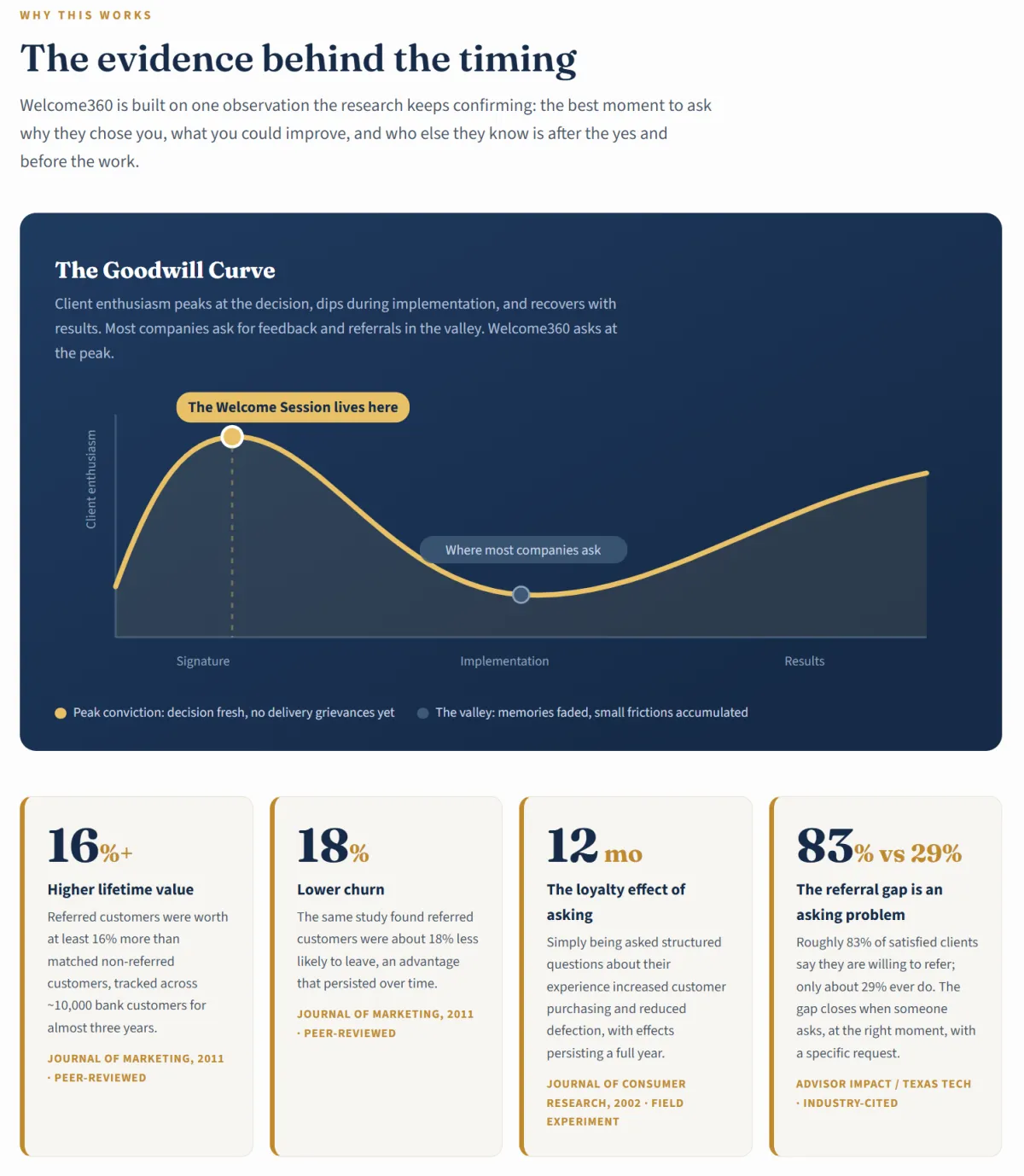
Welcome360 • A Client Growth System: The 45-Minute Meeting That Turns Every New Client Into Referrals.
Discover how the Welcome360 System reveals the exact strategies to:
Ask for Referrals at Peak Goodwill — Before the Honeymoon Ever Fades
FREE AI Insight Miner: Turn One Client Conversation Into 7 Finished Business Assets
Capture the Exact Words Clients Use to Sell You (Then Reuse Them Everywhere)
Close the Feedback Loop That Makes Clients Refer Twice
Sellthrough360 - Flows, Bundling, Upselling Systems for Revenue Generation
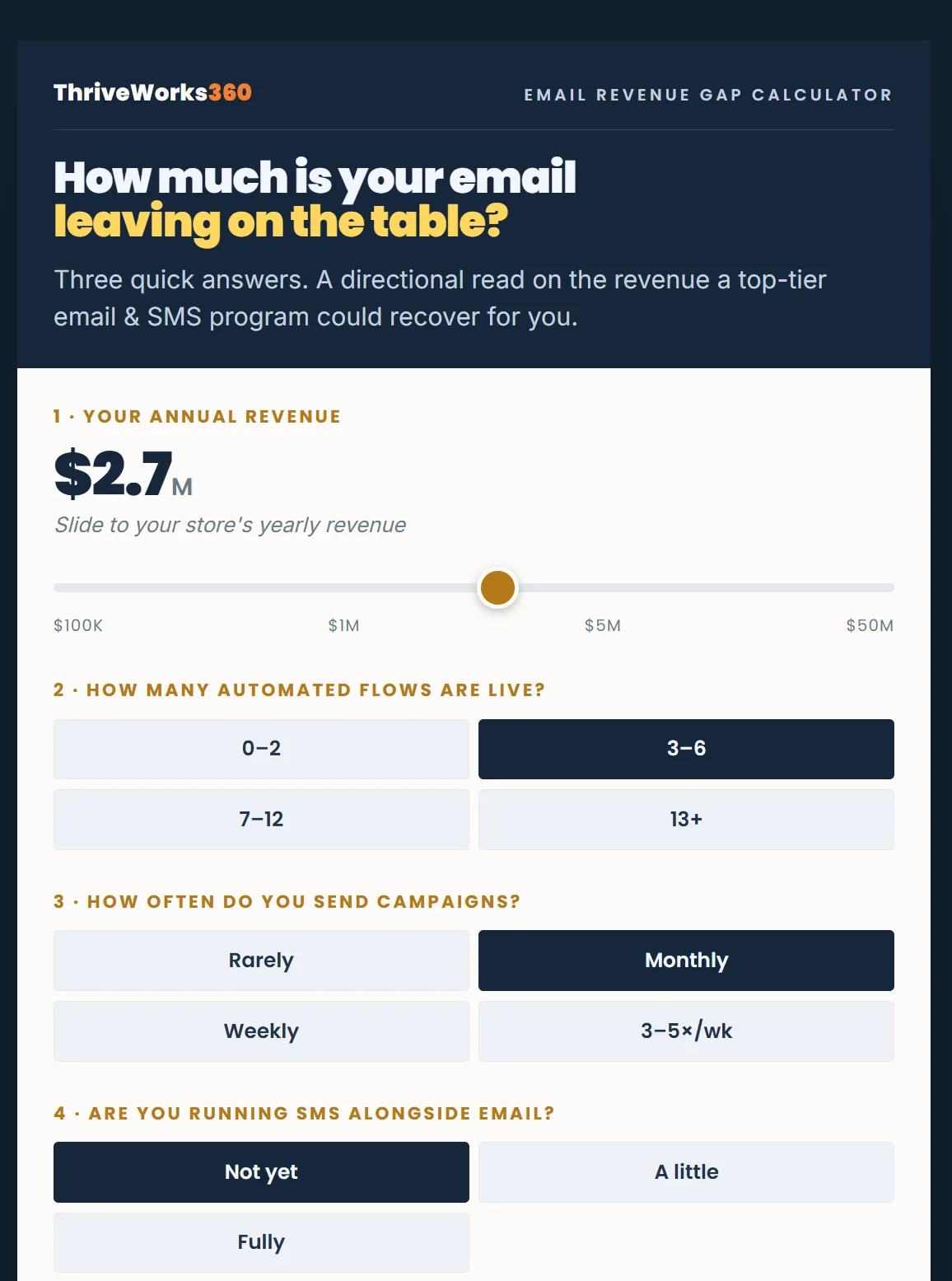
How much is your email leaving on the table?
Three quick answers. A directional read on the revenue a top-tier email & SMS program could recover for you.
Your annual revenue
How many automated flows are live?
How often do you send campaigns?
Are you running SMS alongside email?
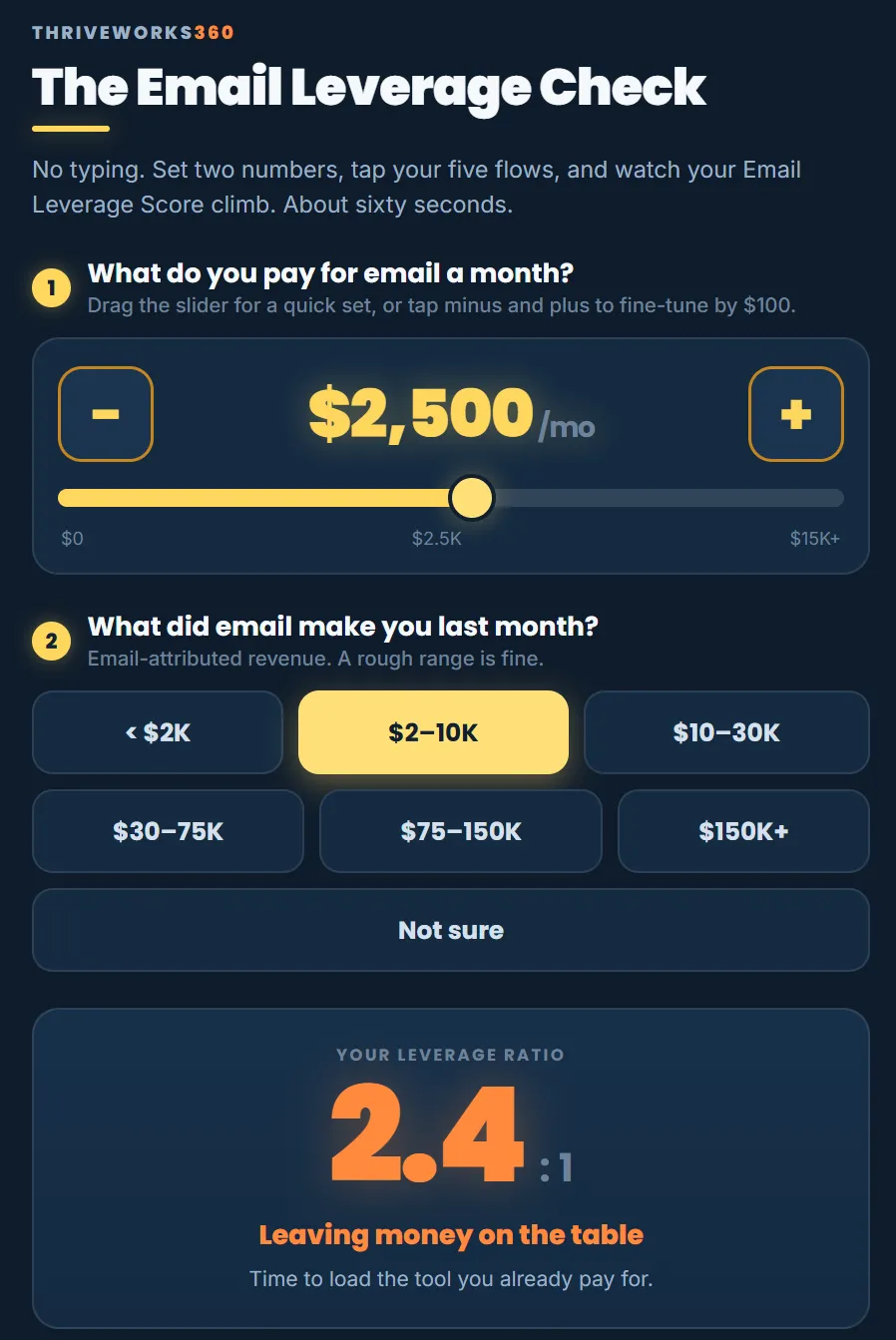
The Email Leverage Check
No typing. Set two numbers, tap your five flows, and watch your Email Leverage Score climb. About sixty seconds.
What do you pay for email a month?
What did email make you last month?
Which of these 5 are running?
Download a printable form
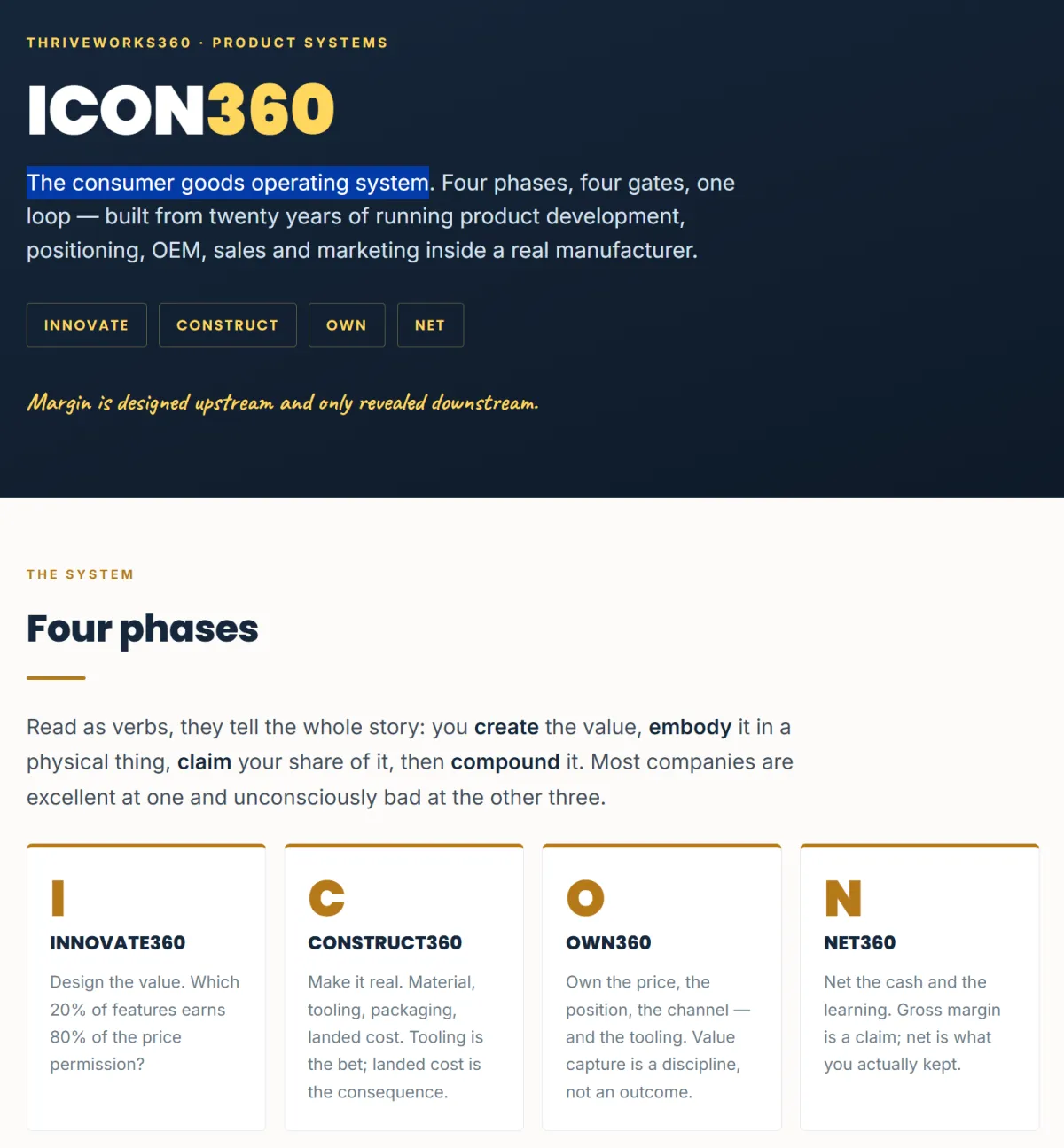
ICON360
The consumer goods operating system.
INNOVATE360 - Design the value. Which 20% of features earns 80% of the price permission?
CONSTRUCT360 - Make it real. Material, tooling, packaging, landed cost. Tooling is the bet; landed cost is the consequence.
OWN360 - Own the price, the position, the channel — and the tooling. Value capture is a discipline, not an outcome.
NET360 - Net the cash and the learning. Gross margin is a claim; net is what you actually kept.
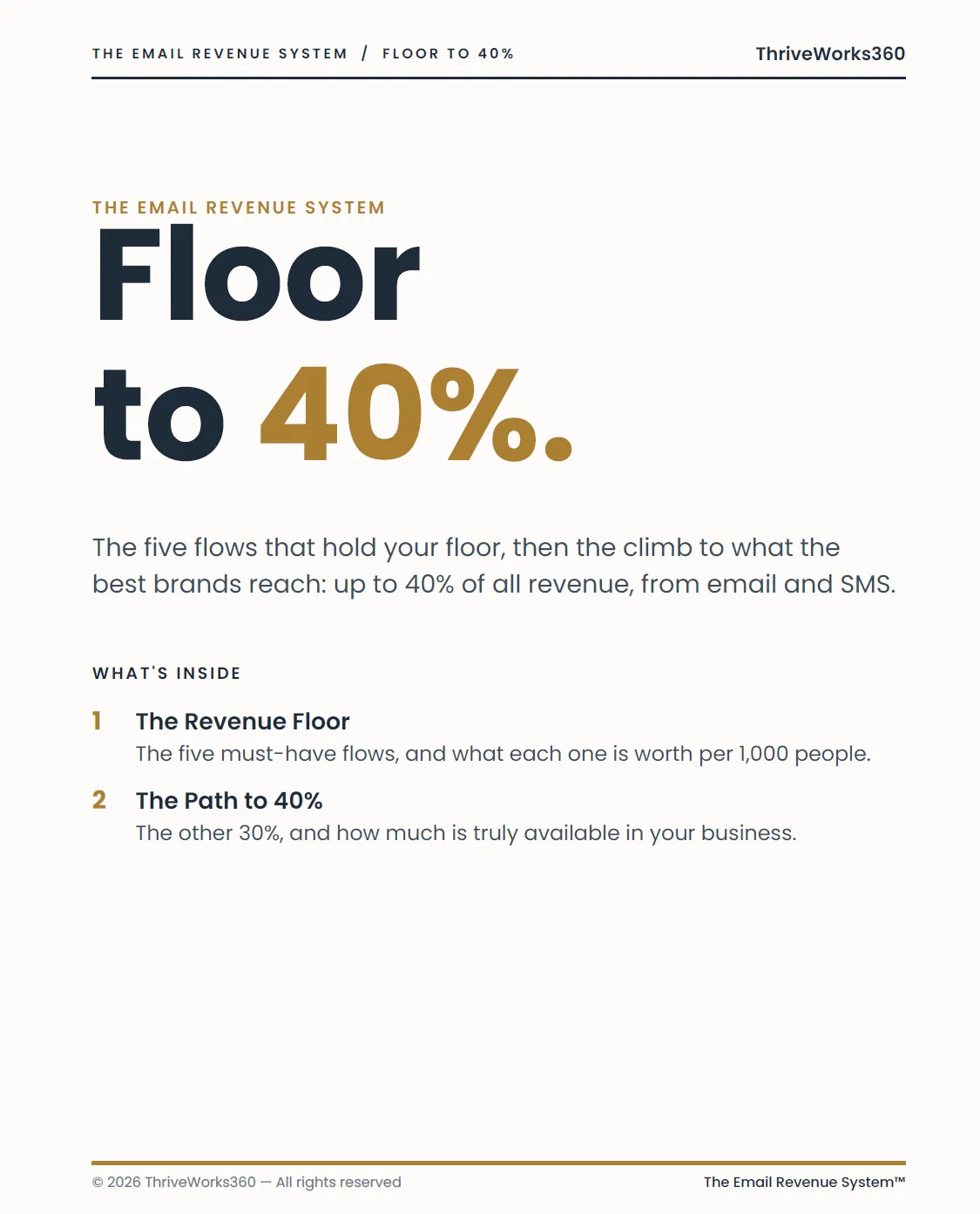
The Email Revenue System Floor to 40%.
The five flows that hold your floor, then the climb to what the best brands reach: up to 40% of all revenue, from email and SMS.
The Revenue Floor - The five must-have flows, and what each one is worth per 1,000 people.What did email make you last month?
The Path to 40% - The other 30%, and how much is truly available in your business.

See the money already in your business, climbing in real time.
Slide in your two numbers, then answer 15 quick questions. Watch the dollar figure move as you go. By the end, you'll know your biggest pocket of found money, the fastest switches to flip, and roughly what it's worth — before you spend a cent on new ads.
Your List
Your Automations
Your Repeat Buyers
Your Offers & Pricing
Your Between-Launch Revenue
Answer all 15 to lock your result
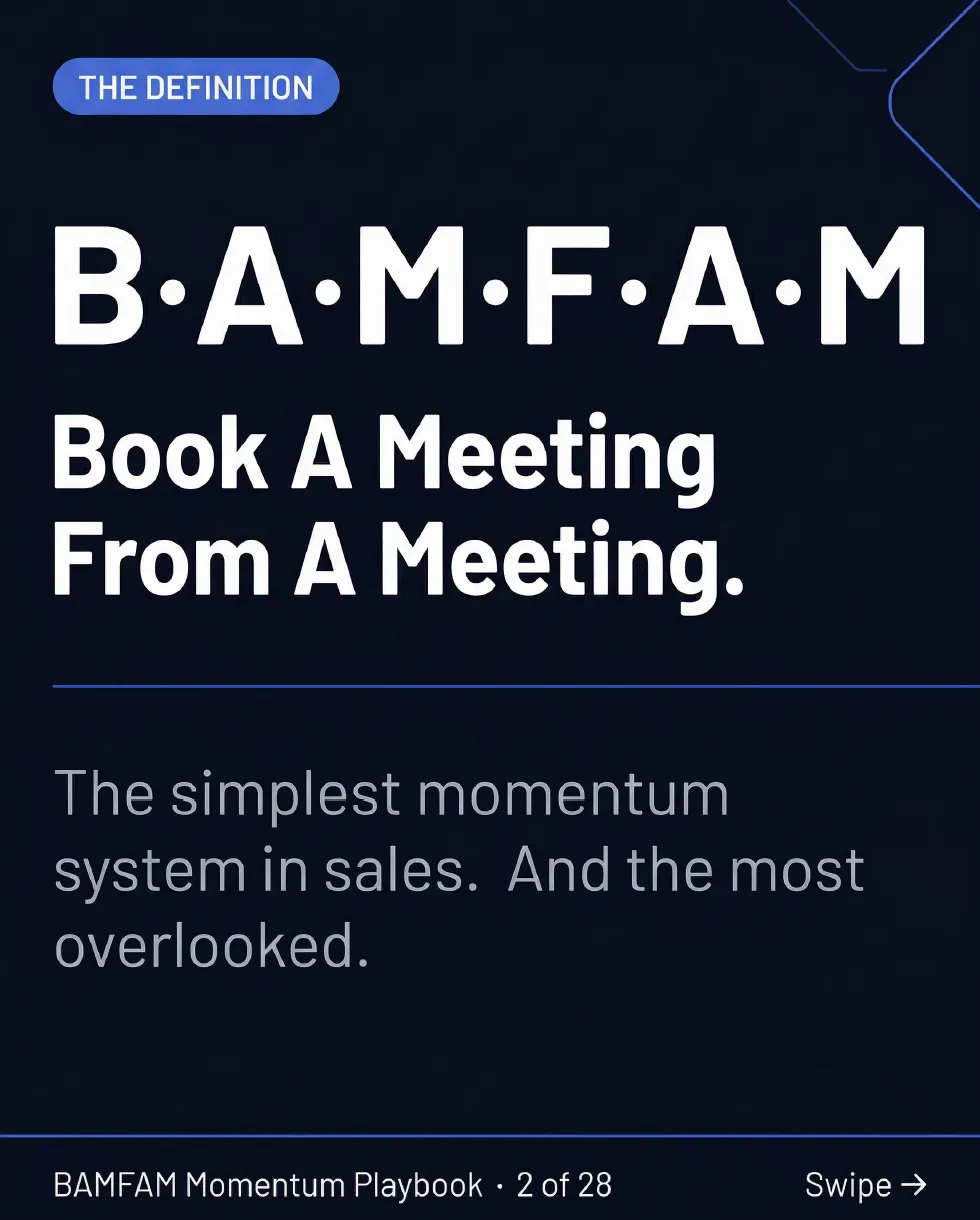
Connect • Clarify • Confirm • Calendar: The 4-Beat Playbook That Ends the Follow-Up Chase.
Discover how the BAMFAM Momentum Playbook reveals the exact strategies to:
Book the Next Meeting While You're Still in the Meeting
Turn "Let Me Get Back to You" Into a Yes (It's Friction, Not Rejection)
Kill the "Just Bumping This Up" Email Forever
Make Momentum Measurable With the Team Scorecard

Stop • Scan • Decide: The 3-Step Playbook to Win the First 51 Seconds.
Discover how the FOCUS360 Playbook reveals the exact strategies to:
FREE GPT Agent to test and build your content
Stop the Scroll on Command
Hold Attention for the First 51 Seconds:
Multiply Conversions With a Single Clear Path:
Unlock Your Business’s Full Potential – Without the Pain
Step into the realm of effortless growth with our P.A.I.N.-L.E.S.S. Playbook.
Designed for entrepreneurs who seek the "Golden Nuggets" that transform them and their businesses without the overwhelming stress. This tool shows a simple and streamlined path toward business success.

Take Control of Your Journey with Our Ultimate FREE Autopilot 360 System Masterclass and Cheat Sheet.
Build A Self-Managed Business And Break Through 6-7 Figures To 8 Figures While Seamlessly Producing Huge Profits!


Uncover Hidden Revenue in 3 Simple Steps
See more details about how this impacts business performance.
PAID COURSE

CORE360: Multiply Your Message — Without Writing a Single Word
See how to easliy increase your visibility with the CORE360 System and AI-driven Prompt Booster Pack™
Built for founders and entrepreneurs who already say brilliant things — this AI-optimized vault gives you the exact prompts to turn one voice note into days of content across Instagram, LinkedIn, TikTok, YouTube Shorts, and Facebook.
No burnout. No blank pages. Just scroll-stopping content formulas that match your voice and work on every platform.
A simple upgrade with exponential reach.
BLOG
Why More Customers Don't Always Mean a More Valuable Business
700 customers this year, up from 500 last year. The dashboard looks great. But customer count tells you almost nothing about whether the business actually got stronger.
More customers. More revenue. More growth.
It sounds like a simple equation. If you had 500 customers last year and 700 this year, the business must be getting stronger, right?
Not necessarily.
Customer growth can look impressive on a dashboard while quietly creating more work, thinner margins, higher support costs, and less predictable cash flow underneath it. That's why customer count alone tells you very little about the quality of your growth.
What matters more is customer profitability. Knowing which customers actually contribute real profit after you account for what it costs to acquire, serve, support, fulfill, and keep them. Because a business with fewer profitable customers can be in far better shape than one with thousands of customers who barely move the bottom line.
Revenue Tells You What Came In. Profitability Tells You What Stayed.
One of the easiest mistakes in a growing business is assuming a high-revenue customer must also be a valuable one.
Picture two customers who each generate $100,000 a year. On a sales report, they look identical.
But Customer A pays close to full price, orders predictably, rarely needs support, pays on time, and stays with you year after year. Customer B negotiates every discount, places complicated orders, needs manual intervention, contacts support every week, returns products constantly, and pays late.
Same revenue. Completely different economics.
That gap is the whole point. Revenue answers "how much did this customer buy?" Profitability asks a better question: after everything it took to win and serve this customer, how much value did the relationship actually create? That second question gives leadership a far clearer picture of the business.
More Customers Can Just Mean More Complexity
Growth creates work. Every new customer brings some mix of acquisition expense, onboarding, fulfillment, service, billing, returns, account management, customization, and admin.
When those costs stay controlled, growth works. But when the cost of serving customers rises faster than the profit they generate, adding more customers just magnifies the inefficiency.
That's the trap. Sales are up, so everyone assumes things are moving the right way. Meanwhile support tickets climb, operations hires faster than planned, discounts creep in, fulfillment exceptions multiply, margins thin out, and finance spends more time reconciling data. Leadership sees growth. The organization feels more strained than ever.
The problem usually isn't that the company has too many customers. It's that nobody knows which customers are worth growing.
Profitability Means Looking Beyond the Sale
A useful profitability picture considers more than invoice value. You have to understand the economics around the whole relationship. Start with revenue, then look at the costs attached to earning and keeping it.
Acquisition cost. What did it cost to win the customer? Ads, outbound sales, commissions, promotions, discounts, sales-team time. A customer who generates $5,000 but cost $3,000 to acquire starts from a very different place than one acquired for $300.
Cost to serve. Some customers need almost nothing after the sale. Others eat hours of support, account management, troubleshooting, and admin. Those costs rarely show up next to the customer's name on a revenue report, but they hit profitability just the same.
Fulfillment and operations. Shipping, special packaging, expedited orders, complex invoicing, returns, rework, exceptions. All of it can quietly reshape the economics of an account, especially when two customers buy similar amounts but behave completely differently operationally.
Retention and lifetime value. A customer who buys once and disappears shouldn't be judged the same as one who stays for years. Retention changes the math, because acquisition cost gets spread across a longer, more valuable relationship. That's why lifetime value belongs right next to acquisition cost, not in a separate conversation.
Your Biggest Account May Not Be Your Best One
Businesses naturally pay attention to large accounts. And they should. But size can hide problems.
A big customer may also demand aggressive pricing, special service levels, custom processes, extended payment terms, and a lot of internal resources. A smaller customer might buy consistently, need almost no attention, pay quickly, refer others, and stay for years.
Which one is more valuable? You can't answer that from revenue alone. That's where profitability becomes a management tool, not just a finance metric. It gives sales, operations, finance, and leadership a shared way to judge the quality of revenue.
Five Questions That Reveal the Quality of Your Customer Base
You don't need a perfect model before you start asking better questions. Begin here.
1. Which customers generate the highest contribution margin? Look past gross sales to what's left after the direct costs of serving them. This alone starts separating high-volume customers from genuinely profitable ones.
2. Which customers require the most operational effort? Ask your operations and service teams. They usually know instantly which accounts create exceptions, manual work, and repeated problems. If that never reaches financial reporting, leadership is missing half the picture.
3. Which segments stay the longest? If one type of customer consistently stays, buys again, and needs little support, that segment may deserve more attention even if the first purchase is small.
4. Where are discounts hiding weak economics? Discounts help close business, but frequent discounting makes revenue look stronger than the profit behind it. Look at profitability after discounts, not before.
5. Are we spending acquisition dollars on the right customers? This might be the most important one. If your most expensive channels are producing customers with poor retention or high service costs, scaling those channels just makes the problem bigger. More leads and more customers don't fix weak unit economics. They multiply them.
The CFO and the COO Are Describing the Same Customer
Profitability isn't only a finance issue. The CFO sees margin compression. The COO sees rising workload. Sales sees a major account. Customer service sees a demanding relationship.
All four might be describing the same customer.
The value comes from connecting those views. Finance shows what the customer contributes. Operations shows what it takes to deliver. Sales explains the relationship and growth potential. Service reveals the ongoing support burden. Put those together and you get a realistic view of customer value, which leads to much better decisions.
Better Growth Starts With Better Visibility
The goal isn't to fire every difficult customer or refuse low-margin business. Sometimes a strategically important customer is worth serving even at lower profit. Sometimes an early relationship becomes profitable over time. Sometimes an operational problem is simply fixable.
The point is to know. Without visibility, leadership is guessing.
A practical approach runs in three stages. First, stabilize the data so revenue, discounts, acquisition costs, fulfillment expenses, returns, and service requirements can be understood with reasonable confidence. Then connect the picture by bringing financial, sales, customer, and operational information together, so profitability can be viewed by customer, segment, product, or channel. Then use the insight to make better growth decisions: which customer types deserve more acquisition budget, which service processes need to change, where pricing should shift, and which segments create the best balance of revenue, margin, retention, and effort. Those are far stronger questions than "how do we get more customers?"
More Customers Are Valuable When They're the Right Customers
Customer growth isn't the problem. Unexamined customer growth is.
A growing customer base can absolutely make a company stronger, but only when those relationships produce healthy economics and can be supported without runaway cost or complexity. That's why customer profitability deserves a place next to revenue growth, acquisition numbers, and customer count on the leadership dashboard.
More is not automatically better. Better is better.
The strongest businesses know which customers create real economic value, what makes those relationships profitable, and how to attract more customers who look like them. So if your customer count is climbing but margins, cash flow, or operational efficiency aren't climbing with it, the next move may not be another growth campaign. Start by understanding the customers you already have. Map revenue against acquisition cost, retention, contribution margin, and cost to serve, and look for the gap between the customers who appear valuable and the ones who actually are. That gap is usually where the clearest path to profitable growth begins.
If your customer count is up but your margins and cash flow aren't, book a call here. I'd like to help you see which customers are actually creating value and which are quietly costing you. No pitch, just an honest read on the quality of your growth.
Not ready for that yet? Join our free community here for more on growing with the right customers instead of just more of them.
Frequently Asked Questions
What is customer profitability?
It measures the real financial value of a customer or segment after accounting for the revenue they generate and the costs of acquiring, serving, fulfilling, supporting, and retaining them.
How do you calculate it?
At a basic level, start with the revenue a customer generates and subtract the costs directly tied to winning and serving them. More mature models also factor in acquisition cost, discounts, returns, support, fulfillment, account management, and retention.
Can a high-revenue customer be unprofitable?
Yes. A customer can bring in significant revenue while also requiring heavy discounts, expensive fulfillment, constant support, frequent returns, or a lot of manual work. Revenue alone never shows the full economics.
Which metrics should you track?
Contribution margin, customer acquisition cost, lifetime value, retention, gross margin, cost to serve, discount levels, and profitability by segment.
ThriveWorks360


Free Weekly Productivity Insights
Sign up for Sunday Snippets - my weekly newsletter where I I share actionable productivity tips, practical life advice, and high-quality insights from across the web, directly to your inbox.
What People Are Saying

Driving Growth, Amplifying Impact

Grace Company

8th to 2nd most recognized brands in the industry in one year

J&B Sewing
Launched new product line and grew 300% in two years

Sewrite
Increased national distribution, D2C Revenue by 400%.
Get In Touch
Email: [email protected]
Address
Office: 14881 S. Auburn Sky Dr
Assistance Hours
Mon – Sat 9:00am – 8:00pm
Sunday – CLOSED
Phone Number:
(888) 870-7314
Contact Us:
BECOME AN TW360 INSIDER
Sign up for exlcusive content, emails, & things Nathan doesn't share anywhere else.
Unleash Your Business Brilliance.
Reach out and connect for your opportunity to shine!
© 2026 ThriveWorks360 - All Rights Reserved, copyright 2024