Free Tools & Resources
Everything You Need to See What's Broken and Fix It.
These tools are used inside real $1M–$20M businesses. Pick the one that matches where you're stuck, and start there.
Free Tools
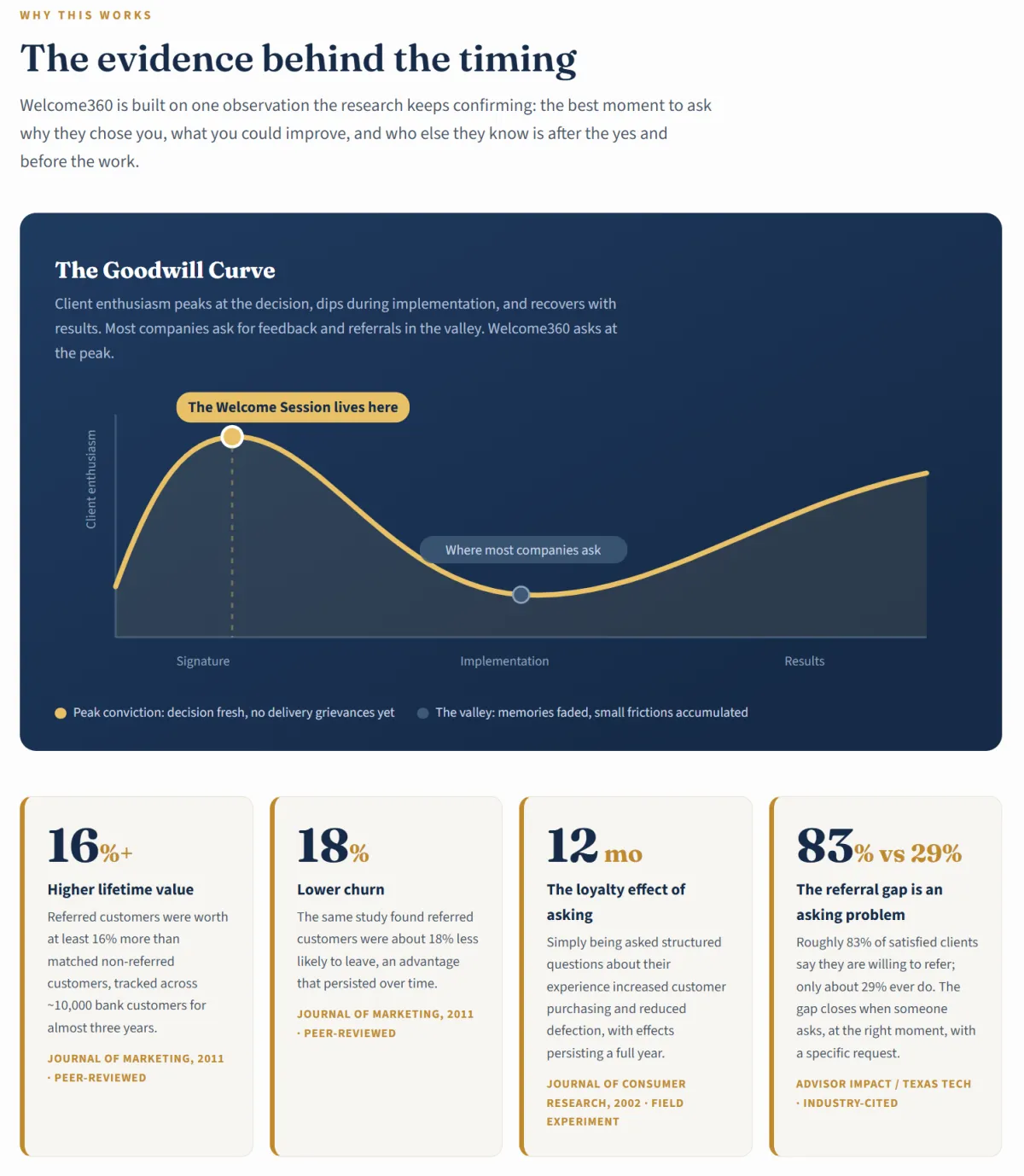
Welcome360 • A Client Growth System: The 45-Minute Meeting That Turns Every New Client Into Referrals.
Discover how the Welcome360 System reveals the exact strategies to:
Ask for Referrals at Peak Goodwill — Before the Honeymoon Ever Fades
FREE AI Insight Miner: Turn One Client Conversation Into 7 Finished Business Assets
Capture the Exact Words Clients Use to Sell You (Then Reuse Them Everywhere)
Close the Feedback Loop That Makes Clients Refer Twice
Sellthrough360 - Flows, Bundling, Upselling Systems for Revenue Generation
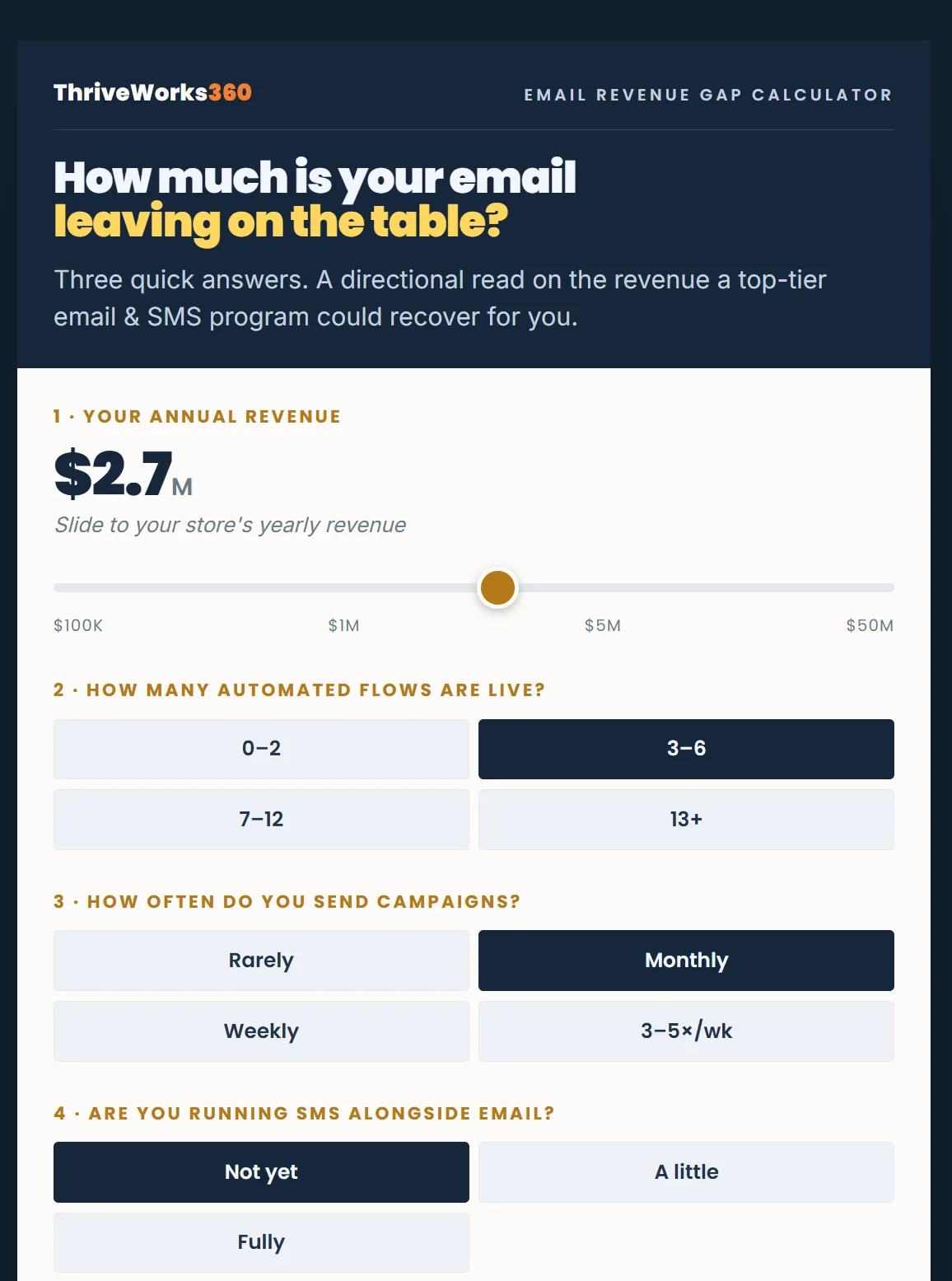
How much is your email leaving on the table?
Three quick answers. A directional read on the revenue a top-tier email & SMS program could recover for you.
Your annual revenue
How many automated flows are live?
How often do you send campaigns?
Are you running SMS alongside email?
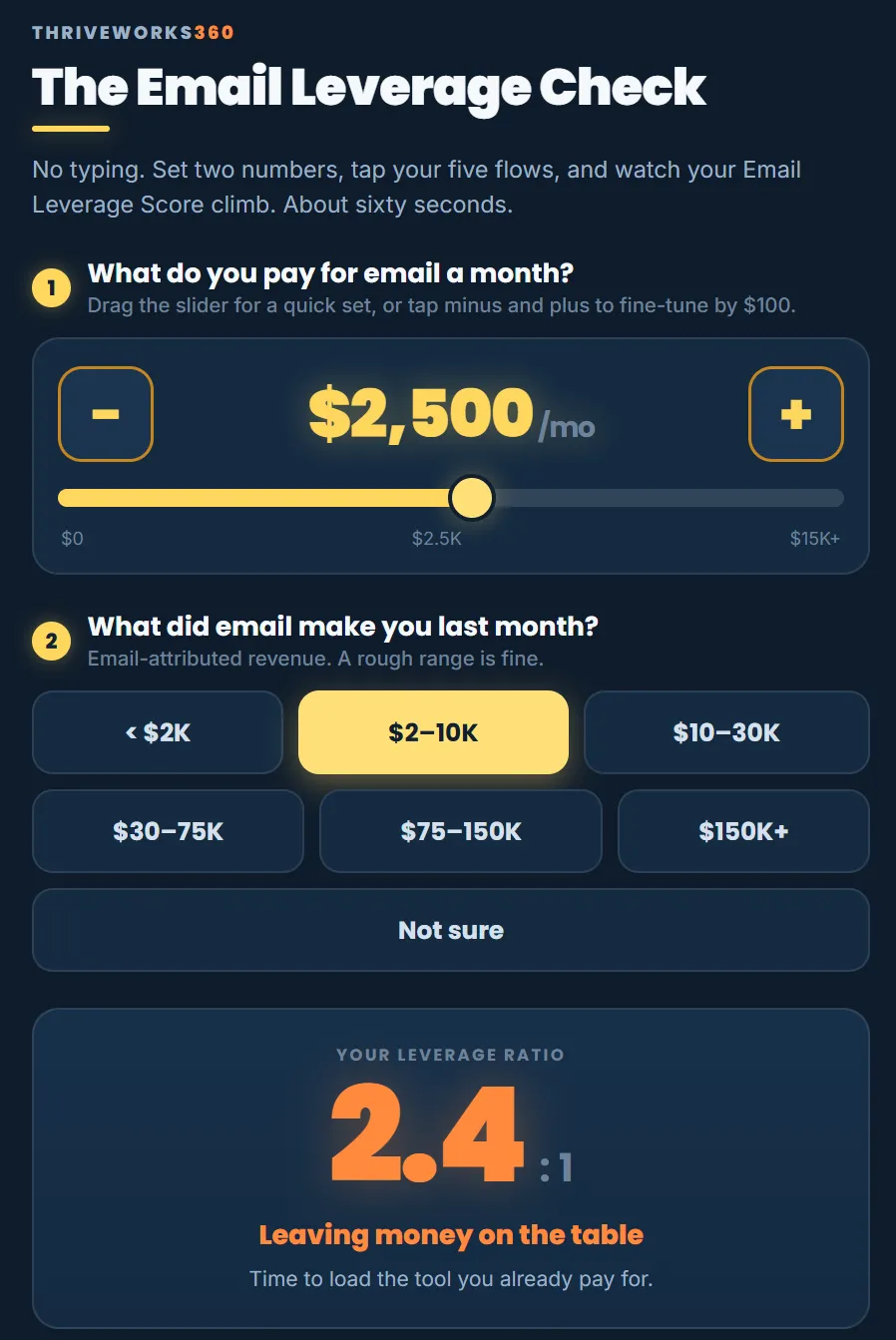
The Email Leverage Check
No typing. Set two numbers, tap your five flows, and watch your Email Leverage Score climb. About sixty seconds.
What do you pay for email a month?
What did email make you last month?
Which of these 5 are running?
Download a printable form
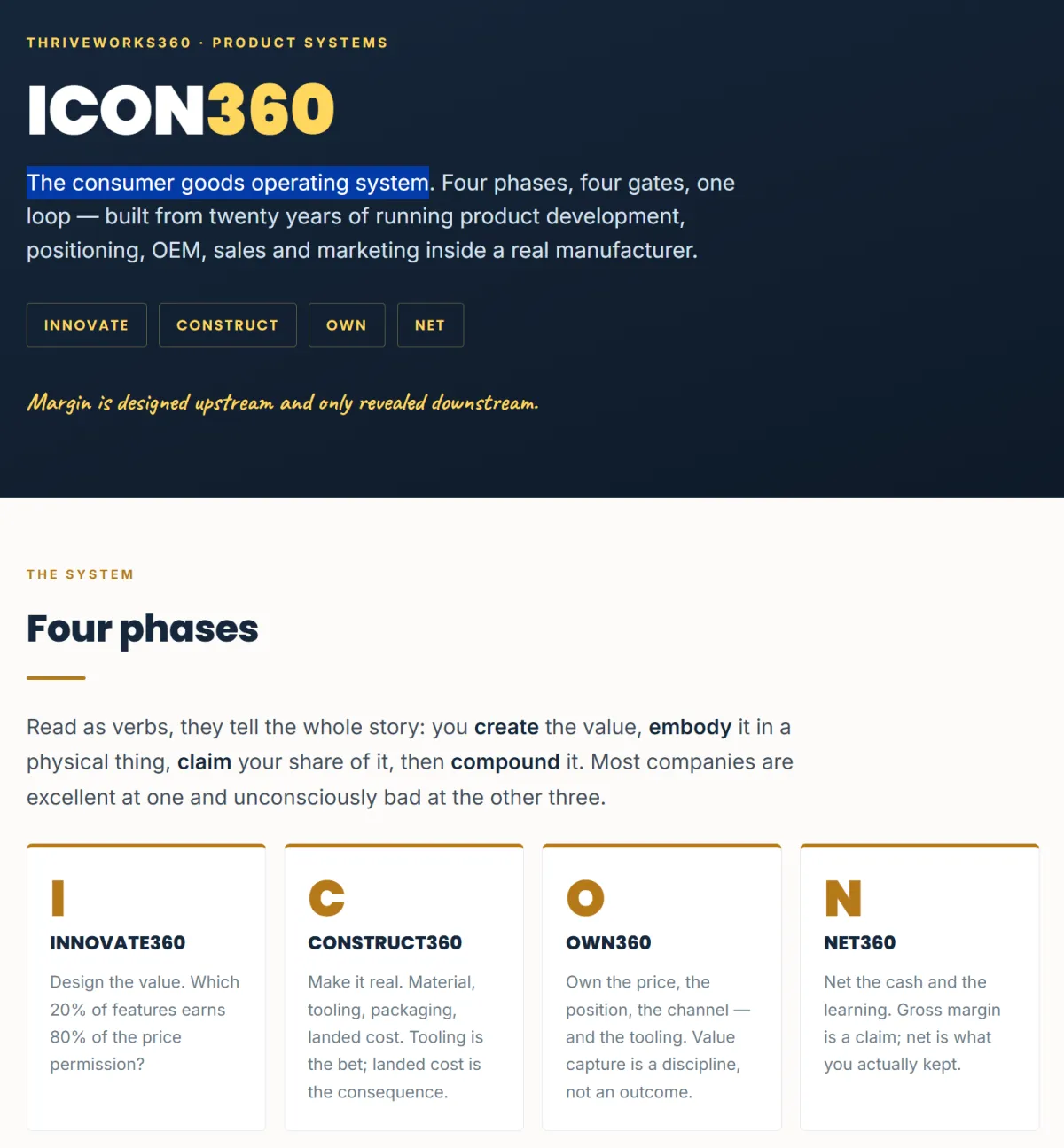
ICON360
The consumer goods operating system.
INNOVATE360 - Design the value. Which 20% of features earns 80% of the price permission?
CONSTRUCT360 - Make it real. Material, tooling, packaging, landed cost. Tooling is the bet; landed cost is the consequence.
OWN360 - Own the price, the position, the channel — and the tooling. Value capture is a discipline, not an outcome.
NET360 - Net the cash and the learning. Gross margin is a claim; net is what you actually kept.
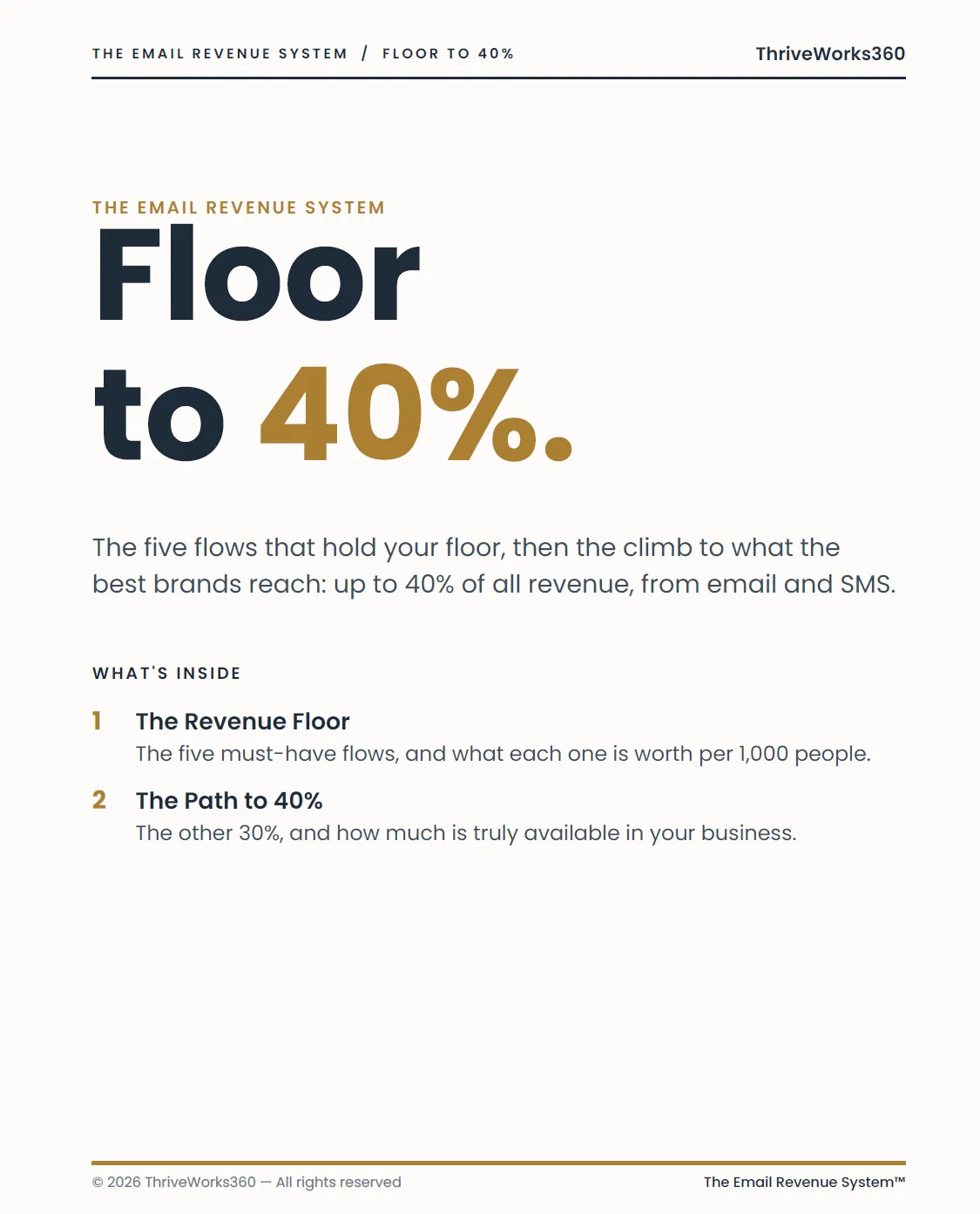
The Email Revenue System Floor to 40%.
The five flows that hold your floor, then the climb to what the best brands reach: up to 40% of all revenue, from email and SMS.
The Revenue Floor - The five must-have flows, and what each one is worth per 1,000 people.What did email make you last month?
The Path to 40% - The other 30%, and how much is truly available in your business.

See the money already in your business, climbing in real time.
Slide in your two numbers, then answer 15 quick questions. Watch the dollar figure move as you go. By the end, you'll know your biggest pocket of found money, the fastest switches to flip, and roughly what it's worth — before you spend a cent on new ads.
Your List
Your Automations
Your Repeat Buyers
Your Offers & Pricing
Your Between-Launch Revenue
Answer all 15 to lock your result
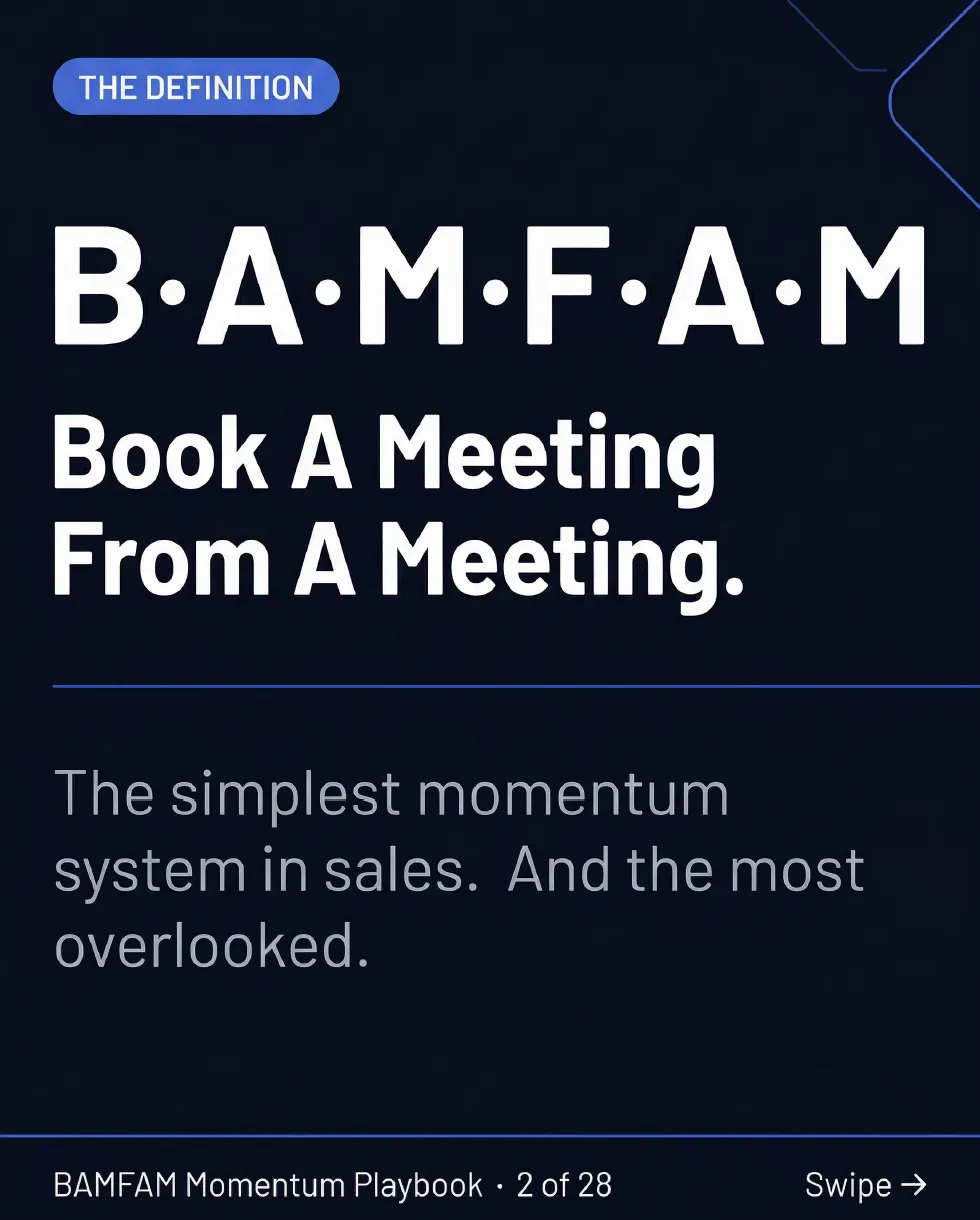
Connect • Clarify • Confirm • Calendar: The 4-Beat Playbook That Ends the Follow-Up Chase.
Discover how the BAMFAM Momentum Playbook reveals the exact strategies to:
Book the Next Meeting While You're Still in the Meeting
Turn "Let Me Get Back to You" Into a Yes (It's Friction, Not Rejection)
Kill the "Just Bumping This Up" Email Forever
Make Momentum Measurable With the Team Scorecard
Stop • Scan • Decide: The 3-Step Playbook to Win the First 51 Seconds.
Discover how the FOCUS360 Playbook reveals the exact strategies to:
FREE GPT Agent to test and build your content
Stop the Scroll on Command
Hold Attention for the First 51 Seconds:
Multiply Conversions With a Single Clear Path:
Unlock Your Business’s Full Potential – Without the Pain
Step into the realm of effortless growth with our P.A.I.N.-L.E.S.S. Playbook.
Designed for entrepreneurs who seek the "Golden Nuggets" that transform them and their businesses without the overwhelming stress. This tool shows a simple and streamlined path toward business success.
Take Control of Your Journey with Our Ultimate FREE Autopilot 360 System Masterclass and Cheat Sheet.
Build A Self-Managed Business And Break Through 6-7 Figures To 8 Figures While Seamlessly Producing Huge Profits!


Uncover Hidden Revenue in 3 Simple Steps
See more details about how this impacts business performance.
PAID COURSE
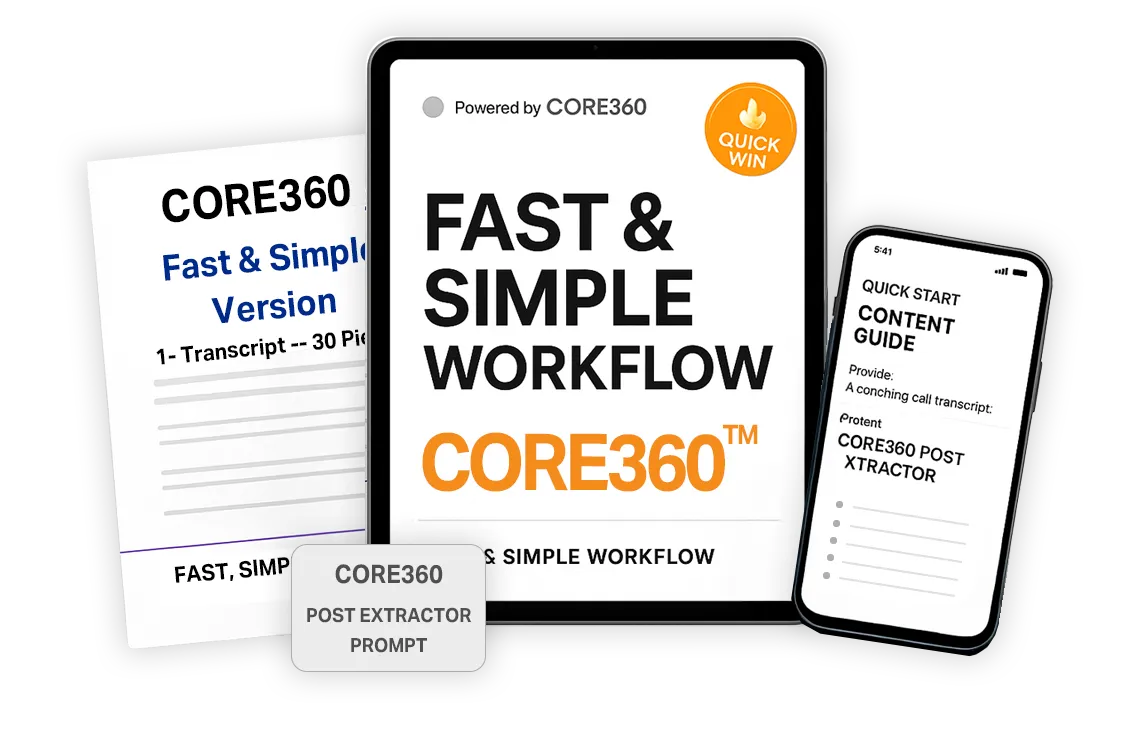
CORE360: Multiply Your Message — Without Writing a Single Word
See how to easliy increase your visibility with the CORE360 System and AI-driven Prompt Booster Pack™
Built for founders and entrepreneurs who already say brilliant things — this AI-optimized vault gives you the exact prompts to turn one voice note into days of content across Instagram, LinkedIn, TikTok, YouTube Shorts, and Facebook.
No burnout. No blank pages. Just scroll-stopping content formulas that match your voice and work on every platform.
A simple upgrade with exponential reach.
BLOG
7 Signs Your Business Has Outgrown Its Operating Model
A single process can be fixed. But when the whole way your business runs no longer fits the company you've become, fixing one workflow at a time won't help. That's a different problem.
Growth is supposed to make a business stronger. Sometimes it does something else first.
It exposes every process that depends on one person knowing what to do. Every spreadsheet that was supposed to be temporary. Every approval that still has to pass through leadership. Every department that quietly built its own way of working.
None of those look serious on their own. They're easy to write off as the normal mess of growing. Until the business hits a point where growth itself starts creating more friction than momentum.
That's usually when the problem is no longer one process, one employee, or one software platform. It's the operating model itself.
Your operating model is simply how your business gets work done. It's the way people, processes, systems, responsibilities, decisions, and accountability all connect. And when those pieces were designed, formally or by accident, for a smaller company, they eventually turn into a constraint. The trouble is that fixing one broken workflow doesn't help when the real issue is the whole structure around it.
So how do you know you've hit that point? Here are seven signs.
1. Growth Is Creating More Complexity Than Capacity
Growth always brings complexity. More customers, more transactions. More employees, more communication. New locations, products, and departments add more decisions and dependencies.
The problem starts when complexity is growing faster than your ability to manage it. Revenue is up, but operations now need a lot more manual coordination. Every new customer adds another layer of admin. Adding a department produced more meetings instead of faster execution.
That's a capacity problem. A scalable operating model lets the organization absorb growth without an equally large jump in coordination, manual work, and management attention. If every step forward makes the company harder to run, the answer isn't to push the team harder. It's to look at the model underneath them.
2. Leadership Is Still the Bottleneck
There's a stage where the founder being involved in almost everything makes sense. Eventually it stops making sense.
When routine decisions keep traveling up to the CEO or COO, growth starts competing for the exact leadership capacity you need to keep daily operations moving. You hear it in the language. "Let me check with leadership." "We need approval before we can move forward." "Only one person knows how this is handled."
The issue usually isn't that leadership needs to work faster. It's that decision rights, responsibilities, and accountability never evolved with the business. Senior leaders should be spending more of their time on strategy as the company grows, not becoming the approval layer for an ever-larger pile of operational work. If everything important still runs through a few people, the company has scaled faster than its structure.
3. Workarounds Have Become the Process
Every company has workarounds. Someone exports a report into Excel because the system doesn't quite show what finance needs. A team copies information between platforms. Someone keeps a separate tracker for a detail the main system can't hold.
One workaround is manageable. Twenty connected workarounds are an operating model. The warning sign is when those temporary fixes quietly become the normal way work gets done, so ingrained that nobody notices them anymore. Familiarity doesn't make a process efficient. Before you buy another platform or hire another person, ask why the workaround exists in the first place. Sometimes it's technology. Often it's process design, unclear ownership, or a disconnect between departments.
4. Nobody Is Quite Sure Who Owns What
As companies grow, work gets more cross-functional. Sales affects operations. Operations affects finance. Customer experience touches almost everyone. Without clear ownership, all that interconnection creates ambiguity.
Something goes wrong, several people were involved, and nobody actually owned the outcome. Or two departments each assume the other was responsible. Or everyone owns a small piece of a process while nobody owns it from start to finish. That fog slows decisions and makes accountability nearly impossible.
A stronger operating model doesn't just hand out job descriptions. It establishes who owns decisions, who owns outcomes, and how responsibility moves across functions. People should know not only what they're responsible for, but where their responsibility begins and ends.
5. Different Departments Work From Different Versions of Reality
Ask finance, sales, and operations the same question and see if you get the same answer.
If each department has different numbers, different systems, different definitions, and different spreadsheets, you've got more than a reporting problem. You've got an alignment problem.
One team counts customers one way, another counts them differently. Finance trusts one system while operations keeps a separate tracker. And leadership burns the first half of every meeting arguing about whose numbers are right before anyone talks about what the numbers actually mean. That makes every decision slower and less reliable, because you're deciding on top of a disagreement about the facts.
The goal isn't to force every department into one tool. It's to create enough consistency in data, ownership, and reporting that everyone operates from a shared understanding of the business. When that shared understanding disappears, coordination gets expensive fast. This is one of the clearest signs the problem has moved from a single process to the whole model.
6. Adding People Isn't Fixing It Anymore
Hiring is one of the most common responses to operational pressure. The team's overloaded, so another person gets added. Then another. Sometimes that's exactly right.
But headcount can't permanently paper over a broken structure. If every jump in volume needs another person just to coordinate work, reconcile systems, move information, and manage exceptions, adding people only makes the underlying complexity bigger. Now more people are participating in the same inefficient workflow.
This is where you separate a true capacity shortage from an operating-model problem. Ask a few honest questions. If volume doubled tomorrow, would this process still work? Would we need twice the people? Would leadership have to approve twice as many decisions? Would the spreadsheets, handoffs, and meetings double too? The answers tell you a lot about whether the company is actually scalable.
7. Strategy Moves Faster Than Execution
Leadership knows where the company needs to go. The opportunity is clear. The priorities have been set. The strategy makes sense. And execution keeps falling behind anyway.
Projects stall between departments. Priorities fight over the same resources. Decisions drag. Teams stay busy, but the strategic initiatives never quite move. That gap between strategy and execution is one of the clearest signs the operating structure needs attention.
Strategy doesn't execute itself. The organization needs the processes, accountability, information, and decision-making structures to turn direction into coordinated action. If leadership keeps asking "why is this taking so long?", the answer usually isn't effort. It's that the company is trying to execute tomorrow's strategy through yesterday's operating model.
The Mistake: Treating Every Symptom Separately
This is where companies lose months. A reporting problem leads to new software. An overloaded department leads to another hire. Communication problems lead to more meetings. Inconsistent execution leads to yet another project-management process.
Each decision is reasonable on its own. But if all those problems share one root cause, solving them one at a time just builds a more complicated organization. A better approach is to look at the whole operating environment at once, how people, processes, technology, accountability, information, and decisions interact, and then figure out which problems are symptoms and which are actually causes.
What Should Change First?
You don't need to redesign the entire company at once. A practical approach runs in three stages.
Stabilize. Find what's creating friction right now. Where are the bottlenecks? Where is ownership unclear? Which processes depend on manual work? What keeps needing leadership to step in? Clear the barriers blocking consistent execution first.
Catalyze. Once the friction is visible, improve the systems underneath it. Clarify responsibilities and decision rights. Redesign the workflows. Connect processes across departments. Improve how information moves. The goal isn't change for its own sake. It's an operating structure that fits the company you actually are today.
Maximize. Only then do you use that stronger foundation to accelerate. Better visibility makes decisions easier. Clear ownership improves execution. Scalable processes create capacity. Leadership finally gets room to focus on strategy instead of constantly resolving operational fires. And growth stops depending on heroic effort.
Has Your Business Outgrown Its Operating Model?
One of these signs alone doesn't mean the whole company needs to change. But patterns matter.
If leadership is becoming a bottleneck, departments run on different versions of reality, manual work keeps climbing, ownership is unclear, and hiring isn't solving it, those issues are probably connected. The question stops being "which process should we fix?" and becomes something bigger. Does the way our business operates still fit the business we've become?
That's the question worth answering before you add another system, another employee, or another layer of process. Because the goal isn't to make today's operations slightly more efficient. It's to build an operating model that can actually carry where the company wants to go next. Clarity first, then the plan.
If several of these signs feel familiar, book a call here. I'd like to map the friction across your people, processes, and decisions and help you see where the real gaps are, before you change anything. No pitch, just an honest read on whether your operating model still fits the business.
Not ready for that yet? Join our free community here for more on building a way of operating that grows with the company instead of holding it back.
ThriveWorks360

Free Weekly Productivity Insights
Sign up for Sunday Snippets - my weekly newsletter where I I share actionable productivity tips, practical life advice, and high-quality insights from across the web, directly to your inbox.
What People Are Saying

Driving Growth, Amplifying Impact

Grace Company

8th to 2nd most recognized brands in the industry in one year

J&B Sewing
Launched new product line and grew 300% in two years

Sewrite
Increased national distribution, D2C Revenue by 400%.
Get In Touch
Email: [email protected]
Address
Office: 14881 S. Auburn Sky Dr
Assistance Hours
Mon – Sat 9:00am – 8:00pm
Sunday – CLOSED
Phone Number:
(888) 870-7314
Contact Us:
BECOME AN TW360 INSIDER
Sign up for exlcusive content, emails, & things Nathan doesn't share anywhere else.
Unleash Your Business Brilliance.
Reach out and connect for your opportunity to shine!
© 2026 ThriveWorks360 - All Rights Reserved, copyright 2024