FREE Tools
Select from below to learn more!
Free Tools
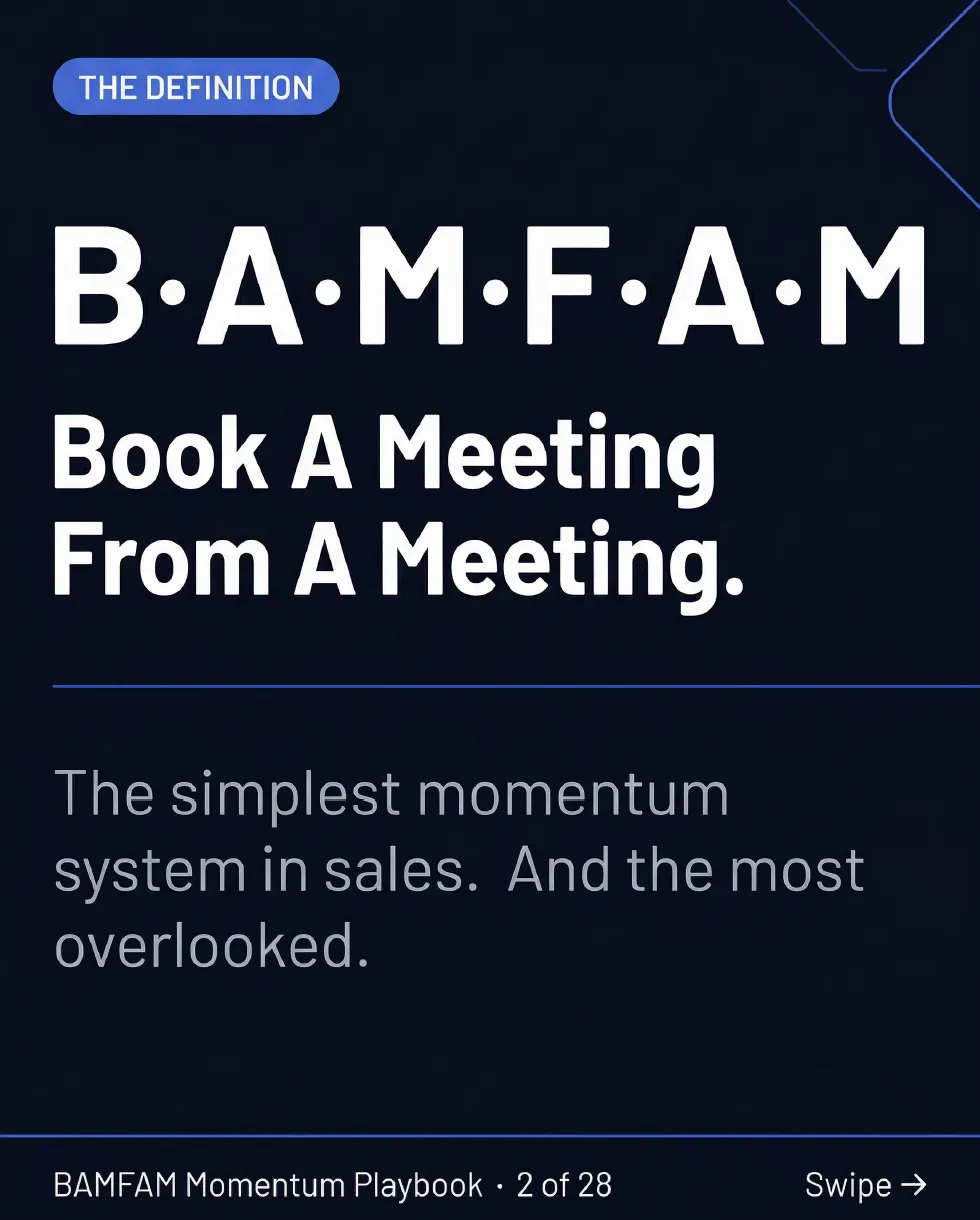
Connect • Clarify • Confirm • Calendar: The 4-Beat Playbook That Ends the Follow-Up Chase.
Discover how the BAMFAM Momentum Playbook reveals the exact strategies to:
Book the Next Meeting While You're Still in the Meeting
Turn "Let Me Get Back to You" Into a Yes (It's Friction, Not Rejection)
Kill the "Just Bumping This Up" Email Forever
Make Momentum Measurable With the Team Scorecard

Stop • Scan • Decide: The 3-Step Playbook to Win the First 51 Seconds.
Discover how the FOCUS360 Playbook reveals the exact strategies to:
FREE GPT Agent to test and build your content
Stop the Scroll on Command
Hold Attention for the First 51 Seconds:
Multiply Conversions With a Single Clear Path:
Unlock Your Business’s Full Potential – Without the Pain
Step into the realm of effortless growth with our P.A.I.N.-L.E.S.S. Playbook.
Designed for entrepreneurs who seek the "Golden Nuggets" that transform them and their businesses without the overwhelming stress. This tool shows a simple and streamlined path toward business success.

Take Control of Your Journey with Our Ultimate FREE Autopilot 360 System Masterclass and Cheat Sheet.
Build A Self-Managed Business And Break Through 6-7 Figures To 8 Figures While Seamlessly Producing Huge Profits!


Uncover Hidden Revenue in 3 Simple Steps
See more details about how this impacts business performance.
PAID COURSE

CORE360: Multiply Your Message — Without Writing a Single Word
See how to easliy increase your visibility with the CORE360 System and AI-driven Prompt Booster Pack™
Built for founders and entrepreneurs who already say brilliant things — this AI-optimized vault gives you the exact prompts to turn one voice note into days of content across Instagram, LinkedIn, TikTok, YouTube Shorts, and Facebook.
No burnout. No blank pages. Just scroll-stopping content formulas that match your voice and work on every platform.
A simple upgrade with exponential reach.
BLOG
The Founder Bottleneck: How to Tell If You're the Reason Your Business Isn't Growing
The habits that built your business are usually the ones now capping it. Here's how to spot the ceiling and lift it.
You hired smart people. You invested in the software. You work harder than anyone else on the team.
And yet growth feels… stuck.
Revenue flattens out. Decisions pile up on your desk. People wait on your approval before they move. And somehow every problem that actually matters finds its way back to you.
What makes it maddening is that the business isn't failing it might be doing genuinely well. It's just not growing the way you pictured when you started.
So here's the uncomfortable possibility, and then I'll get out of the way: you might be the bottleneck.
Before you wince this isn't a founder-shaming exercise. Just the opposite. Most founder bottlenecks are built by success. The exact instincts that got the business off the ground quietly turn into the thing holding it down. Let's talk about how to tell whether that's happening to you, and what to actually do about it.
What a Founder Bottleneck Actually Is
A founder bottleneck shows up when too many decisions, relationships, and processes all run through one person.
The business can only move as fast as you can.
Early on, that feels completely normal and it is. You know the customers better than anyone, you make the calls fast, you catch problems before anyone else even notices them.
Then the company grows. Ten people need your sign-off. Then twenty. And at some point your calendar quietly becomes the operating system the whole business runs on.
Growth slows after that. Not because the team isn't talented, and not because the market shifted. It slows because the company was designed around you and that design has a ceiling baked in.
The Misunderstanding That Keeps Founders Stuck
Most founders assume the fix is delegation. I need to trust the team more. Hire better people. Work less.
Sometimes that helps, sure.
But more often the real issue is something else entirely: the business has no system for making decisions without you in the loop.
Sit with that for a second. If every client exception, every pricing question, every hire, every strategic call eventually lands on your desk pulling yourself out isn't a delegation problem. It's a design problem. You built a business that depends on your presence, and businesses built that way always hit a wall eventually.
That distinction matters, because you can't delegate your way out of a structure that was never built to run without you. You have to redesign it.
7 Signs You Might Be the Bottleneck
They don't all look the same. Some are obvious; others hide behind strong revenue and a packed calendar. See how many feel a little too familiar.
1. Everyone waits on your approval. Can I send this? What should we charge? Should we move ahead? Flattering at first. Exhausting by month six. If your people can't make routine calls without you, you've become the approval department and approvals don't scale.
2. Vacations turn into chaos. Picture vanishing for two weeks. If your gut says "nothing would get done" or "I'd come back to a hundred fires," that's the tell. Healthy businesses keep moving when the founder steps out. Founder-dependent ones stall the moment you do.
3. You're working harder, but growth isn't speeding up. This one blindsides people. Sixty-hour weeks, midnight emails, problems solved faster than anyone and revenue growth still flattens. The reason is simple and a little brutal: the company grows only when you push harder, and eventually you run out of hours to give.
4. The important knowledge lives only in your head. Why certain clients get exceptions, which team members need a little extra support, how pricing really gets decided, the exact sequence for untangling an operational mess. You know all of it. Your team knows almost none of it. That's not just inconvenient it's fragile.
5. People have stopped taking ownership. Often it isn't a lack of initiative. They've simply learned that asking you is faster than deciding themselves. So they stop deciding. They wait. You get busier, they get more passive, and everyone ends up a little frustrated with a problem nobody designed on purpose.
6. Every meeting somehow needs you. Sales, operations, hiring, project reviews you're in all of them. And if you've ever sat in one quietly wondering "what do these teams actually do when I'm not here?", that question is the answer. Your presence being required everywhere means the decision-making muscle never got built anywhere else.
7. Your quiet fear is becoming unnecessary. This one's subtle. Somewhere underneath, a lot of founders worry: if I step back, what am I even for? So they stay in everything. They keep solving, keep being indispensable. But here's the paradox the founder who's essential to every task becomes the single biggest obstacle to growth. The founder who builds the systems becomes genuinely valuable.
Why Founders Build Bottlenecks Without Meaning To
Almost none of this is ego. It's survival strategy that overstayed its welcome.
In the beginning you had to do everything sell, deliver, hire, market, handle the unhappy customer at 9pm. You got extraordinarily good at wearing every hat at once. That's the job.
Then success shows up. But the habits don't leave with the struggle. You still want eyes on everything. You still dive into the problem yourself. You still half-believe nobody understands the business the way you do and honestly, sometimes that's still true.
The trouble is when it stays true forever. The business outgrows the founder's operating style long before it outgrows the founder's vision. Strange way for it to work, but that's almost always the order it happens in.
The Real Cost of Founder Dependency
The obvious cost is burnout. But that's only the part you can feel. The rest compounds quietly underneath.
Decisions get slower, because everything queues behind one person and while it waits, opportunities pass, competitors move, customers sit on hold. Team confidence erodes, because people who always need approval never get to develop their own judgment; you hired sharp people and then, without meaning to, trained them to depend on you. Growth gets capped, because a company rarely outgrows its bottleneck, and if that bottleneck is you, growth is now chained to your personal capacity which is finite no matter how hard you push.
And there's one more that founders almost never see coming. The day you try to sell the business, a buyer takes one look and realizes the founder is the business. That's a discount, sometimes a dealbreaker. Companies with real systems, documented processes, and empowered teams are worth more precisely because they can run without the person who started them.
How to Take Yourself Out of the Critical Path
This isn't about vanishing overnight. It's about redesigning how the business runs. Think of it in three moves.
Phase 1 Stabilize. First, just find where the business leans on you. What decisions need your sign-off? What only you know? Which meetings can't happen without you in the room? Where do projects slow down because they're waiting on you specifically? Most founders are genuinely surprised by the map once they draw it. Awareness has to come first.
Phase 2 Catalyze. Now build the systems. Document the processes, clarify who owns what, define who's actually allowed to decide, write playbooks for the problems that keep recurring. It is not glamorous work nobody puts "wrote an SOP" on a highlight reel but it's the part that changes everything. The aim is to swap founder memory for organizational memory, and founder intuition for frameworks anyone can run. This is usually where founders realize they never had a people problem at all. They had a systems problem.
Phase 3 Maximize. Once the systems hold, your job quietly changes. You stop being the chief firefighter and start being the architect. Your energy moves to the things only you can really do long-term strategy, vision, partnerships, the next market, the next idea. And this is often exactly where the business finds its next gear. Not because the founder started working more. Because the founder started working differently.
A Quick Test: Are You the Bottleneck?
Run the thought experiment. One month off no Slack, no email, no calls, no "sorry to bug you" texts.
Does the company (A) keep humming along, (B) wobble for a bit and then find its feet, or (C) grind to a halt?
If you landed on B or C, you've got some degree of founder dependency. That's fine most founder-led companies do. The useful question was never "am I the bottleneck?" It's "what would have to exist so I don't have to be?" That reframe is the whole game.
The Goal Isn't to Make Yourself Irrelevant
A lot of founders resist this whole conversation because they hear "make yourself unnecessary" and that sounds like erasing the thing they built.
That's not it at all. The goal is to make your day-to-day involvement optional. Those are very different outcomes.
Great founders don't disappear. They get more valuable. They stop solving every problem with their own hands and start designing an organization that solves problems consistently without them. That's where durable growth actually comes from not from more hustle, more hours, or more heroics, but from better systems, better decisions, and a business that holds up just fine when you're not in the room.
See Where the Business Depends on You
You can't fix a dependency you haven't mapped. So start by finding yours.
A free Customer GapMap360 session pinpoints exactly where your business runs through you, names the single biggest gap quietly capping your growth, and shows you the first move to close it so the company can keep moving whether you're at your desk or on a beach.
Frequently Asked Questions
What is a founder bottleneck in business?
It's when too many decisions, processes, or relationships depend on the founder, so the whole company is limited by one person's time and attention. Growth gets harder to sustain because nothing moves faster than that single point of approval.
How do I know if I'm the founder bottleneck?
The usual signs: people constantly seeking your approval, decisions that stall without you, vacations that turn into firefighting, your own creeping burnout, and critical knowledge that lives nowhere but in your head.
Is founder dependency always a bad thing?
Not early on. Young companies lean hard on their founders, and that's normal. It only becomes a problem when the business keeps growing but the operating model doesn't evolve with it that's the point where dependency starts capping growth.
How do founders actually remove the bottleneck?
By documenting processes, clarifying who owns which decisions, building repeatable systems, and giving the team real authority to act. The shift is from founder-driven execution to systems-driven growth.
One Last Thing
If this made you a little uncomfortable, that's probably a good sign.
The founder bottleneck isn't a character flaw. Usually it's proof you've built something worth scaling. But businesses don't grow because their founders turn into superheroes they grow because their founders build systems that let other people succeed.
The companies that go the furthest aren't the ones with the busiest founders. They're the ones where leadership, decisions, and execution can happen without everything funneling through a single person.
That's a problem worth solving.
ThriveWorks360

Free Weekly Productivity Insights
Sign up for Sunday Snippets - my weekly newsletter where I I share actionable productivity tips, practical life advice, and high-quality insights from across the web, directly to your inbox.
What People Are Saying

Driving Growth, Amplifying Impact

Grace Company

8th to 2nd most recognized brands in the industry in one year

J&B Sewing
Launched new product line and grew 300% in two years

Sewrite
Increased national distribution, D2C Revenue by 400%.
Get In Touch
Email: [email protected]
Address
Office: 14881 S. Auburn Sky Dr
Assistance Hours
Mon – Sat 9:00am – 8:00pm
Sunday – CLOSED
Phone Number:
(888) 870-7314
Contact Us:
BECOME AN TW360 INSIDER
Sign up for exlcusive content, emails, & things Nathan doesn't share anywhere else.
Unleash Your Business Brilliance.
Reach out and connect for your opportunity to shine!
© 2026 ThriveWorks360 - All Rights Reserved, copyright 2024