FREE Tools
Select from below to learn more!
Free Tools
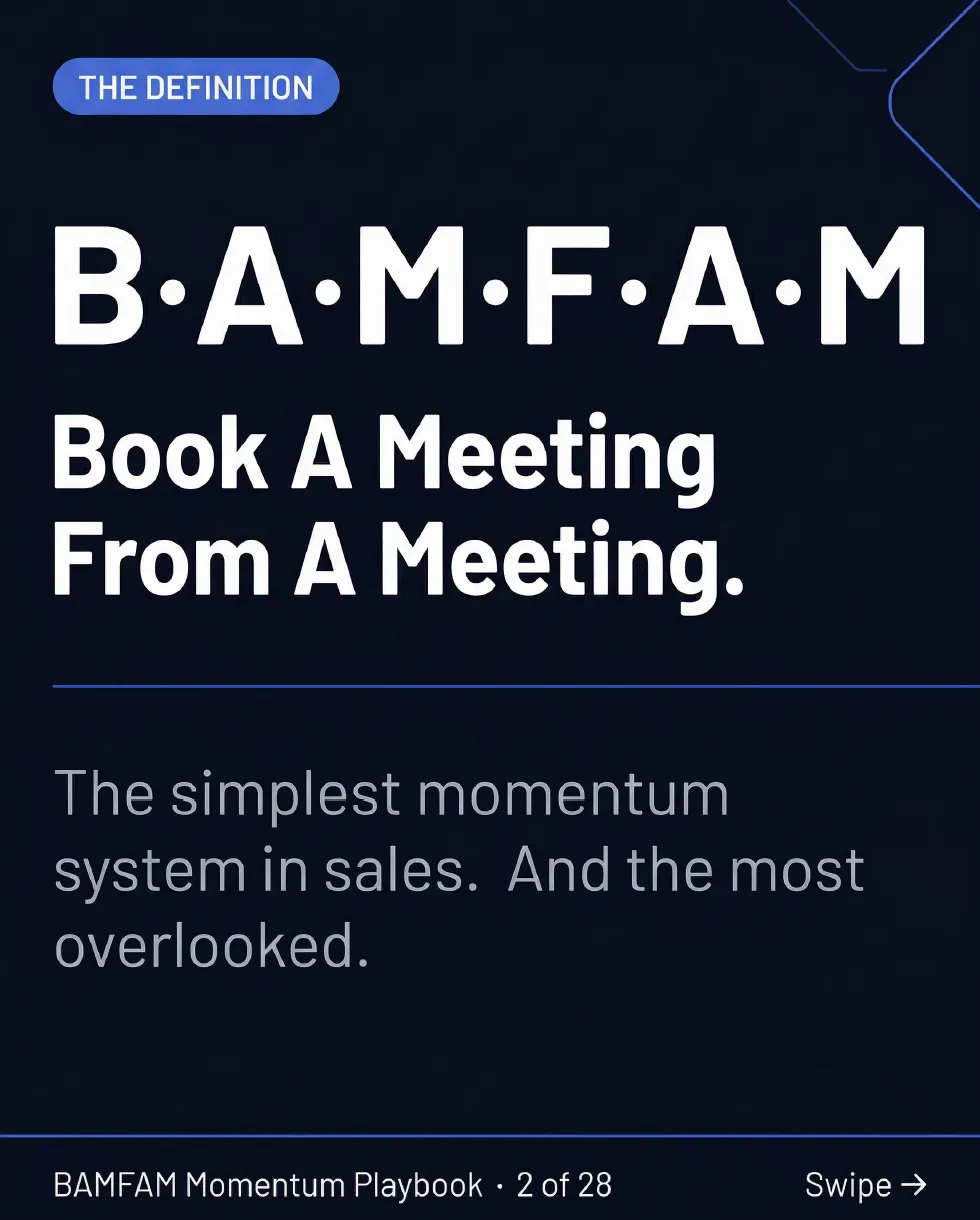
Connect • Clarify • Confirm • Calendar: The 4-Beat Playbook That Ends the Follow-Up Chase.
Discover how the BAMFAM Momentum Playbook reveals the exact strategies to:
Book the Next Meeting While You're Still in the Meeting
Turn "Let Me Get Back to You" Into a Yes (It's Friction, Not Rejection)
Kill the "Just Bumping This Up" Email Forever
Make Momentum Measurable With the Team Scorecard

Stop • Scan • Decide: The 3-Step Playbook to Win the First 51 Seconds.
Discover how the FOCUS360 Playbook reveals the exact strategies to:
FREE GPT Agent to test and build your content
Stop the Scroll on Command
Hold Attention for the First 51 Seconds:
Multiply Conversions With a Single Clear Path:
Unlock Your Business’s Full Potential – Without the Pain
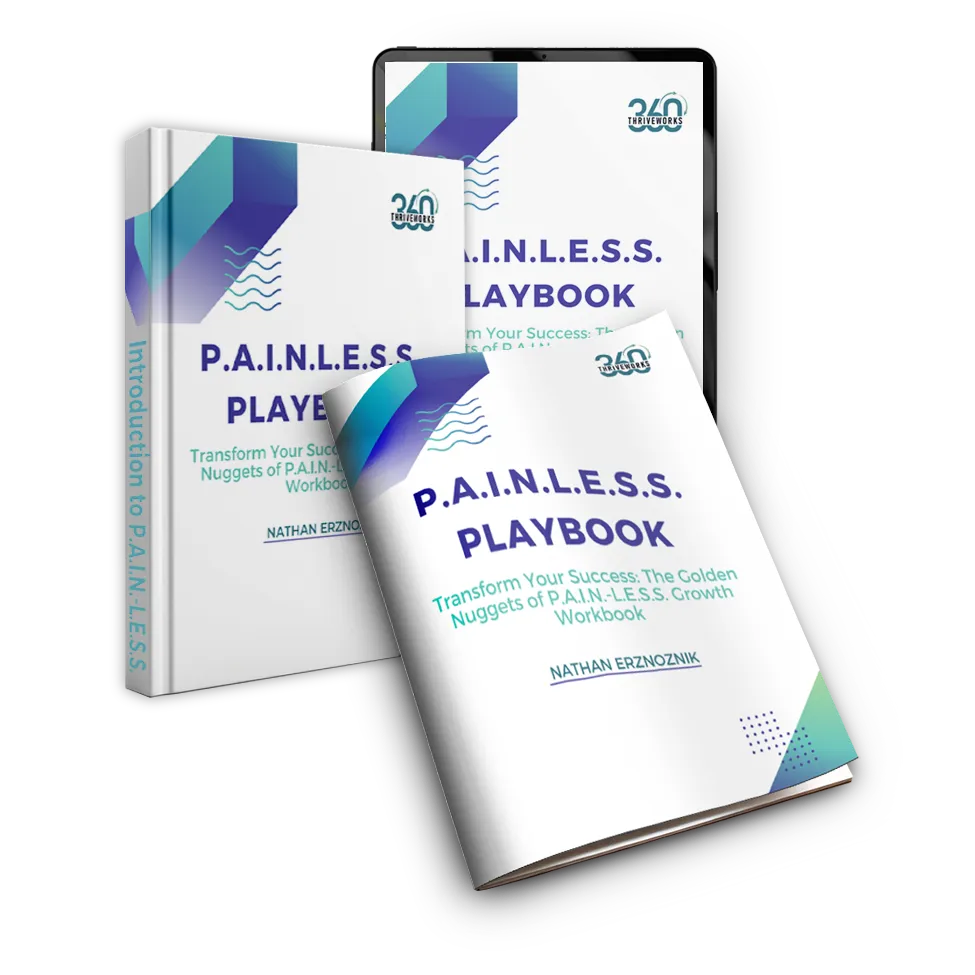
Step into the realm of effortless growth with our P.A.I.N.-L.E.S.S. Playbook.
Designed for entrepreneurs who seek the "Golden Nuggets" that transform them and their businesses without the overwhelming stress. This tool shows a simple and streamlined path toward business success.
Take Control of Your Journey with Our Ultimate FREE Autopilot 360 System Masterclass and Cheat Sheet.
Build A Self-Managed Business And Break Through 6-7 Figures To 8 Figures While Seamlessly Producing Huge Profits!


Uncover Hidden Revenue in 3 Simple Steps
See more details about how this impacts business performance.
PAID COURSE
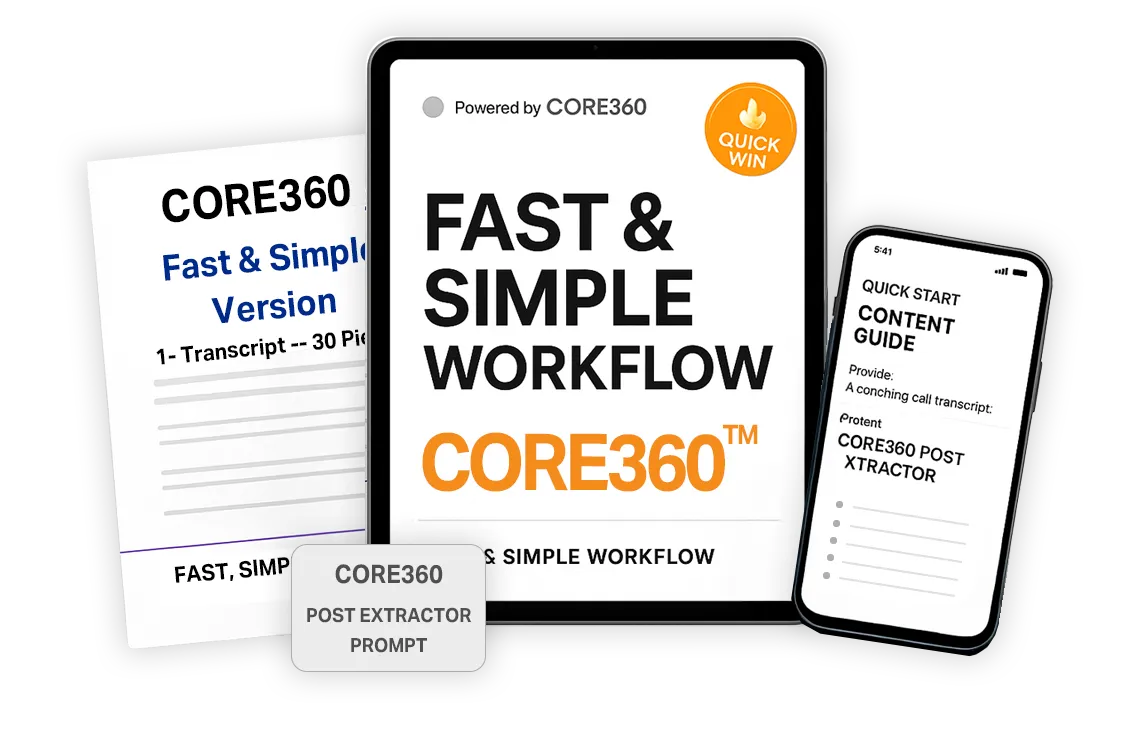
CORE360: Multiply Your Message — Without Writing a Single Word
See how to easliy increase your visibility with the CORE360 System and AI-driven Prompt Booster Pack™
Built for founders and entrepreneurs who already say brilliant things — this AI-optimized vault gives you the exact prompts to turn one voice note into days of content across Instagram, LinkedIn, TikTok, YouTube Shorts, and Facebook.
No burnout. No blank pages. Just scroll-stopping content formulas that match your voice and work on every platform.
A simple upgrade with exponential reach.
BLOG
How to Define Your Ideal Client Without Wasting 3 Years Talking to the Wrong People
Most founders don't have an offer problem or a pricing problem. They have a who problem and it quietly costs them years.
Three years.
That's roughly how long a lot of founders spend talking to the wrong people before it finally clicks that the problem was never the thing they assumed.
It wasn't the offer. It wasn't pricing. It wasn't the marketing, and it wasn't even sales.
It was who they were trying to sell to.
Most businesses don't struggle because they can't find customers. They struggle because they keep attracting customers they were never built to serve in the first place and the symptoms are maddeningly familiar. Discovery calls that wander nowhere. Prospects who say "this sounds great, but…" and vanish. Constant pressure to drop the price. Marketing that pulls plenty of attention and almost no buyers.
Eventually the self-doubt creeps in. Maybe the market isn't really there. Maybe the offer's too weak. Maybe people just don't get the value.
Usually none of that is true. The real issue is quieter, and a lot more fixable: you haven't defined your ideal client yet.
Why Most Client Avatars Are Useless
If you've ever looked up how to build an ideal client avatar, you've probably been handed something like this. Female. 35 to 50. Lives in a city. Drinks coffee, scrolls Instagram, listens to podcasts.
That's not an avatar. That's a dating profile.
Demographics can be useful around the edges, but demographics don't buy anything. Problems do. Urgency does. Frustration does. The avatars that actually work are built around pain, priorities, and how someone behaves when it's time to buy.
Because two businesses with identical demographics can act like completely different customers. A manufacturing founder lying awake over cash flow buys nothing like a founder trying to scale operations. A consultant chasing more freedom buys nothing like one trying to maximize their valuation. Same age, same city, same LinkedIn headline totally different buyer.
Step 1: Start With Your Best Clients, Not Your Dream Ones
Here's where most businesses take a wrong turn. They gather in a room and invent a perfect customer from scratch.
Don't invent. Start with reality. Look back and ask which clients actually got the best results, which were the easiest to work with, which projects were the most profitable, which ones sent you referrals, and which ones you'd happily take on again tomorrow morning.
Patterns show up faster than you'd think. Maybe your best clients all sit in a similar revenue range. Maybe they all hit the same growth ceiling right before they called you. Maybe they all complain about the exact same operational headache.
Those patterns are the point. Your ideal client should be discovered, not imagined.
Step 2: Find the Trigger That Makes Them Buy
People rarely buy because they want something. They buy because they want something to stop.
The trigger matters far more than the demographic. A contractor keeps losing money because job costs land too late to do anything about them. A founder suddenly sees they're the bottleneck in every decision. A manufacturer finally outgrows the spreadsheets holding the whole operation together. A service business keeps pushing harder and the growth keeps not getting easier.
Those are the moments that create urgency and without urgency, most buying decisions just drift, postponed forever. When you're working out who your real customer is, understanding the trigger usually beats knowing their age, industry, or headcount by a mile.
Step 3: Spot the Shared Pain Pattern
Your best clients probably don't run identical businesses. But they tend to share identical frustrations.
Listen for the phrases that keep coming up. We've outgrown our systems. We don't have visibility. The team depends on me for everything. We're growing but it doesn't feel any easier.
Those aren't throwaway comments they're signals. Real positioning starts the moment you notice you're solving the same underlying problem over and over, across businesses that look nothing alike on the surface. The surface problem keeps changing. The root problem usually doesn't.
Step 4: Decide Who You Don't Want
This one's uncomfortable. It's also usually where the growth hides.
Most businesses try to grow by saying yes to more customers. The strongest ones grow by getting steadily more comfortable saying no. You know the poor-fit profile when you see it: they want everything custom, they negotiate on price before they've understood the value, they stall decisions endlessly, and they soak up more support than your next five clients combined.
And here's the surprising bit cutting the bad-fit customers loose often lifts revenue faster than chasing new ones. Because great clients refer other great clients. Difficult ones refer more difficult ones. You're not just removing a headache; you're changing who finds you next.
Step 5: Get Clear on the Outcome They Want
Customers don't buy products. They buy outcomes.
Nobody actually wants accounting software they want visibility. Nobody wants consulting they want confidence. Nobody wants automation for its own sake they want their time back.
So your avatar has to answer one plain question: what result is this person trying to create in their business or their life? The sharper that answer gets, the easier everything downstream becomes the messaging, the sales conversations, the referrals, the marketing because you're finally talking straight to the people who genuinely need what you do.
Step 6: Build an Ideal Client Scorecard
One of the simplest ways to put all of this to work is to turn it into a quick scoring system. For every new opportunity, rate the prospect 1–5 across a handful of categories:
A prospect scoring 28 out of 30 has earned your attention. One scoring 14 probably hasn't. The scorecard does one valuable thing: it pulls the emotion out of the decision. And founders tend to need that optimism has closed more bad deals than weak sales skills ever have.
The Hidden Cost of Getting This Wrong
Most founders badly underestimate what the wrong customer actually costs. It's rarely one bad project. It compounds.
Wrong customers leave you with the wrong testimonials, which pull in the wrong referrals, which shape the wrong product tweaks, which bleak into your marketing language, which quietly rewrites your positioning. Give it enough time and the entire business ends up optimized for the exact people you never wanted to serve.
That's how companies lose years. Not from lack of effort from climbing the wrong mountain, fast, for a long time.
What This Actually Looks Like
I'll be straight with you about the part nobody warns you about. When a business finally tightens its positioning, lead volume usually drops first. That spooks people.
Then the interesting thing happens. Conversions climb. Sales cycles shorten. Projects get more profitable. Referrals improve. Retention improves. The whole thing starts to feel aligned in a way it never did before less activity, better results. Most founders have honestly never experienced that combination, so it feels almost suspicious at first.
Picture a 10-person consulting firm serving everyone healthcare, manufacturing, retail, construction, professional services. The founder is forever rewriting messaging, proposals, and pricing. Sales are erratic. Margins swing all over the place. Then they actually study their own client base and find the pattern: their most profitable clients are manufacturers between $10M and $50M, hitting operational bottlenecks during a growth spurt.
And everything loosens. Marketing gets easier. Sales gets easier. Referrals get easier. The business isn't doing more it's doing less, with far more precision.
The Goal Was Never More Customers
This is the part that catches people off guard. The goal isn't more customers. It's more of the right customers. Those are completely different objectives one manufactures complexity, the other builds momentum.
So if you're trying to define your ideal client, stop asking "who could buy this?" Start asking "who gets the biggest result from this?" That second person is the one your business quietly wants a whole lot more of.
Your First Move
Here's something you can do this week, before you spend another dollar on marketing. Pull your top five clients from the last twelve months. Find the patterns. Name the triggers that made them buy. Write down the outcome each one was really after.
You may well discover that the customer you've been hunting for has been sitting in your CRM the whole time.
Want to see where talking to the wrong people is leaking your revenue? A free Customer GapMap360 session pinpoints the gap between who you're attracting and who you're actually built to serve, names what it's costing you, and shows you the first move to close it.
Frequently Asked Questions
How do you find your ideal client avatar?
Start with your best existing customers, not an imagined one. Look for the pain points, buying triggers, desired outcomes, and traits they share the patterns are usually already there in your client history.
What's the difference between an ideal client avatar and a buyer persona?
A buyer persona leans heavily on demographics. An ideal client avatar centers on the business problem, the motivation, the urgency, and how the person actually buys.
Should a small business have more than one ideal client?
It can but usually no more than two or three. Past that, the messaging blurs and the positioning weakens.
How often should I revisit my ideal client?
Once a year is a good rhythm, or any time your offer, business model, or customer base shifts in a meaningful way.
Final Thought
The businesses that grow fastest aren't always the ones with the best product. They're usually the ones with the clearest sense of who they serve.
Everything gets easier on the other side of that clarity marketing, sales, pricing, referrals, growth.
Because the moment you stop talking to the wrong people, the right ones finally start listening.
— ThriveWorks360

Free Weekly Productivity Insights
Sign up for Sunday Snippets - my weekly newsletter where I I share actionable productivity tips, practical life advice, and high-quality insights from across the web, directly to your inbox.
What People Are Saying

Driving Growth, Amplifying Impact

Grace Company

8th to 2nd most recognized brands in the industry in one year

J&B Sewing
Launched new product line and grew 300% in two years

Sewrite
Increased national distribution, D2C Revenue by 400%.
Get In Touch
Email: [email protected]
Address
Office: 14881 S. Auburn Sky Dr
Assistance Hours
Mon – Sat 9:00am – 8:00pm
Sunday – CLOSED
Phone Number:
(888) 870-7314
Contact Us:
BECOME AN TW360 INSIDER
Sign up for exlcusive content, emails, & things Nathan doesn't share anywhere else.
Unleash Your Business Brilliance.
Reach out and connect for your opportunity to shine!
© 2026 ThriveWorks360 - All Rights Reserved, copyright 2024