FREE Tools
Select from below to learn more!
Free Tools
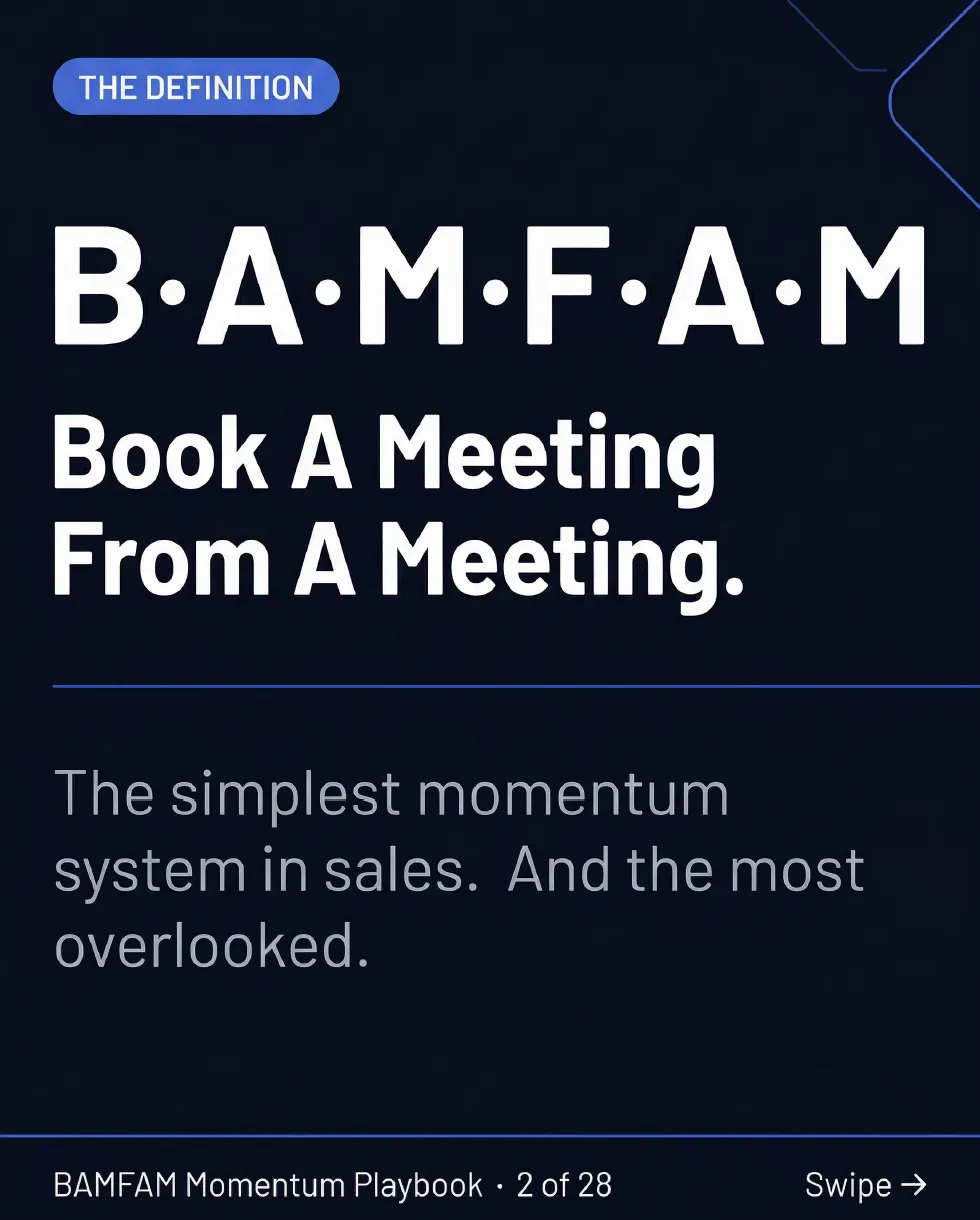
Connect • Clarify • Confirm • Calendar: The 4-Beat Playbook That Ends the Follow-Up Chase.
Discover how the BAMFAM Momentum Playbook reveals the exact strategies to:
Book the Next Meeting While You're Still in the Meeting
Turn "Let Me Get Back to You" Into a Yes (It's Friction, Not Rejection)
Kill the "Just Bumping This Up" Email Forever
Make Momentum Measurable With the Team Scorecard
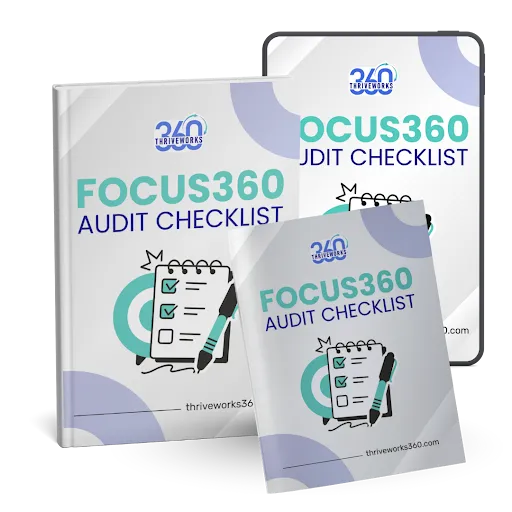
Stop • Scan • Decide: The 3-Step Playbook to Win the First 51 Seconds.
Discover how the FOCUS360 Playbook reveals the exact strategies to:
FREE GPT Agent to test and build your content
Stop the Scroll on Command
Hold Attention for the First 51 Seconds:
Multiply Conversions With a Single Clear Path:
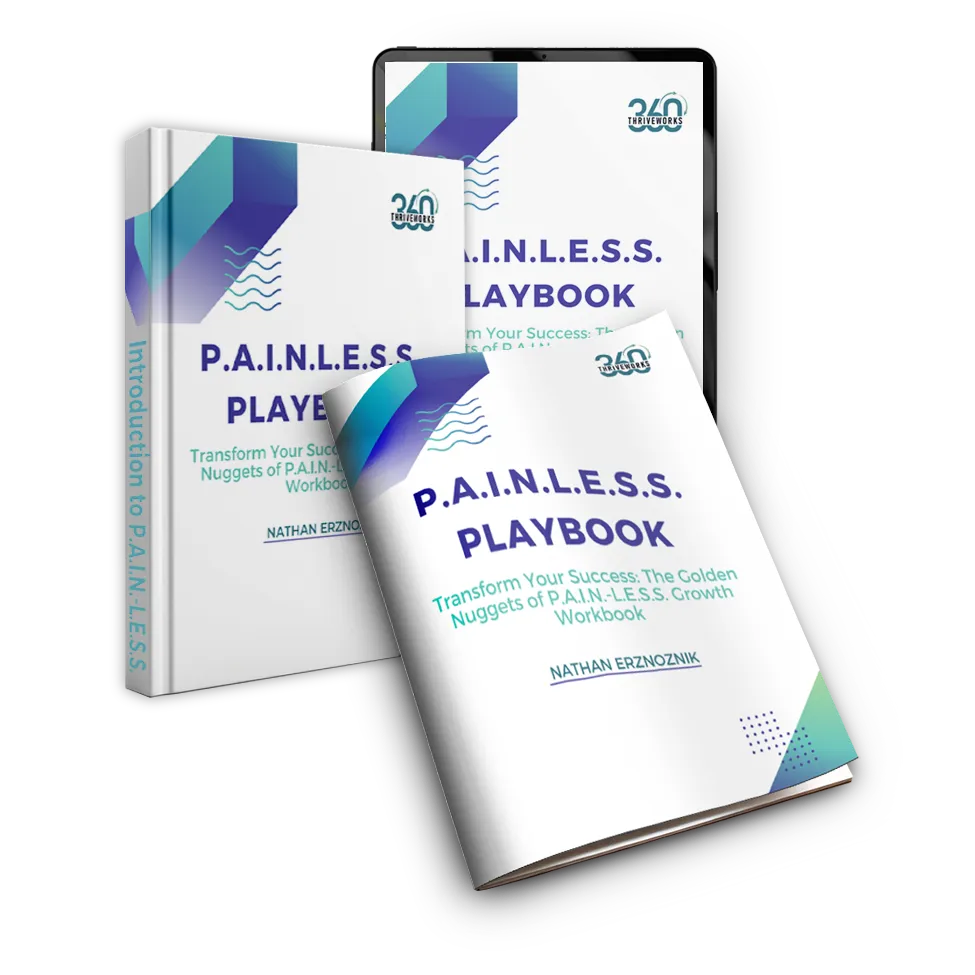
Unlock Your Business’s Full Potential – Without the Pain
Step into the realm of effortless growth with our P.A.I.N.-L.E.S.S. Playbook.
Designed for entrepreneurs who seek the "Golden Nuggets" that transform them and their businesses without the overwhelming stress. This tool shows a simple and streamlined path toward business success.
Take Control of Your Journey with Our Ultimate FREE Autopilot 360 System Masterclass and Cheat Sheet.
Build A Self-Managed Business And Break Through 6-7 Figures To 8 Figures While Seamlessly Producing Huge Profits!


Uncover Hidden Revenue in 3 Simple Steps
See more details about how this impacts business performance.
PAID COURSE
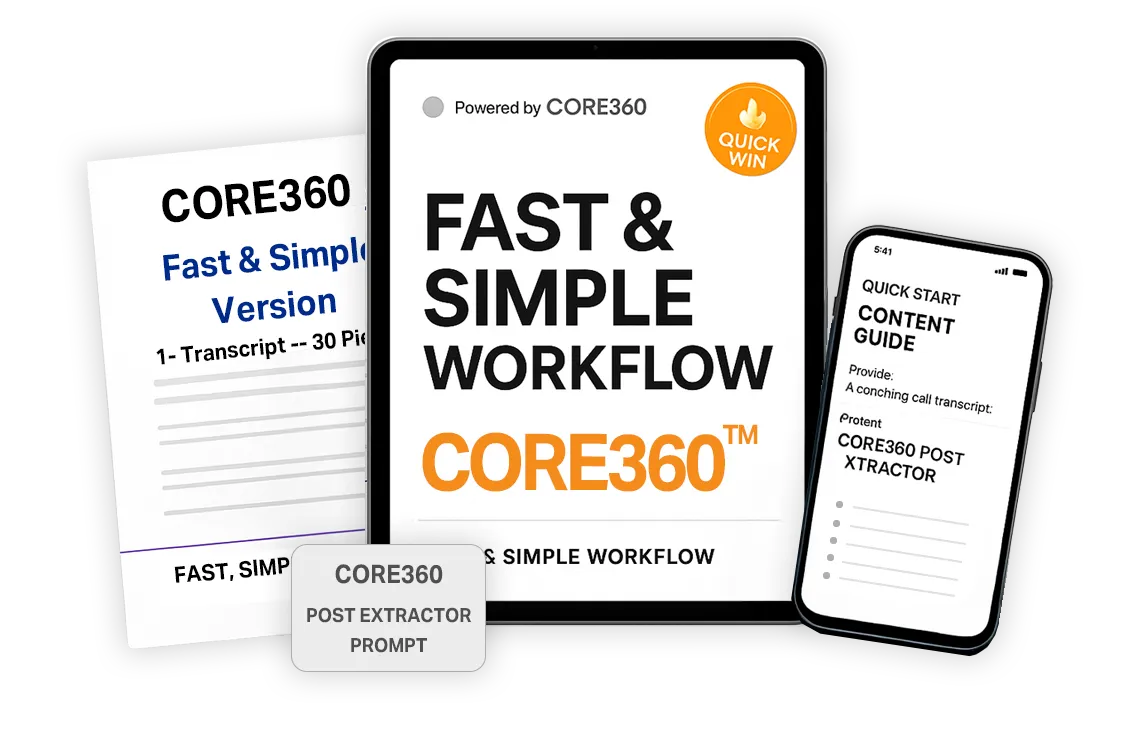
CORE360: Multiply Your Message — Without Writing a Single Word
See how to easliy increase your visibility with the CORE360 System and AI-driven Prompt Booster Pack™
Built for founders and entrepreneurs who already say brilliant things — this AI-optimized vault gives you the exact prompts to turn one voice note into days of content across Instagram, LinkedIn, TikTok, YouTube Shorts, and Facebook.
No burnout. No blank pages. Just scroll-stopping content formulas that match your voice and work on every platform.
A simple upgrade with exponential reach.
BLOG
How to Build a Repeatable Sales System in 90 Days
Why founder-led selling stops working as you grow and the 90-day path from "good months and bad months" to predictable revenue.
Most founders don't have a sales problem.
They have a systems problem.
For a while, founder-led selling works beautifully. You know the product better than anyone. You hop on calls, handle objections on instinct, and keep deals moving.
Then growth happens.
You hire someone to help. Leads start coming from different channels. Prospects need follow-up while you're stuck in meetings. And suddenly revenue feels unpredictable.
One month is great. The next is nerve-racking.
If that sounds familiar, you're not alone.
The difference between companies that scale and companies that stall is rarely effort.
It's whether there's a repeatable system underneath the selling.
Here's how to build a sales system for founders in 90 days. Not a pile of random tactics a process that creates consistency, supports your team, and eventually becomes a predictable revenue system.
First, Stop Hunting for a Magic Tool
A surprising number of founders start with software.
They buy a CRM. Add an email automation platform. Try an AI prospecting tool. Maybe hire an SDR.
Six months later? The pipeline is still inconsistent.
Here's why.
Tools amplify systems. They don't replace them.
If your messaging is unclear, automation just sends unclear messages faster. If your follow-up is inconsistent, AI helps you be inconsistent at scale.
The order matters:
Process → Consistency → Automation → Scale
Get that backwards and you'll spend money chasing fixes that never touch the root problem.
Days 1–30: Stabilize the Foundation
The first month isn't about selling more.
It's about understanding how sales actually happen inside your business right now.
Define your ideal customer. Most founders believe they know their customer. Then you ask: Who buys fastest? Who stays longest? Who's worth the most? Who refers others? And the answers get fuzzy.
Narrowing your focus makes everything easier. Instead of "We help businesses grow," try "We help founder-led B2B companies with 5–50 employees build repeatable sales systems using AI and automation."
Specificity creates momentum because now your messaging, outreach, and content all point at the same person.
Map your current sales journey. Grab a whiteboard, a notebook, the back of an envelope. Lay out the stages: awareness, first conversation, qualification, proposal, decision, onboarding.
Then ask where deals slow down, where prospects vanish, and which stages run entirely through you.
You'll usually find one or two bottlenecks causing most of the pain.
And here's the uncomfortable truth: in founder-led businesses, the founder is often the bottleneck. Not because they're doing anything wrong because they haven't yet built a system anyone else can follow.
Establish your core metrics. You don't need twenty dashboards. You need a few numbers that tell the truth: qualified opportunities created, meetings booked, conversion rate by stage, average cycle length, pipeline value, forecast accuracy.
That's the foundation of a predictable revenue system. Because you stop asking "How do sales feel?" and start asking "What do the numbers say?"
Huge difference.
Days 31–60: Build Repeatable Processes
Now that the foundation exists, it's time to standardize.
This is where a lot of founders resist because processes feel restrictive.
They're not. Good processes create freedom.
Standardize your outreach. Picture two reps. Rep A sends whatever feels right that day. Rep B follows a proven sequence personalized intro, value-based follow-up, a case study, a short check-in, a final touch.
Who wins? Usually Rep B. Not because they're more talented. Because consistency compounds.
Your outreach doesn't need to be robotic. It needs to be repeatable.
Create qualification rules. Not every lead deserves equal attention. Founders burn enormous time talking to people who'll never buy.
So define what makes someone a great customer revenue, industry, team size, current challenges, urgency. Document it. Train the team on it. Now sales runs on decision criteria instead of gut feel. That's when growth starts to feel manageable.
Build a CRM that supports the process. A CRM isn't a trophy. It's an operating system. If nobody updates it or trusts it, it's just expensive storage.
Yours should answer four questions at a glance: Where's every opportunity? What's the next action? Who owns it? What are the risks?
Keep it simple. Complex systems impress consultants. Simple systems get adopted.
Days 61–90: Introduce AI and Automation
Here's where it gets interesting.
Once your process works, AI can make it dramatically more efficient.
Notice the emphasis: once your process works. Not before.
Use AI for research and prospecting. Your team shouldn't spend hours researching companies by hand. AI can enrich lead data, summarize a company, flag buying signals, suggest personalization angles, and prioritize the best prospects. The point isn't to replace human judgment it's to give your people more time for the conversations that matter.
Automate the follow-ups. Most deals aren't lost because a prospect said no. They're lost because nobody followed up. A founder gets busy. A rep forgets. The opportunity quietly disappears.
Automation closes that gap reminders, sequences, task creation, lead routing, all running in the background. Fewer dropped deals, smoother experience.
Automate the reporting. You shouldn't spend Monday morning building spreadsheets. Your dashboard should already show pipeline health, conversion trends, forecasted revenue, sales velocity, channel performance. When reporting is automatic, decisions get faster and fast decisions are a competitive advantage.
The Biggest Mistake Founders Make
They automate chaos.
Seriously.
They buy expensive tools hoping technology will create clarity. But automation scales whatever already exists.
If your messaging is confusing, automation spreads the confusion. If your process is broken, automation breaks things faster.
The companies getting the biggest results from AI aren't the ones with the most tools.
They're the ones with the clearest systems.
Because AI isn't the strategy.
It's the amplifier.
Where a Framework Like AutoPilot360 Fits
This is exactly why a framework like AutoPilot360 exists. Not to replace founders. Not to throw more software at the problem. But to create a structured path from founder-led selling to scalable growth.
The sequence is the whole point:
Stabilize: remove bottlenecks, clarify messaging, define the sales process.
Catalyze: document the workflows, standardize outreach, build accountability.
Maximize: introduce AI, automate the repetitive work, scale what already works.
Growth gets far less risky when each stage builds on the one before it.
You don't wake up one morning hoping the system works. You know it works, because you tested it, refined it, and improved it over time.
What a Repeatable Sales System Actually Feels Like
Let's make it concrete. Picture a 12-person consulting firm.
Before: the founder handled every major deal. Follow-ups were inconsistent. Revenue swung wildly month to month. Nobody trusted the forecast.
Ninety days later: messaging is documented. Every opportunity follows the same process. The CRM data is accurate. AI assists with research and prioritization. Automated workflows make sure no lead gets forgotten.
The founder still plays a role.
But they're not carrying the entire business anymore.
That's the real goal.
Not removing humans from sales.
Removing uncertainty from growth.
Predictable Revenue Isn't About Working Harder
Founders are usually willing to work harder. That's rarely the issue.
The real challenge is building a business that doesn't depend on heroic effort.
A strong sales system for founders creates leverage. It turns knowledge into process. Process into consistency. And consistency into a predictable revenue system.
That doesn't happen overnight. But it doesn't take years either.
With the right roadmap, 90 days is enough to move from reactive selling to repeatable growth.
And once the system is working? That's when AI, automation, and advanced growth strategies finally become powerful because now they're accelerating something that already works, instead of trying to fix something that never did.
Ready to build your own? If your sales process still leans heavily on you, start by asking three questions: Where do deals get stuck? Which activities are inconsistent? And what would happen if you stepped away for two weeks?
The answers will tell you exactly where to focus first.
From there, a framework like AutoPilot360 can help you move from founder-led selling to a scalable, repeatable system built for long-term growth.
Because predictable revenue isn't luck.
It's the result of building the right system.
— ThriveWorks360

Free Weekly Productivity Insights
Sign up for Sunday Snippets - my weekly newsletter where I I share actionable productivity tips, practical life advice, and high-quality insights from across the web, directly to your inbox.
What People Are Saying

Driving Growth, Amplifying Impact

Grace Company

8th to 2nd most recognized brands in the industry in one year

J&B Sewing
Launched new product line and grew 300% in two years

Sewrite
Increased national distribution, D2C Revenue by 400%.
Get In Touch
Email: [email protected]
Address
Office: 14881 S. Auburn Sky Dr
Assistance Hours
Mon – Sat 9:00am – 8:00pm
Sunday – CLOSED
Phone Number:
(888) 870-7314
Contact Us:
BECOME AN TW360 INSIDER
Sign up for exlcusive content, emails, & things Nathan doesn't share anywhere else.
Unleash Your Business Brilliance.
Reach out and connect for your opportunity to shine!
© 2026 ThriveWorks360 - All Rights Reserved, copyright 2024