FREE Tools
Select from below to learn more!
Free Tools
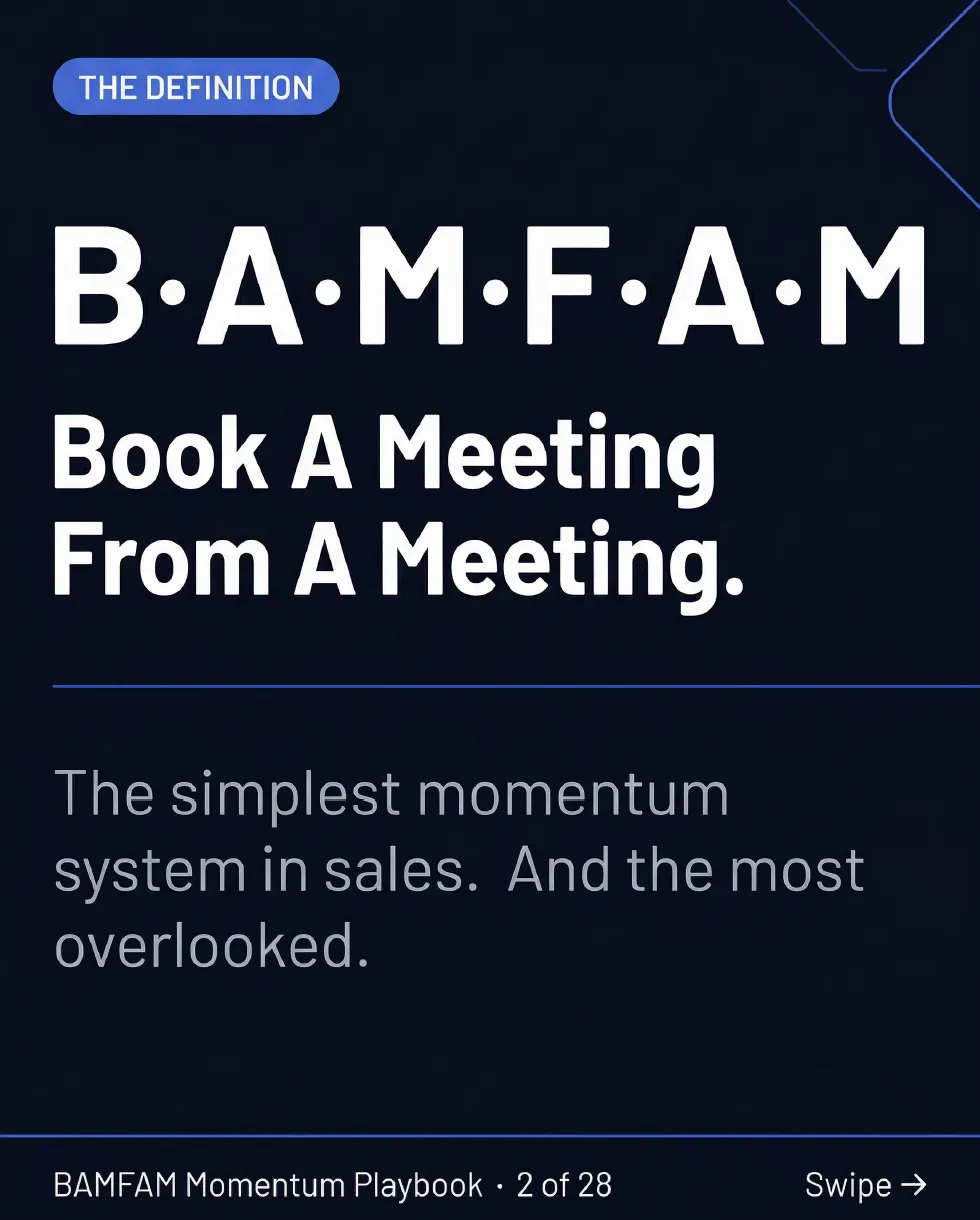
Connect • Clarify • Confirm • Calendar: The 4-Beat Playbook That Ends the Follow-Up Chase.
Discover how the BAMFAM Momentum Playbook reveals the exact strategies to:
Book the Next Meeting While You're Still in the Meeting
Turn "Let Me Get Back to You" Into a Yes (It's Friction, Not Rejection)
Kill the "Just Bumping This Up" Email Forever
Make Momentum Measurable With the Team Scorecard
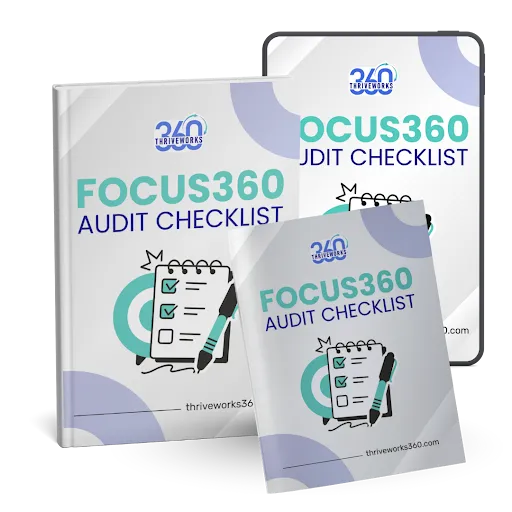
Stop • Scan • Decide: The 3-Step Playbook to Win the First 51 Seconds.
Discover how the FOCUS360 Playbook reveals the exact strategies to:
FREE GPT Agent to test and build your content
Stop the Scroll on Command
Hold Attention for the First 51 Seconds:
Multiply Conversions With a Single Clear Path:
Unlock Your Business’s Full Potential – Without the Pain
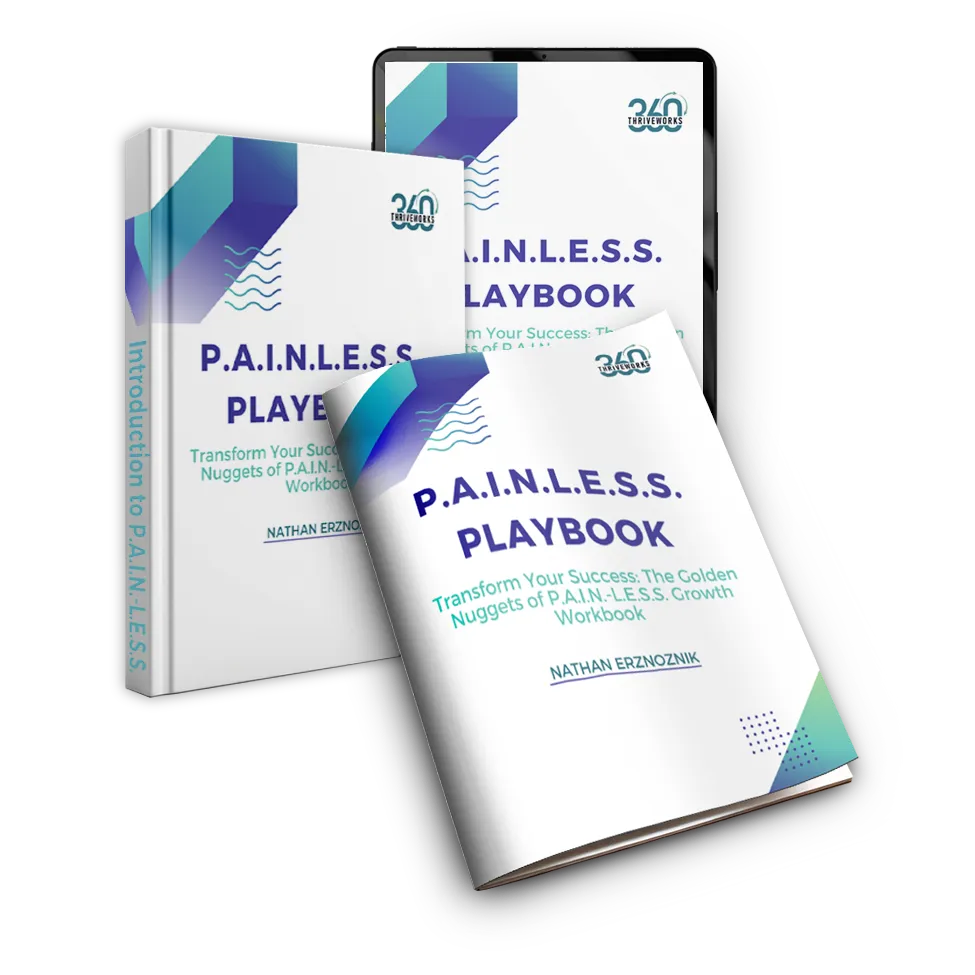
Step into the realm of effortless growth with our P.A.I.N.-L.E.S.S. Playbook.
Designed for entrepreneurs who seek the "Golden Nuggets" that transform them and their businesses without the overwhelming stress. This tool shows a simple and streamlined path toward business success.
Take Control of Your Journey with Our Ultimate FREE Autopilot 360 System Masterclass and Cheat Sheet.
Build A Self-Managed Business And Break Through 6-7 Figures To 8 Figures While Seamlessly Producing Huge Profits!


Uncover Hidden Revenue in 3 Simple Steps
See more details about how this impacts business performance.
PAID COURSE
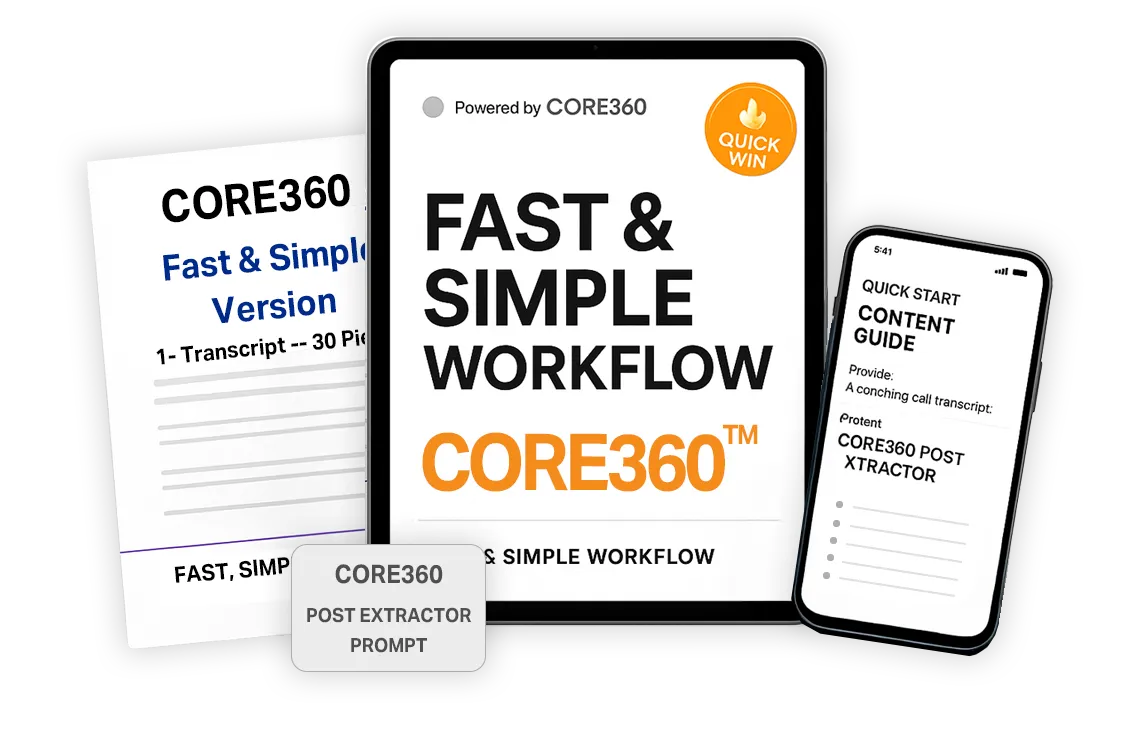
CORE360: Multiply Your Message — Without Writing a Single Word
See how to easliy increase your visibility with the CORE360 System and AI-driven Prompt Booster Pack™
Built for founders and entrepreneurs who already say brilliant things — this AI-optimized vault gives you the exact prompts to turn one voice note into days of content across Instagram, LinkedIn, TikTok, YouTube Shorts, and Facebook.
No burnout. No blank pages. Just scroll-stopping content formulas that match your voice and work on every platform.
A simple upgrade with exponential reach.
BLOG
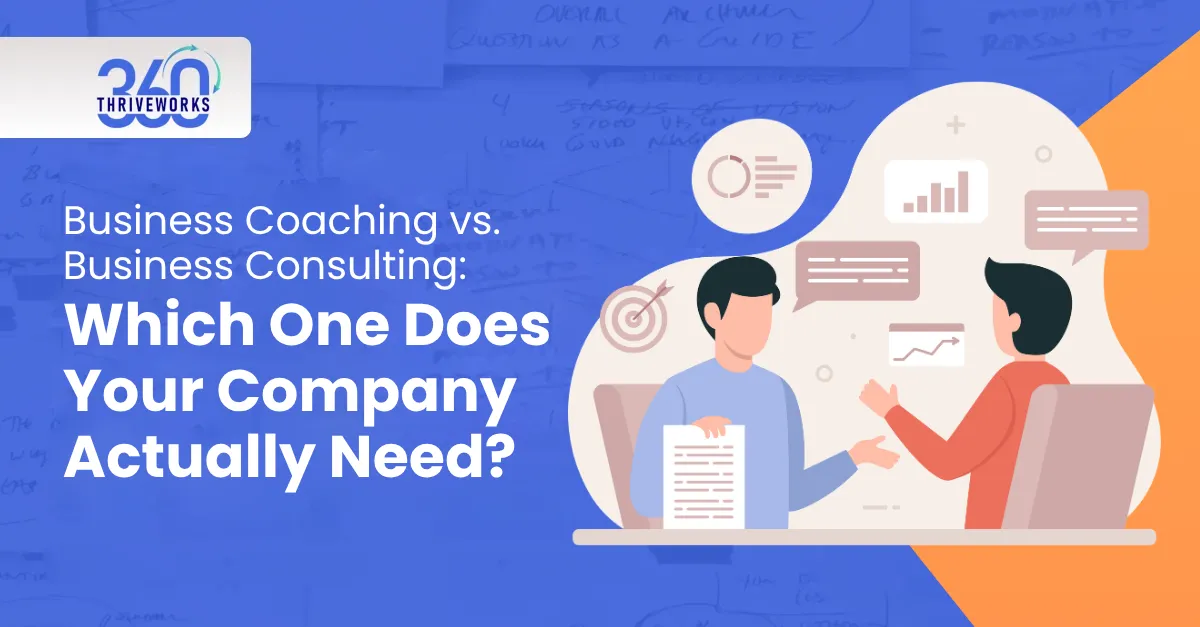
Business Coaching vs. Business Consulting: Which One Does Your Company Actually Need?
Pick the wrong one and you get great advice with no execution or a flawless plan nobody runs. The real first step is diagnosis.
If you've ever looked at your business and thought "we know where we want to go, we're just not sure how to get there," you've almost certainly run into two options: business coaching and business consulting.
At first glance they look nearly identical. Both promise growth. Both help you solve problems. Both put an experienced outsider next to your leadership team.
But the difference matters more than most companies realize and getting it wrong is expensive in a quiet way. Choose coaching when you needed consulting and you'll end up with sharper leaders and the same broken system. Choose consulting when the real issue was leadership behavior and you'll get a beautiful strategy nobody actually adopts.
So how do you tell which one your company needs? Let's break it down.
What Business Coaching Actually Is
Coaching is about helping the people who run the business think, decide, communicate, and lead better.
A coach usually doesn't show up with a playbook and hand you the answers. They help you find them strengthening your judgment and building the muscle to solve the next problem on your own. Think of a coach as a guide for the owner, the founder, or the leadership team rather than for the business itself.
In practice, coaching tends to touch leadership development, accountability and execution, strategic thinking, team communication, goal-setting, founder decision fatigue, and plain personal effectiveness.
The point isn't just to fix today's problem. It's to build leaders who handle tomorrow's faster, and with more confidence.
What Business Consulting Actually Is
Consulting comes at things from the other direction.
You bring a consultant in to solve a specific, defined problem using their expertise, their frameworks, and their recommendations. Instead of asking questions to draw the answer out of you, they usually arrive with the answer or with the exact process for reaching it.
That's the work you'd hire a consultant for: ERP selection and rollout, operational inefficiencies, financial reporting messes, process redesign, technology strategy, supply-chain fixes, growth planning. More hands-on, more technical, more focused on a particular corner of the organization.
The goal is measurable improvement in a defined area, usually inside a set window of time.
The Difference in One Sentence
Coaches develop people. Consultants solve problems.
Neither is better than the other. They just do different jobs and knowing which job you actually need is the whole game.
Signs Your Business Needs Coaching
A few situations point pretty hard toward coaching.
The business leans too heavily on the founder. Lots of growing companies reach a stage where every decision still routes through one person approvals, hiring, pricing, the tricky customer. It all lands on the same desk. A coach helps build the delegation, accountability, and leadership habits that let the company grow past a single person's capacity.
The strategy exists, but execution keeps slipping. Sometimes the leadership team already knows exactly what needs to happen. The gap isn't the plan it's alignment. Projects stall, priorities shift, teams drift apart. Coaching tends to focus there: building accountability and a steadier execution rhythm.
Leadership skills haven't caught up to the growth. Running a ten-person shop and leading fifty people are genuinely different jobs. Growth keeps quietly raising the bar, and coaching helps founders and executives make that jump instead of stalling at it.
Signs Your Business Needs Consulting
Now flip it over.
You've got a specific operational problem. The inventory numbers don't match reality. The ERP rollout is behind. Margins are shrinking and nobody can say why. That's consulting territory you don't need help discovering the answer, you need someone who's solved this exact thing before.
Your team is missing specialized expertise. Most businesses don't need a full-time ERP strategist or process engineer on payroll. But they might need one for six months. Consulting buys you that expertise without the permanent overhead.
You need it done faster. Consultants move quicker because they've got pattern recognition they've seen this challenge across a dozen other companies. That experience shortens the learning curve and saves you from the expensive mistakes.
The Mistake Almost Everyone Makes
Plenty of businesses hire a coach when they really needed a consultant. Just as many hire consultants when the real issue is how their leaders behave.
Here's the version I see most often. A manufacturer is drowning in delayed orders and lousy reporting visibility. Leadership decides it's a technology problem and hires consultants to put in a new ERP system. The software launches clean, on time, everything working.
Six months later, the same problems are still there. Why?
Because technology was never the root issue. The managers weren't using the data. Departments weren't talking to each other. Nobody was clearly responsible for the decisions. The business needed coaching alongside the consulting the software fixed the technical problem, and it took leadership work to fix the human one.
That's the trap. When you buy a solution before you've diagnosed the actual constraint, you can execute it perfectly and still not move.
Can You Use Both?
Absolutely and the strongest companies usually do. Coaching and consulting aren't rivals. They're partners.
Consulting answers "what should we do?" Coaching answers "how do we become the kind of organization that can actually do it, consistently?" One improves the system. The other improves the people running the system. Together they stick.
A Simple Way to Decide
Still unsure? Four questions usually settle it.
Is the challenge mostly about people or processes? People issues lean toward coaching. Process issues lean toward consulting.
Do you need answers or accountability? If you already know what to do but keep failing to execute, coaching is probably the better bet. If you genuinely don't know the answer, start with consulting.
Is the problem recurring? Something that keeps coming back usually signals a leadership or culture issue. A one-time technical breakdown usually points to consulting.
What happens if you do nothing? If delays and poor visibility are bleeding revenue right now, consulting tends to deliver faster ROI. If the real limiter is a leadership bottleneck capping future growth, coaching produces the kind of value that compounds.
Red Flags You're About to Choose Wrong
Watch for these. Hiring a coach to fix a technical problem. Hiring consultants to fix an accountability problem. Expecting software to solve a leadership issue. Expecting mindset work to fix a broken process. And the big one underneath all of them treating the symptom instead of the root cause.
The wrong choice buys you a brief improvement followed by the same frustration. The right one builds momentum.
Final Thoughts
The coaching-versus-consulting question was never really about picking a winner. It's about matching the right tool to the right problem.
If your challenge lives in leadership, accountability, communication, or founder dependency, coaching may be exactly it. If it lives in systems, technology, operations, or specialized execution, consulting is probably the fit. And if you're in the middle of serious growth or a real transformation? You likely need both.
But notice what every one of those sentences depends on: knowing the real constraint first. Almost every expensive mistake here comes from buying the solution before diagnosing the problem and the diagnosis is the part most businesses skip.
Before you hire anyone, find out what's actually holding you back. A free Customer GapMap360 session diagnoses where your business is really constrained people, systems, or something between them names the single biggest gap, and shows you what to fix first, so you invest in the right kind of help instead of guessing.
Frequently Asked Questions
What's the main difference between business coaching and consulting?
Coaching develops your leaders and sharpens decision-making. Consulting solves a specific business problem through outside expertise and implementation. One improves the people; the other improves the system.
Is coaching better than consulting?
Neither is better they do different jobs, and they often work best together during a period of growth or change.
Can small businesses benefit from consultants?
Yes. Small businesses frequently need specialized expertise they can't justify hiring full-time, and consulting gives them access to it for a defined stretch.
When should a company use both?
Businesses going through rapid growth, digital transformation, an ERP implementation, or major organizational change usually get the most from combining the two.
— ThriveWorks360


Free Weekly Productivity Insights
Sign up for Sunday Snippets - my weekly newsletter where I I share actionable productivity tips, practical life advice, and high-quality insights from across the web, directly to your inbox.
What People Are Saying

Driving Growth, Amplifying Impact

Grace Company

8th to 2nd most recognized brands in the industry in one year

J&B Sewing
Launched new product line and grew 300% in two years

Sewrite
Increased national distribution, D2C Revenue by 400%.
Get In Touch
Email: [email protected]
Address
Office: 14881 S. Auburn Sky Dr
Assistance Hours
Mon – Sat 9:00am – 8:00pm
Sunday – CLOSED
Phone Number:
(888) 870-7314
Contact Us:
BECOME AN TW360 INSIDER
Sign up for exlcusive content, emails, & things Nathan doesn't share anywhere else.
Unleash Your Business Brilliance.
Reach out and connect for your opportunity to shine!
© 2026 ThriveWorks360 - All Rights Reserved, copyright 2024