FREE Tools
Select from below to learn more!
Free Tools
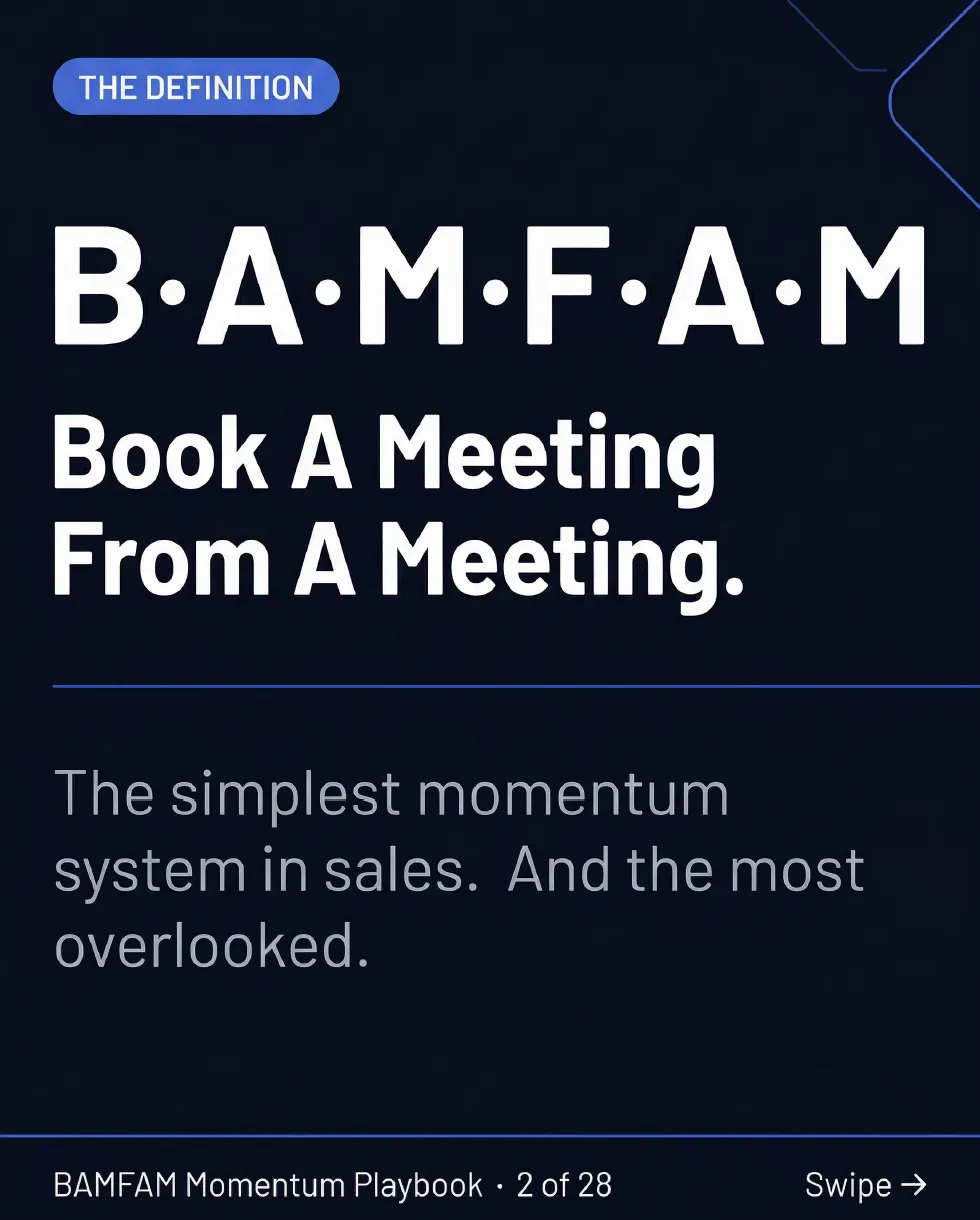
Connect • Clarify • Confirm • Calendar: The 4-Beat Playbook That Ends the Follow-Up Chase.
Discover how the BAMFAM Momentum Playbook reveals the exact strategies to:
Book the Next Meeting While You're Still in the Meeting
Turn "Let Me Get Back to You" Into a Yes (It's Friction, Not Rejection)
Kill the "Just Bumping This Up" Email Forever
Make Momentum Measurable With the Team Scorecard

Stop • Scan • Decide: The 3-Step Playbook to Win the First 51 Seconds.
Discover how the FOCUS360 Playbook reveals the exact strategies to:
FREE GPT Agent to test and build your content
Stop the Scroll on Command
Hold Attention for the First 51 Seconds:
Multiply Conversions With a Single Clear Path:
Unlock Your Business’s Full Potential – Without the Pain
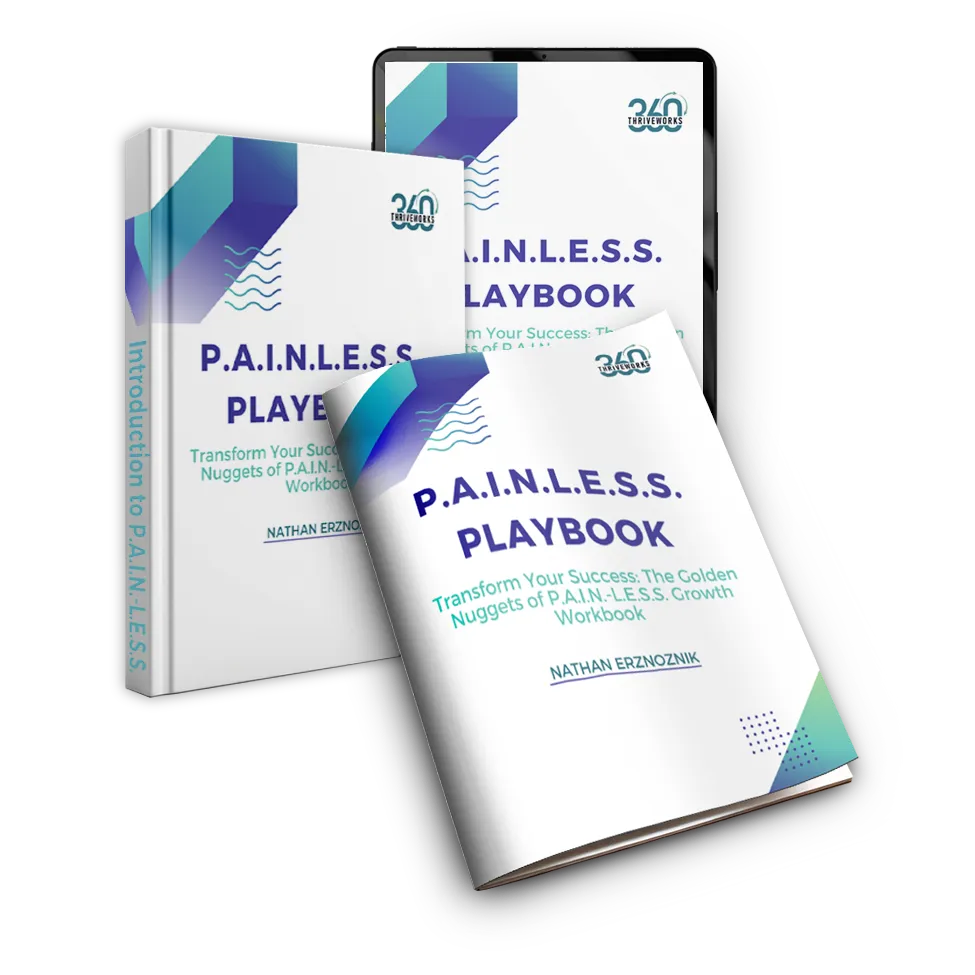
Step into the realm of effortless growth with our P.A.I.N.-L.E.S.S. Playbook.
Designed for entrepreneurs who seek the "Golden Nuggets" that transform them and their businesses without the overwhelming stress. This tool shows a simple and streamlined path toward business success.
Take Control of Your Journey with Our Ultimate FREE Autopilot 360 System Masterclass and Cheat Sheet.
Build A Self-Managed Business And Break Through 6-7 Figures To 8 Figures While Seamlessly Producing Huge Profits!


Uncover Hidden Revenue in 3 Simple Steps
See more details about how this impacts business performance.
PAID COURSE
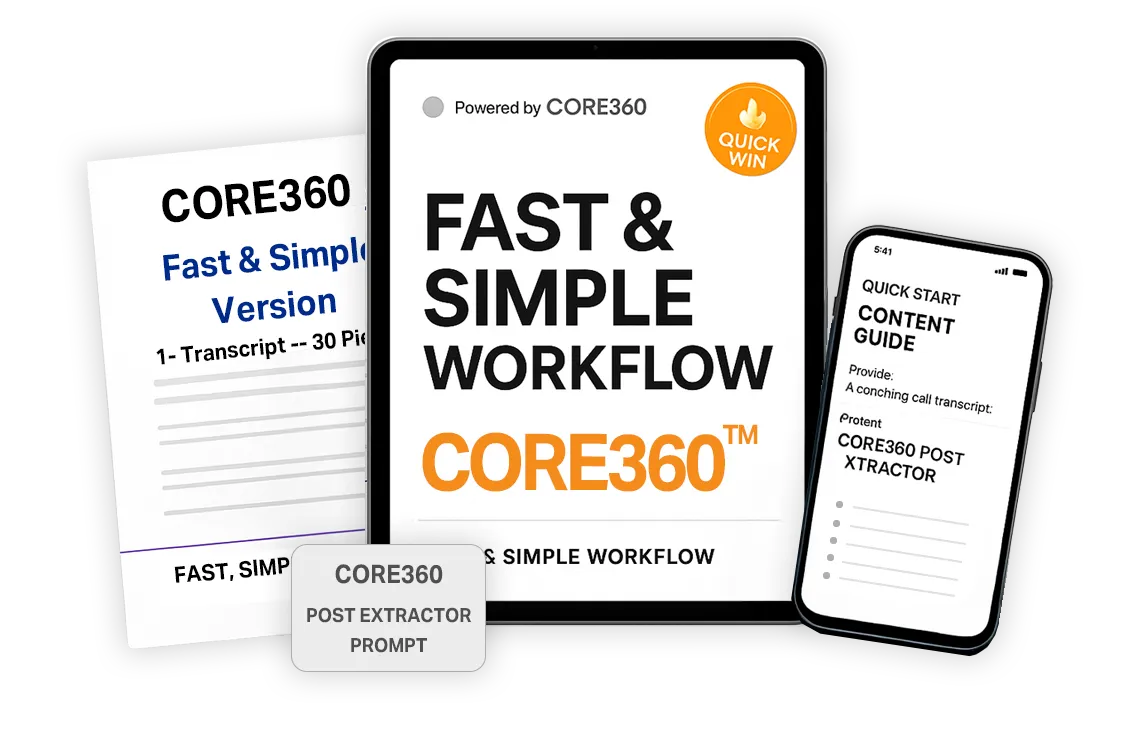
CORE360: Multiply Your Message — Without Writing a Single Word
See how to easliy increase your visibility with the CORE360 System and AI-driven Prompt Booster Pack™
Built for founders and entrepreneurs who already say brilliant things — this AI-optimized vault gives you the exact prompts to turn one voice note into days of content across Instagram, LinkedIn, TikTok, YouTube Shorts, and Facebook.
No burnout. No blank pages. Just scroll-stopping content formulas that match your voice and work on every platform.
A simple upgrade with exponential reach.
BLOG
Best AI Tools to Grow and Automate Your Business
Why most businesses get no return on AI and how to choose tools that create growth instead of complexity.
A few years ago, businesses asked, "Should we use AI?"
Now the question is more practical:
Which AI tools will actually help us grow without creating more complexity?
Here's the thing.
Most companies don't fail with AI because the technology isn't good enough.
They fail because they buy tools before they have a strategy.
One team adopts an AI writer. Marketing experiments with a chatbot. Sales tries an automation platform. Operations starts testing workflow automation.
Six months later, everyone's on a different system, nothing talks to anything else, and leadership is wondering where the promised productivity went.
The businesses getting real results take a different approach.
They choose AI tools based on business outcomes first and technology second.
Let's look at the tools making the biggest impact right now and, more importantly, how to use them with intent.
Start With the Problem, Not the Tool
The market is flooded with AI products.
New platforms launch every week. Existing software bolts on AI features every month. It's exciting. It's also overwhelming.
Before you evaluate a single AI tool for business growth, ask:
Where are employees spending the most time?
Which processes are repetitive?
What slows down customer acquisition?
Where are bottlenecks blocking growth?
The answers almost always point to four areas where AI returns the most:
Marketing and content
Sales and customer engagement
Workflow automation
Analytics and decision-making
Let's take them one at a time.
AI Marketing Tools That Help Teams Scale
Marketing is usually the first department to adopt AI, because the gains show up fast.
Content gets faster. Campaigns get more personalized. Teams spend less time on repetitive work and more on strategy.
The common AI marketing tools: writing assistants for blogs, ads, and email; image and video generation; AI-powered SEO; social scheduling and optimization; customer segmentation and personalization.
But here's a mistake businesses make constantly.
They assume AI will replace creativity.
It won't.
The best marketing teams use AI to remove friction. Instead of burning hours on first drafts and campaign data, they let AI handle the groundwork and put their energy into messaging, positioning, and customer relationships.
That's where the real advantage lives.
Picture a ten-person agency. Before AI: a blog took two weeks, social scheduling was all manual, and reporting ate every Friday afternoon. After: drafts generate in minutes, reports update themselves, and the team spends its time improving campaigns and talking to clients.
Same people. Better systems. More output.
AI Sales Tools That Increase Revenue
Growth isn't only marketing.
Sales teams are using AI to automate prospecting, qualify leads, and sharpen engagement — automated lead scoring, email personalization, meeting summaries, CRM updates, follow-up reminders, conversation intelligence.
Reps don't need to spend hours updating notes anymore. AI can summarize a meeting, surface objections, and recommend the next step almost instantly.
And that matters, because selling usually isn't limited by talent.
It's limited by time.
When salespeople spend less time on admin, they spend more time building relationships and closing. For anyone weighing AI tools for business growth, this is where even small efficiency gains move real revenue.
AI Automation: Where the Biggest ROI Hides
This is the category quietly changing everything.
Content tools get the headlines. Chatbots get the attention. But AI automation is where businesses see the biggest long-term gains.
Why?
Because most organizations are full of repetitive workflows.
A lead fills out a form. Someone updates the CRM by hand. A task gets created. An email goes out. A spreadsheet gets touched. Then someone copies that information into yet another system.
It works.
Until growth makes it unmanageable.
Automation platforms connect those systems and handle the repetitive steps for you leads routed instantly, data kept in sync, less manual copying, workflows that scale without adding headcount.
And the benefit compounds.
Five minutes saved a day sounds like nothing. Multiply it across twenty people. Then across a year.
Now you're talking about hundreds of hours handed back to the business.
The Biggest AI Mistake Businesses Make
Buying tools without a framework.
It's surprisingly common.
Leadership goes to a conference. Someone recommends a platform. A department starts experimenting. Another team buys something else. Soon there are subscriptions everywhere and almost no coordination.
The result? Disconnected systems. Confused teams. Unclear ROI. Eventually, frustration.
The businesses getting the best outcomes don't ask, "What's the best AI tool?"
They ask, "What business problem are we solving, and which technology helps us solve it?"
That small shift changes everything.
Because AI isn't the strategy.
It's the enabler.
How to Choose the Right Tools
There's no universal "best." The right choice depends on your goals. But run any tool through four questions first.
Does it solve a specific problem? Don't buy because it's trendy. Be clear on the outcome faster response times, lower operating costs, better marketing performance, sharper forecasting, higher sales productivity. If it doesn't directly serve a goal, keep looking.
Does it integrate with what you already have? This matters more than people realize. A tool that's brilliant in isolation but disconnected from everything else creates friction instead of removing it. Look for platforms that plug into your CRM, marketing stack, project management, and operational workflows.
Is the ROI measurable? Good AI investments produce numbers you can see hours saved, revenue growth, customer acquisition cost, conversion rates, productivity. If you can't measure it, you can't improve it.
Will it scale with you? The tool that fits a team of five can become a ceiling at fifty. Think past your immediate need. Growth changes everything choose systems that grow with you.
A Better Approach: Build the Roadmap Before You Buy
Most businesses don't need more software.
They need clarity.
That's why the AI adoption that actually works tends to move through three stages.
Stabilize. Identify the bottlenecks. Map the repetitive processes. Understand where teams lose time and where automation will hit hardest. This stage isn't glamorous but skipping it is expensive.
Catalyze. Introduce AI on purpose. Connect marketing, sales, and operations. Automate the workflows that create measurable value. The focus isn't adopting the most technology. It's adopting the right technology.
Maximize. With the foundation in place, AI becomes a growth engine better customer experiences, scaled operations, higher productivity, expansion without a matching jump in cost.
That's the thinking behind CORE360. Instead of treating AI as a pile of disconnected tools, it helps businesses build a roadmap that aligns the technology, the processes, and the growth goals.
Because the question was never whether AI can transform a business. It can.
The real question is whether that transformation will be intentional or accidental.
What's Next for AI in Business
AI isn't slowing down.
The tools will keep improving. Automation will get more sophisticated. Personalization will get more precise.
And the businesses that learn to combine AI with strong systems will build an advantage that's hard to copy.
But technology alone won't create it.
Strategy will.
The companies winning with AI aren't chasing every new trend. They're building systems, automating thoughtfully, and making sure every tool serves a bigger objective.
That's the real takeaway.
The best AI tools for business growth aren't the newest or the most popular.
They're the ones that help your team work smarter, move faster, and focus on what humans do best.
Ready to build an AI growth strategy? If you're exploring AI but unsure where to start, begin with the bigger picture identify the gaps, understand your workflows, and build the roadmap before you buy more software. That's exactly where a framework like CORE360 helps: a structured way to evaluate the opportunities, implement AI automation, and turn AI from an experiment into a sustainable growth strategy.
Because the future probably won't belong to the businesses using the most AI.
It'll belong to the ones using AI with purpose.
— ThriveWorks360


Free Weekly Productivity Insights
Sign up for Sunday Snippets - my weekly newsletter where I I share actionable productivity tips, practical life advice, and high-quality insights from across the web, directly to your inbox.
What People Are Saying

Driving Growth, Amplifying Impact

Grace Company

8th to 2nd most recognized brands in the industry in one year

J&B Sewing
Launched new product line and grew 300% in two years

Sewrite
Increased national distribution, D2C Revenue by 400%.
Get In Touch
Email: [email protected]
Address
Office: 14881 S. Auburn Sky Dr
Assistance Hours
Mon – Sat 9:00am – 8:00pm
Sunday – CLOSED
Phone Number:
(888) 870-7314
Contact Us:
BECOME AN TW360 INSIDER
Sign up for exlcusive content, emails, & things Nathan doesn't share anywhere else.
Unleash Your Business Brilliance.
Reach out and connect for your opportunity to shine!
© 2026 ThriveWorks360 - All Rights Reserved, copyright 2024