FREE Tools
Select from below to learn more!
Free Tools
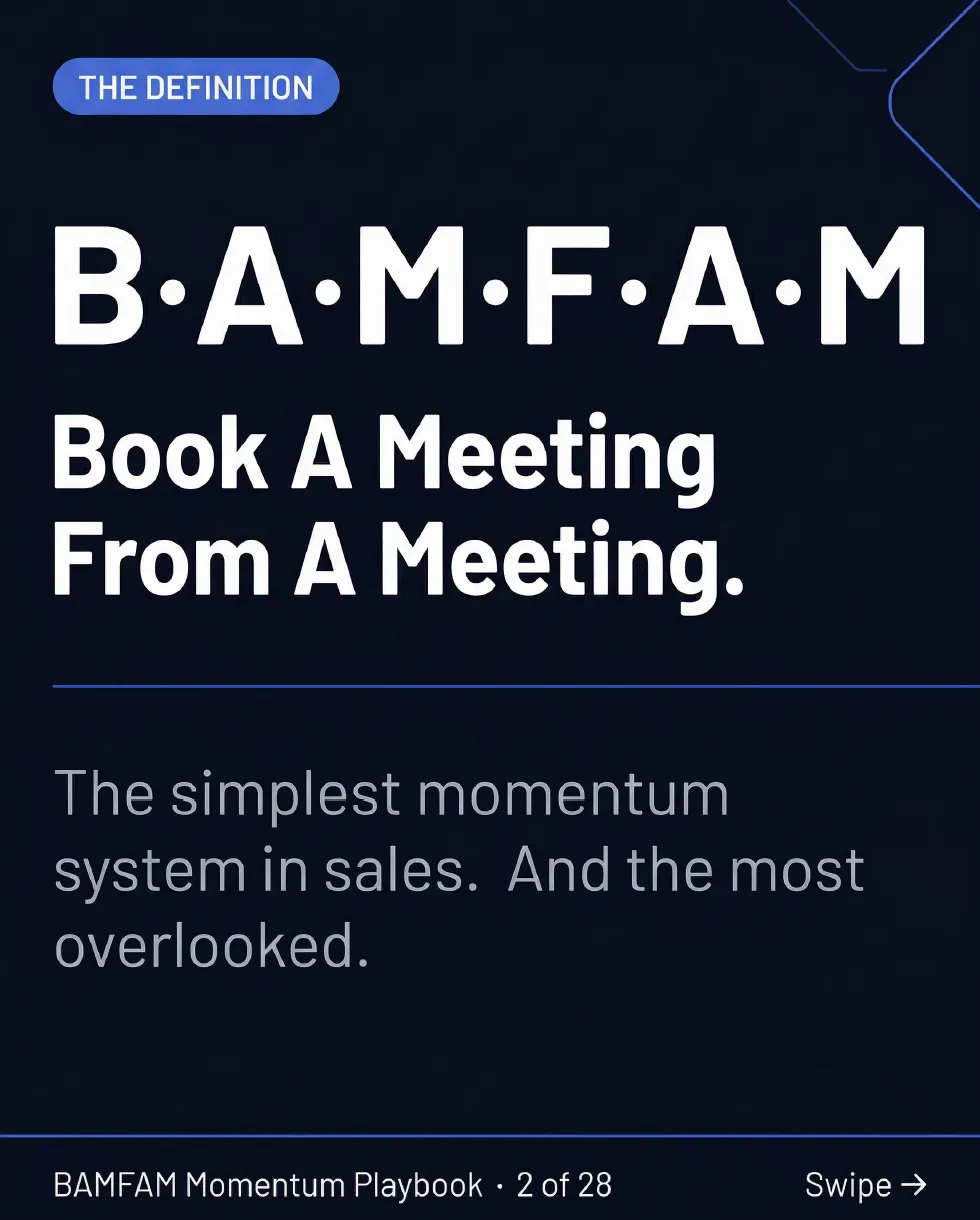
Connect • Clarify • Confirm • Calendar: The 4-Beat Playbook That Ends the Follow-Up Chase.
Discover how the BAMFAM Momentum Playbook reveals the exact strategies to:
Book the Next Meeting While You're Still in the Meeting
Turn "Let Me Get Back to You" Into a Yes (It's Friction, Not Rejection)
Kill the "Just Bumping This Up" Email Forever
Make Momentum Measurable With the Team Scorecard
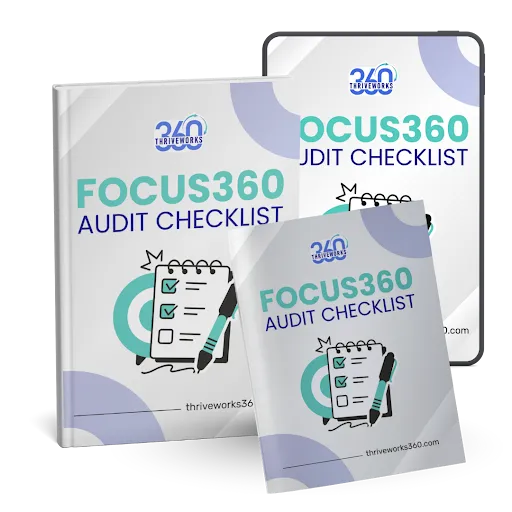
Stop • Scan • Decide: The 3-Step Playbook to Win the First 51 Seconds.
Discover how the FOCUS360 Playbook reveals the exact strategies to:
FREE GPT Agent to test and build your content
Stop the Scroll on Command
Hold Attention for the First 51 Seconds:
Multiply Conversions With a Single Clear Path:
Unlock Your Business’s Full Potential – Without the Pain
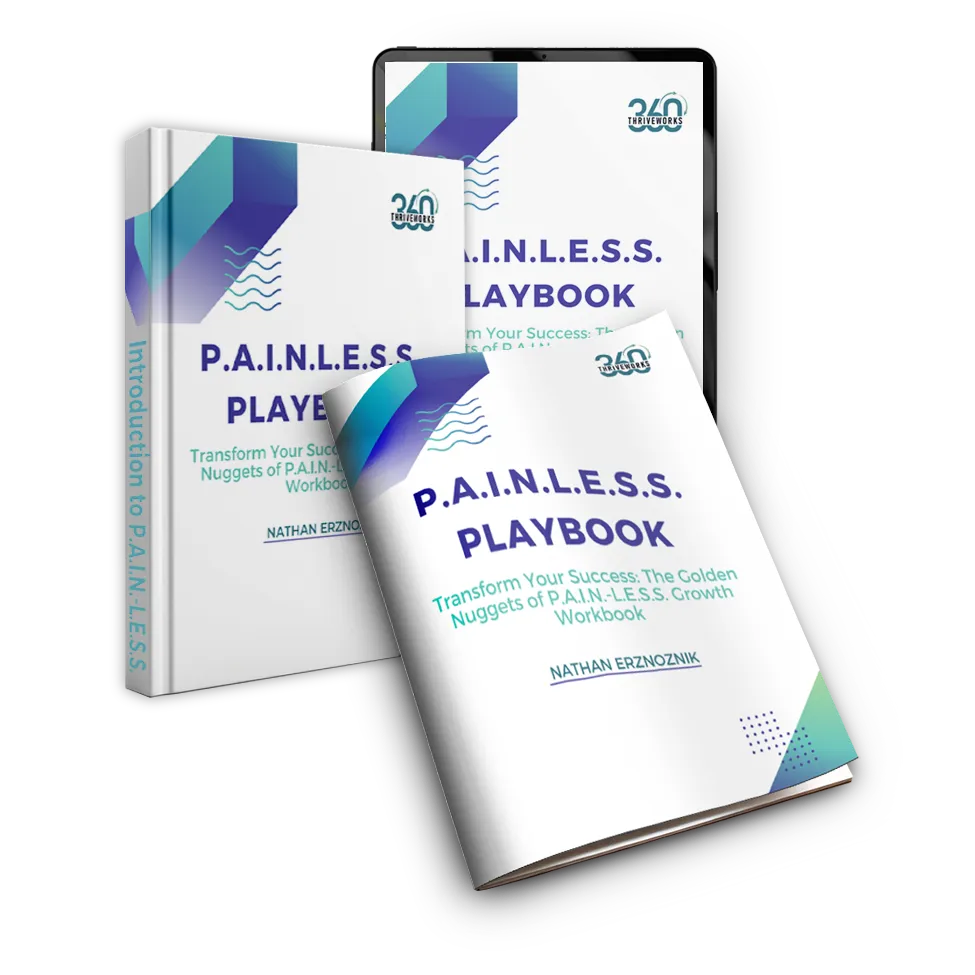
Step into the realm of effortless growth with our P.A.I.N.-L.E.S.S. Playbook.
Designed for entrepreneurs who seek the "Golden Nuggets" that transform them and their businesses without the overwhelming stress. This tool shows a simple and streamlined path toward business success.
Take Control of Your Journey with Our Ultimate FREE Autopilot 360 System Masterclass and Cheat Sheet.
Build A Self-Managed Business And Break Through 6-7 Figures To 8 Figures While Seamlessly Producing Huge Profits!


Uncover Hidden Revenue in 3 Simple Steps
See more details about how this impacts business performance.
PAID COURSE
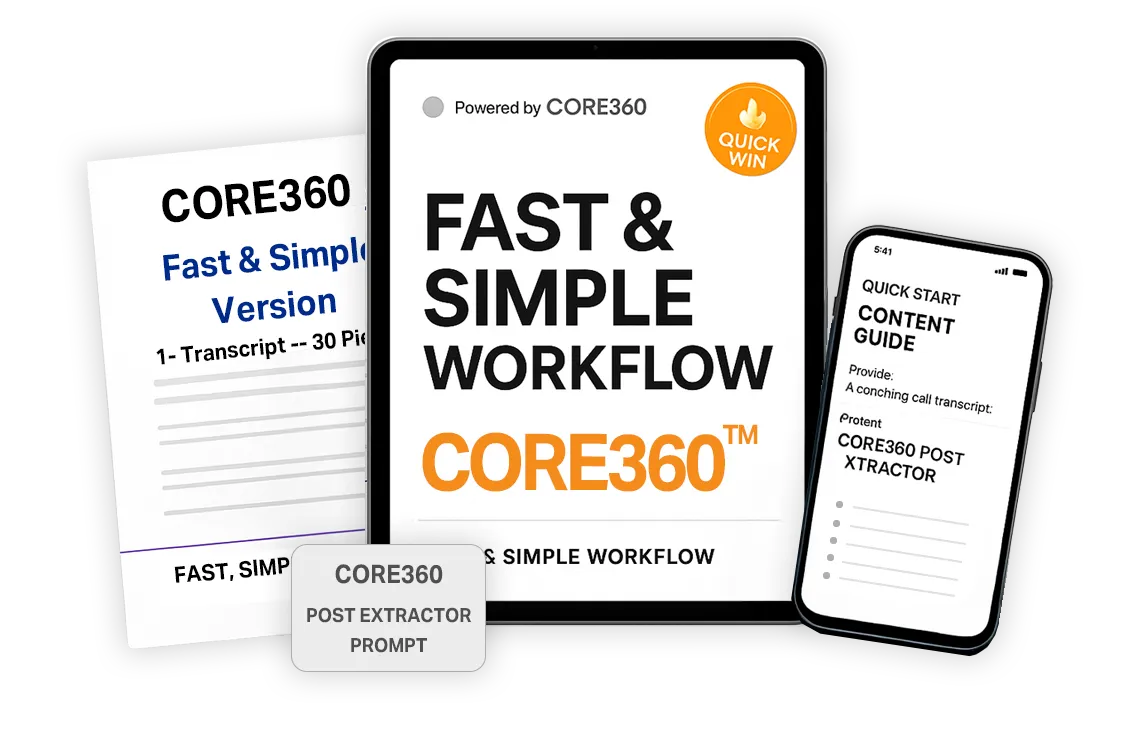
CORE360: Multiply Your Message — Without Writing a Single Word
See how to easliy increase your visibility with the CORE360 System and AI-driven Prompt Booster Pack™
Built for founders and entrepreneurs who already say brilliant things — this AI-optimized vault gives you the exact prompts to turn one voice note into days of content across Instagram, LinkedIn, TikTok, YouTube Shorts, and Facebook.
No burnout. No blank pages. Just scroll-stopping content formulas that match your voice and work on every platform.
A simple upgrade with exponential reach.
BLOG
Beginner's Guide to Lead Magnets That Convert
Why most lead magnets become forgotten PDFs and how to build ones that actually start customer relationships.
Most businesses don't struggle to get traffic.
They struggle to get people to take the next step.
A visitor lands on your site, browses a few pages, maybe reads a post and then disappears forever.
No email. No conversation. No chance to build a relationship.
That's the gap a lead magnet is supposed to close.
The right one turns anonymous visitors into subscribers, prospects, and eventually customers.
The wrong one becomes another PDF collecting digital dust.
If you're new to lead generation and want lead magnet ideas that actually work, here's what they are, why they matter, and how to build offers that drive both email list building and real conversion.
What a Lead Magnet Actually Is
A lead magnet is something valuable you offer in exchange for a visitor's contact information.
Usually an email address.
The value can take a lot of forms checklists, templates, guides, calculators, assessments, webinars, resource libraries, free trials.
But the format isn't the point.
Solving a specific problem quickly is the point.
People don't opt in because they want another PDF. They opt in because they want a solution.
A business owner wrestling with marketing will happily grab a one-page campaign checklist. A finance lead might want a budgeting template. A contractor might want a job-costing calculator.
Different audiences. Different needs. Different lead magnets.
Same principle underneath.
Why Lead Magnets Matter
Social algorithms change. Ad costs climb. Search rankings move around.
Your email list is one of the few marketing assets you actually own.
When someone joins it, you've earned permission to keep the conversation going. That's your room to educate, build trust, and guide someone toward a decision.
Without a lead magnet, most visitors leave and never come back.
With the right one, you've given them a reason to stay connected.
That's the whole game: create value before you ask for a sale.
7 Lead Magnet Ideas That Consistently Perform
1. Checklists. Simple, practical, fast to use. A Website Launch Checklist, a Marketing Campaign Checklist, an Onboarding Checklist. People love them because they kill uncertainty instead of wondering what's next, they have a clear path.
2. Templates. Templates save time, and time is the most valuable currency a business owner has. Budget templates, sales email templates, content calendars, project plans. A good one lets people act immediately which is why templates often beat long guides.
3. Assessments. These show prospects where they stand. A Marketing Readiness Assessment, an Operational Efficiency Scorecard, a Lead Generation Audit. They're powerful because the feedback is personalized not generic advice, but something relevant to their situation.
4. Industry guides. Best when buyers need to understand something before they can decide. A Beginner's Guide to ERP Selection, a Small Business Marketing Guide. The strongest ones simplify a complex topic and help readers dodge an expensive mistake.
5. Webinars and workshops. Sometimes people want interaction. Live or recorded, a session lets you teach while you build trust. Keep the focus on solving a real problem, not pitching. Value first. Sales later.
6. Resource libraries. Instead of one asset, bundle several templates, worksheets, checklists, training videos. The bundle raises the perceived value and pulls more signups.
7. Calculators and tools. Interactive tools often convert highest of all. ROI calculators, cost-savings estimators, pricing tools. People love a fast answer, and a useful tool can keep generating leads for years.
How to Choose the Right One
Most businesses ask the wrong question first.
They ask, "What lead magnet should we create?"
The better question is, "What problem are our prospects trying to solve right now?"
Start there. Then run any idea through four filters.
Does it solve one specific problem? Broad offers underperform. Specific ones win. Instead of "Marketing Guide," try "10-Step Lead Generation Checklist for Service Businesses." Specificity raises the perceived value.
Can someone use it immediately? The faster they see value, the higher your conversion. A checklist delivers a win faster than a 50-page ebook ever will.
Is it relevant to what you sell? This is where a lot of businesses go wrong. A lead magnet shouldn't just generate leads it should generate the right leads. If you help companies improve operations, your offer should attract people who care about operations. Not everyone.
The goal isn't a bigger list.
It's a better list.
Does it create a logical next step? Every lead magnet should connect naturally to what you offer. A growth-consulting business might give away a Growth Bottleneck Assessment and once someone sees their results, they naturally want help fixing those bottlenecks.
That's a smooth handoff. Not a forced pitch.
The Mistakes That Sink Most Lead Magnets
Even good businesses build ones that flop. Usually for one of these reasons.
Being too generic. Generic content is everywhere. If your offer could apply to any business in any industry, it's too broad. Pick a specific audience and a specific challenge.
Asking for too much. Long forms create friction. If you're handing over a simple checklist, you don't need ten fields. Start small. Earn the trust first.
Forgetting the follow-up. The download is the beginning, not the finish line. With no follow-up sequence, most leads never hear from you again. The real opportunity is everything that happens after the opt-in.
Building it with no strategy. Plenty of companies spend weeks creating a lead magnet and never ask how it fits the customer journey. A lead magnet should support a larger system not sit on its own.
The Part Everyone Skips: Connecting It to Growth
Here's the truth most beginner advice leaves out.
A lead magnet by itself doesn't create growth.
A system does.
The businesses that win don't obsess over downloads. They obsess over what happens next.
That's where a framework like Bridge360 earns its place. Instead of treating lead generation as a standalone activity, it connects messaging, lead capture, nurturing, and conversion into one coordinated process:
Stabilize: find the audience's biggest challenge and build a lead magnet that addresses it.
Catalyze: sharpen the landing pages, messaging, email sequences, and conversion paths.
Maximize: turn the winners into scalable assets that generate qualified opportunities on repeat.
The result isn't simply more leads.
It's better-qualified leads entering a journey that's actually built to convert.
How to Measure Whether It's Working
Look past the download count.
Track the things that tell you the truth landing page conversion rate, subscriber growth, open rates, click-throughs, lead-to-opportunity rate, lead-to-customer rate.
A lead magnet pulling 100 highly qualified leads usually beats one pulling 1,000 unqualified subscribers.
Quality matters more than volume. Every time.
Final Thoughts
The best lead magnet ideas aren't the most creative.
They're the most useful.
A simple checklist that solves a pressing problem will outperform an elaborate ebook nobody opens.
So if you're focused on email list building, start with your audience's challenges. Build something that gets them a quick win. Then connect that resource to a larger journey built around conversion and long-term trust.
Because lead magnets were never really about collecting email addresses.
They're about starting conversations.
And the businesses that start the most valuable conversations are usually the ones that grow the fastest.
Ready to build better growth assets? If your lead generation isn't producing the quality or consistency you need, the issue is usually how the pieces fit together not the offer alone. A Bridge360 assessment can pinpoint the gaps, strengthen your conversion paths, and turn lead generation into a repeatable growth engine.
— ThriveWorks360


Free Weekly Productivity Insights
Sign up for Sunday Snippets - my weekly newsletter where I I share actionable productivity tips, practical life advice, and high-quality insights from across the web, directly to your inbox.
What People Are Saying

Driving Growth, Amplifying Impact

Grace Company

8th to 2nd most recognized brands in the industry in one year

J&B Sewing
Launched new product line and grew 300% in two years

Sewrite
Increased national distribution, D2C Revenue by 400%.
Get In Touch
Email: [email protected]
Address
Office: 14881 S. Auburn Sky Dr
Assistance Hours
Mon – Sat 9:00am – 8:00pm
Sunday – CLOSED
Phone Number:
(888) 870-7314
Contact Us:
BECOME AN TW360 INSIDER
Sign up for exlcusive content, emails, & things Nathan doesn't share anywhere else.
Unleash Your Business Brilliance.
Reach out and connect for your opportunity to shine!
© 2026 ThriveWorks360 - All Rights Reserved, copyright 2024