FREE Tools
Select from below to learn more!
Free Tools
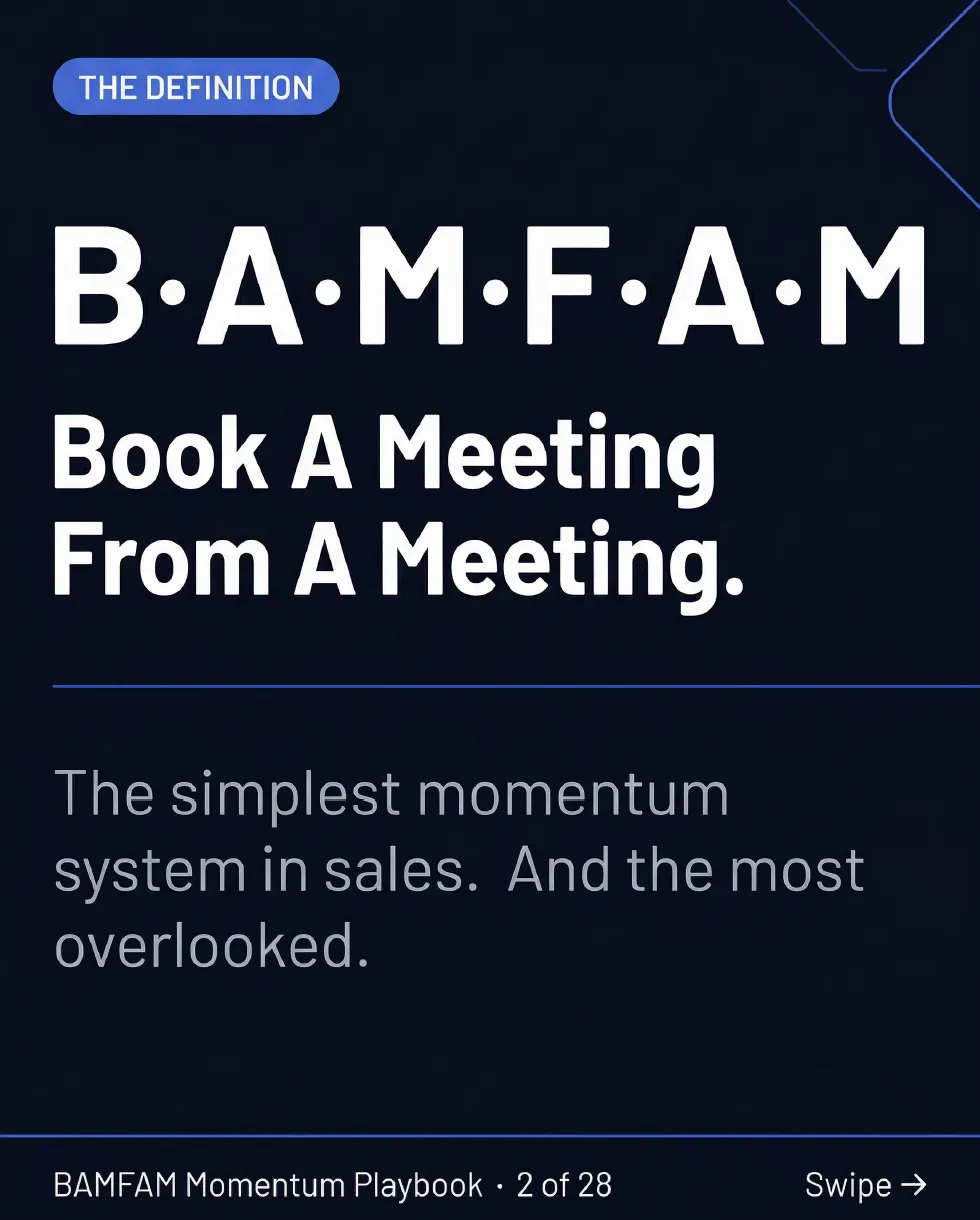
Connect • Clarify • Confirm • Calendar: The 4-Beat Playbook That Ends the Follow-Up Chase.
Discover how the BAMFAM Momentum Playbook reveals the exact strategies to:
Book the Next Meeting While You're Still in the Meeting
Turn "Let Me Get Back to You" Into a Yes (It's Friction, Not Rejection)
Kill the "Just Bumping This Up" Email Forever
Make Momentum Measurable With the Team Scorecard

Stop • Scan • Decide: The 3-Step Playbook to Win the First 51 Seconds.
Discover how the FOCUS360 Playbook reveals the exact strategies to:
FREE GPT Agent to test and build your content
Stop the Scroll on Command
Hold Attention for the First 51 Seconds:
Multiply Conversions With a Single Clear Path:
Unlock Your Business’s Full Potential – Without the Pain
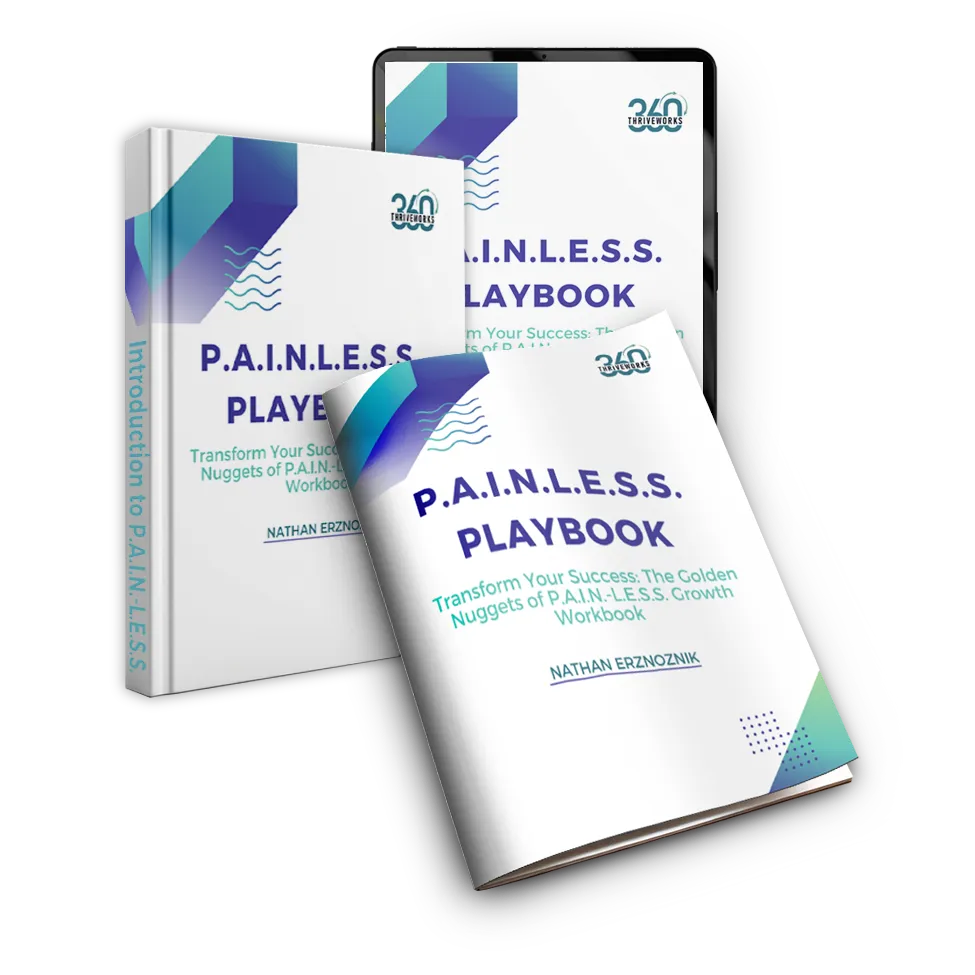
Step into the realm of effortless growth with our P.A.I.N.-L.E.S.S. Playbook.
Designed for entrepreneurs who seek the "Golden Nuggets" that transform them and their businesses without the overwhelming stress. This tool shows a simple and streamlined path toward business success.
Take Control of Your Journey with Our Ultimate FREE Autopilot 360 System Masterclass and Cheat Sheet.
Build A Self-Managed Business And Break Through 6-7 Figures To 8 Figures While Seamlessly Producing Huge Profits!


Uncover Hidden Revenue in 3 Simple Steps
See more details about how this impacts business performance.
PAID COURSE
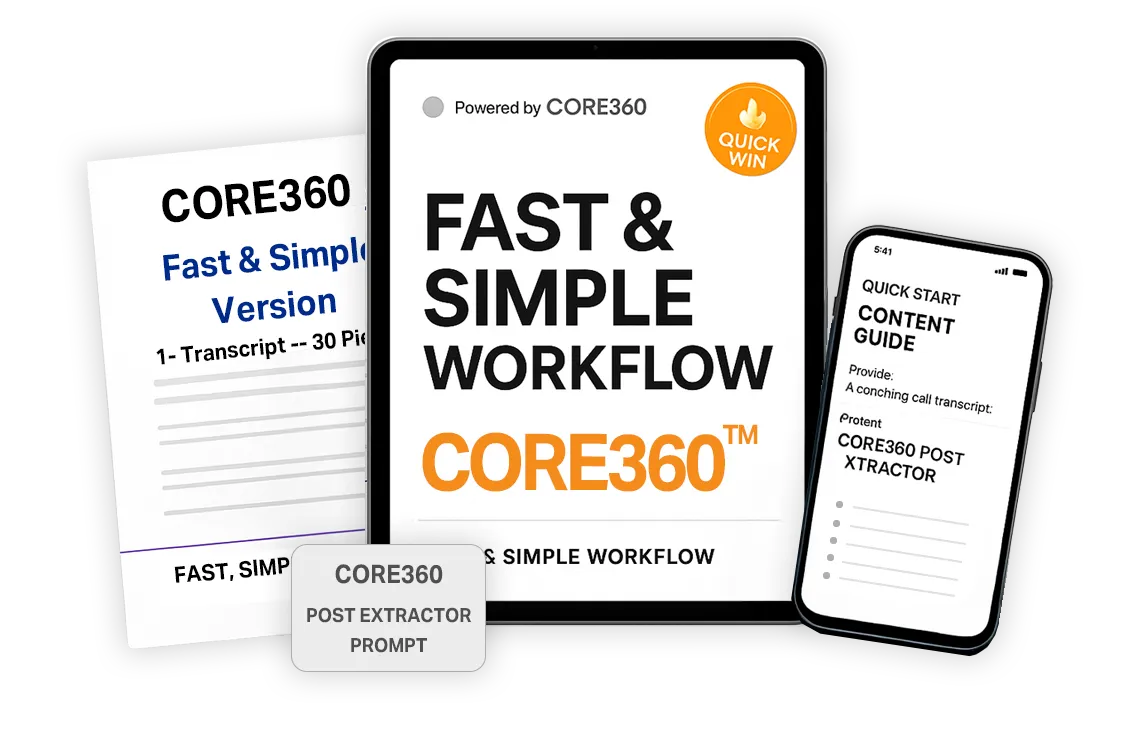
CORE360: Multiply Your Message — Without Writing a Single Word
See how to easliy increase your visibility with the CORE360 System and AI-driven Prompt Booster Pack™
Built for founders and entrepreneurs who already say brilliant things — this AI-optimized vault gives you the exact prompts to turn one voice note into days of content across Instagram, LinkedIn, TikTok, YouTube Shorts, and Facebook.
No burnout. No blank pages. Just scroll-stopping content formulas that match your voice and work on every platform.
A simple upgrade with exponential reach.
BLOG
The CEO Clarity Framework: A Step-by-Step Guide to Getting Unstuck in Your Business
When effort stops producing results, the problem usually isn't effort. It's clarity and clarity is a discipline, not a personality trait.
There's a point in almost every business where effort stops paying what it used to.
The founder puts in longer hours. The team gets busier. More projects kick off, more meetings fill the calendar. And somehow growth feels slower than it did a year ago.
Most entrepreneurs, at that point, don't have an effort problem. They have a clarity problem.
What makes it so hard to catch is that a lack of clarity almost never shows up wearing its own name. It disguises itself as a marketing issue, a hiring headache, an operational bottleneck, a cash-flow worry, a productivity slump. So founders spend months attacking symptoms while the real constraint sits there, untouched, quietly setting the ceiling on everything.
That's where a structured approach to clarity earns its keep. Because clarity isn't something a leader simply has or doesn't have. It's a process, a discipline for working out what matters, what doesn't, and where the next breakthrough actually lives.
Why Smart Entrepreneurs Get Stuck
Most people picture a stuck business as one in decline. The reality looks almost the opposite.
Most stuck businesses are growing. Revenue is creeping up, customers are arriving, the team's expanding. From the outside it all looks healthy.
Inside, the founder feels something completely different. Every problem feels urgent. Every opportunity feels important. Priorities reshuffle weekly. Decisions take longer than they should. And progress feels strangely disconnected from how hard everyone's working.
The business gets heavier to run not because anything's broken, but because complexity showed up before clarity did. Growth creates options, options create noise, and noise quietly eats focus. Somewhere in there the CEO's real job changes from doing more of the work to deciding which work actually matters. Most founders don't notice the switch until they're well behind it.
The Hidden Cost of Running Without Clarity
Founders tend to underestimate how expensive uncertainty gets when it's left to compound. It shows up in three main places.
Misalignment. Every department starts optimizing for its own thing. Marketing wants leads, operations wants efficiency, sales wants flexibility, leadership wants growth. Everyone's working hard and pulling in slightly different directions the whole time.
Wasted resources. Businesses pour money into software, ads, consultants, or new hires before they've actually named the bottleneck. Sometimes the real problem is demand. Sometimes it's the fulfillment capacity. Sometimes it's pricing. The wrong fix aimed at the wrong problem doesn't just fail, it adds expensive complexity you now have to manage.
Founder dependency. This is the big one. Every decision routes through the founder, every escalation lands on the same desk, every priority needs their sign-off. Growth ends up chained directly to one person's capacity and eventually the business stops scaling because the CEO has quietly become the bottleneck.
The CEO Clarity Framework
A workable clarity process moves through five steps, and the order matters. Skip one and you usually manufacture more confusion, not less.
Step 1: Find the Constraint
Most businesses have one dominant constraint. One. Not seven, not twelve one.
It might be lead generation, conversion, delivery capacity, hiring, cash flow, retention, or leadership bandwidth. The tricky part is that the symptoms almost always point somewhere else. A company watching sales slide assumes marketing is failing. Dig in, and the real culprit turns out to be proposal turnaround that takes two weeks. More leads were never going to fix a slow sales process.
The first job of leadership isn't action. It's diagnosis.
Step 2: Separate Signal From Noise
Founders are drowning in opportunity new platforms, new strategies, new software, new trends, all of it looking like the thing that finally unlocks growth.
Businesses rarely fail because they ignored an opportunity. They fail because they chased too many at once. And one question tends to cut through most of it: if we could only improve one thing over the next six months, what would move the needle most? The answer usually drags the signal up out of the noise.
Step 3: Align the Whole Business Around One Priority
Clarity only gets powerful once it spreads past the leadership team. The whole organization has to understand the primary objective, why it matters, how success gets measured, and this is the part people skip what becomes less important as a result.
This is exactly where most growth initiatives quietly die. Leadership changes direction; the team keeps running on last quarter's assumptions; the mismatch turns into friction nobody can quite locate. Alignment is what dissolves that friction before it starts.
Step 4: Build Systems Around Your Decisions
Plenty of founders run on intuition, and honestly it works remarkably well early on. It gets dangerous during growth.
As the company gets bigger, decision quality improves when repeatable systems replace reactive gut calls hiring scorecards, customer qualification criteria, investment thresholds, priority frameworks, a dashboard that actually tells the truth. Good systems protect you from emotional decisions. Great ones keep the quality consistent even when the leader isn't in the room.
Step 5: Review and Recalibrate
Clarity has a shelf life. Markets move, teams evolve, customers change their behavior, and the constraint that capped your growth six months ago may simply be gone.
The best CEOs revisit their assumptions on purpose. Monthly strategic reviews tend to beat annual planning here, because they let you adjust before a small problem compounds into a big one. The goal was never certainty. It's staying honest with reality.
The Mistakes That Keep Founders Stuck
A handful of patterns show up again and again.
Solving symptoms. Shrinking margins trigger cost-cutting. Late projects trigger more meetings. Missed targets trigger pressure on the team. The symptom gets all the attention while the actual cause strolls off untouched.
Treating every opportunity as equal. Not every good idea deserves execution. Focus builds momentum; scattering it kills momentum just as fast.
Confusing activity with progress. A packed calendar feels productive. Often it isn't and plenty of founders stay busy precisely to avoid the strategic decisions that require an uncomfortable trade-off.
Waiting for perfect information. Perfect clarity doesn't exist, and waiting for it is usually procrastination in a nicer outfit. A good decision made quickly tends to beat a perfect one made too late.
A Simple Decision Checklist
When you're weighing a new initiative, opportunity, or investment, run it through five questions. Does this solve our primary constraint? Does it support our current priority? Do we actually have the capacity to do it well? What are we saying no to by saying yes to this? And how will we measure whether it worked?
If the answers feel fuzzy, the decision probably is too.
What Clarity Looks Like in Practice
Picture a twenty-person professional services firm. Growth had been flat for nearly a year, and leadership was sure the problem was lead generation. So they raised the marketing budget and expanded the campaigns. The results barely twitched.
Eventually they mapped the actual customer journey and found something they didn't expect. Lead volume was never the issue. Delivery capacity was. Projects were running long, which quietly capped how many new clients they could bring on. More leads would've just backed up further behind the real bottleneck.
So instead of spending more on marketing, they fixed the process and the team's utilization. Within six months delivery sped up, satisfaction rose, capacity opened up, and revenue started climbing again. Same business, same team different diagnosis. That's the whole thing right there.
Why Clarity Becomes a Competitive Advantage
Most businesses compete on product. Some compete on price. The strongest ones compete on decision speed.
When priorities are genuinely clear, teams move faster, opportunities get evaluated quickly, resources flow toward impact, and execution improves almost on its own. Clarity compounds the small decisions get easier, the big ones get less risky, and the whole business gets lighter to operate. Maybe best of all, the founder finally gets the strategic room to think instead of reacting all day.
Frequently Asked Questions
What is a CEO clarity strategy?
It's a structured process for identifying your real business constraint, prioritizing opportunities, and aligning your resources around the few actions with the highest impact rather than spreading effort thin across everything at once.
How do I know if my business lacks clarity?
The usual tells: priorities that shift constantly, slow decisions, heavy founder dependency, a team that describes the goal differently, and growth that feels harder than it should.
Is clarity a mindset issue or an operational one?
Usually both. Your mindset shapes decision quality; your systems determine whether those decisions actually scale.
How often should CEOs revisit strategy?
Quarterly reviews are valuable, but a lighter monthly check-in usually gives you enough signal to adjust early, before problems compound.
The Next Move
Most businesses don't need more ideas. They need fewer priorities and better decisions.
The founders who break through a plateau aren't usually the smartest people in the room. They're the clearest.
So if you're feeling stuck, don't open with "what should we do next?" Start somewhere more useful: "what problem are we actually trying to solve?" The answer tends to change everything after it.
Not sure what your one constraint actually is? A free Customer GapMap360 session diagnoses where your business is really stuck, names the single biggest gap capping your growth, and shows you what to fix first so you stop pouring effort into symptoms and start moving the thing that actually matters.
ThriveWorks360


Free Weekly Productivity Insights
Sign up for Sunday Snippets - my weekly newsletter where I I share actionable productivity tips, practical life advice, and high-quality insights from across the web, directly to your inbox.
What People Are Saying

Driving Growth, Amplifying Impact

Grace Company

8th to 2nd most recognized brands in the industry in one year

J&B Sewing
Launched new product line and grew 300% in two years

Sewrite
Increased national distribution, D2C Revenue by 400%.
Get In Touch
Email: [email protected]
Address
Office: 14881 S. Auburn Sky Dr
Assistance Hours
Mon – Sat 9:00am – 8:00pm
Sunday – CLOSED
Phone Number:
(888) 870-7314
Contact Us:
BECOME AN TW360 INSIDER
Sign up for exlcusive content, emails, & things Nathan doesn't share anywhere else.
Unleash Your Business Brilliance.
Reach out and connect for your opportunity to shine!
© 2026 ThriveWorks360 - All Rights Reserved, copyright 2024